
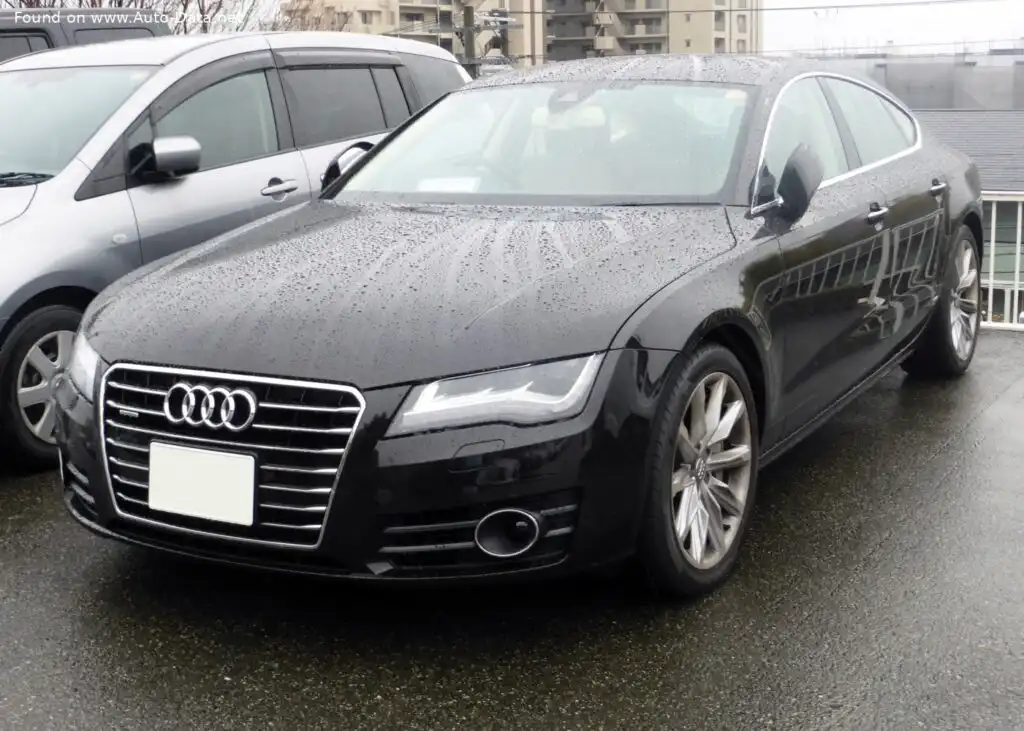
Technical Specifications
| Brand | Audi |
| Model | A7 |
| Generation | A7 Sportback (C7) |
| Type (Engine) | 3.0 BiTDI V6 (313 Hp) quattro Tiptronic |
| Start of production | November, 2011 |
| End of production | 2014 |
| Powertrain Architecture | Internal Combustion engine |
| Body type | Liftback |
| Seats | 5 |
| Doors | 5 |
| Fuel consumption (urban) | 8 l/100 km (29.4 US mpg, 35.3 UK mpg, 12.5 km/l) |
| Fuel consumption (extra urban) | 5.6 l/100 km (42 US mpg, 50.4 UK mpg, 17.9 km/l) |
| Fuel consumption (combined) | 6.4 l/100 km (36.8 US mpg, 44.1 UK mpg, 15.6 km/l) |
| CO2 emissions | 169 g/km |
| Fuel Type | Diesel |
| Acceleration 0 – 100 km/h | 5.3 sec |
| Acceleration 0 – 62 mph | 5.3 sec |
| Acceleration 0 – 60 mph | 5 sec (Calculated) |
| Maximum speed | 250 km/h (155.34 mph) |
| Emission standard | Euro 5 |
| Weight-to-power ratio | 5.9 kg/Hp, 169.2 Hp/tonne |
| Weight-to-torque ratio | 2.8 kg/Nm, 351.4 Nm/tonne |
| Power | 313 Hp @ 3900-4500 rpm |
| Power per litre | 105.5 Hp/l |
| Torque | 650 Nm @ 1450-2800 rpm (479.42 lb.-ft. @ 1450-2800 rpm) |
| Engine layout | Front, Longitudinal |
| Engine Model/Code | CGQB, CVUC |
| Engine displacement | 2967 cm3 (181.06 cu. in.) |
| Number of cylinders | 6 |
| Engine configuration | V-engine |
| Cylinder Bore | 83 mm (3.27 in.) |
| Piston Stroke | 91.4 mm (3.6 in.) |
| Compression ratio | 16:1 |
| Number of valves per cylinder | 4 |
| Fuel injection system | Diesel Commonrail |
| Engine aspiration | BiTurbo, Intercooler |
| Valvetrain | DOHC |
| Engine oil capacity | 6.4 l (6.76 US qt | 5.63 UK qt) |
| Coolant | 11.5 l (12.15 US qt | 10.12 UK qt) |
| Kerb Weight | 1850 kg (4078.55 lbs.) |
| Max. weight | 2460 kg (5423.37 lbs.) |
| Max load | 610 kg (1344.82 lbs.) |
| Trunk (boot) space – minimum | 535 l (18.89 cu. ft.) |
| Trunk (boot) space – maximum | 1390 l (49.09 cu. ft.) |
| Fuel tank capacity | 65 l (17.17 US gal | 14.3 UK gal) |
| Max. roof load | 100 kg (220.46 lbs.) |
| Permitted trailer load with brakes (8%) | 2100 kg (4629.71 lbs.) |
| Permitted trailer load with brakes (12%) | 2100 kg (4629.71 lbs.) |
| Permitted trailer load without brakes | 750 kg (1653.47 lbs.) |
| Permitted towbar download | 85 kg (187.39 lbs.) |
| Length | 4969 mm (195.63 in.) |
| Width | 1911 mm (75.24 in.) |
| Height | 1420 mm (55.91 in.) |
| Wheelbase | 2914 mm (114.72 in.) |
| Front track | 1644 mm (64.72 in.) |
| Rear (Back) track | 1635 mm (64.37 in.) |
| Minimum turning circle | 11.9 m (39.04 ft.) |
| Drive wheel | All wheel drive (4×4) |
| Number of gears and type of gearbox | 8 gears, automatic transmission Tiptronic |
| Front suspension | Independent multi-link suspension |
| Rear suspension | Independent on trapezoidal lever |
| Front brakes | Ventilated discs |
| Rear brakes | Disc |
| Tires size | 235/55 R17 |
| Wheel rims size | 8.0J x 17 |
The Audi A7 Sportback (C7) 3.0 BiTDI V6 quattro Tiptronic, launched in November 2011, was a significant variant within the second-generation A7 lineup. The C7 generation marked a notable evolution in Audi’s design philosophy, successfully merging the sleek profile of a coupe with the practicality of a hatchback – a body style Audi termed “Sportback.” This particular model, powered by the 3.0-liter BiTDI engine and paired with Audi’s Tiptronic eight-speed automatic transmission, aimed to deliver a compelling combination of performance, fuel efficiency, and all-weather capability thanks to Audi’s quattro all-wheel-drive system. It occupied a strategic position in the A7 range, offering a step up in performance from the 2.0 TDI models while remaining more accessible than the flagship 4.0 TDI or petrol-powered options.
Powertrain & Engine Architecture
The core of this A7 variant is the 3.0-liter V6 diesel engine, identified by the engine codes CGQB or CVUC depending on the production year and specific market. This engine is a bi-turbocharged diesel, utilizing two turbochargers – a smaller unit for rapid response at lower engine speeds and a larger turbocharger to maintain power output at higher RPMs. The engine employs a common rail direct injection system, injecting fuel at extremely high pressures to optimize combustion efficiency. A Double Overhead Camshaft (DOHC) valvetrain with four valves per cylinder further enhances gas exchange and engine performance. The eight-speed Tiptronic automatic transmission is a conventional torque-converter type, chosen for its ability to handle the engine’s substantial torque and provide a smooth, comfortable driving experience. The transmission also allows for manual gear selection, giving the driver more control when desired.
Driving Characteristics
The 3.0 BiTDI engine coupled with the Tiptronic transmission delivers a refined and capable driving experience. The engine’s impressive 650 Nm (479 lb-ft) of torque, readily available from just 1450 rpm, provides strong and responsive acceleration in everyday driving scenarios. While not as aggressively sporty as the higher-output petrol versions, the 5.3-second 0-62 mph acceleration time is more than sufficient for most drivers. The Tiptronic transmission generally provides smooth and seamless gear changes, although it can occasionally exhibit a slight hesitation during quick downshifts compared to a dual-clutch transmission. The quattro all-wheel-drive system ensures excellent traction in various weather conditions, enhancing stability and driver confidence. The transmission’s gear ratios are carefully tuned to balance acceleration performance with fuel economy, offering relaxed cruising at highway speeds.
Equipment & Trim Levels
The A7 3.0 BiTDI quattro Tiptronic typically came generously equipped as standard. Interior appointments included leather upholstery, a three-zone automatic climate control system, a multi-function steering wheel, and Audi’s MMI infotainment system featuring a central display screen. Standard safety features encompassed ABS, ESP (Electronic Stability Program), and a comprehensive suite of airbags. A range of optional extras were available, including adaptive cruise control, a premium Bang & Olufsen sound system, advanced parking assistance features, and various interior trim upgrades. The specific trim level – such as SE, Sport, or S-Line – influenced the standard equipment and the availability of optional packages.
Chassis & Braking
The A7 Sportback features a sophisticated independent suspension system on both the front and rear axles. The front suspension utilizes a multi-link design, while the rear employs a trapezoidal link setup. This configuration strikes a balance between ride comfort and handling precision. Braking is provided by ventilated discs at the front and solid discs at the rear, offering ample stopping power. The braking system is enhanced by ABS and ESP, ensuring effective stopping performance and stability in various driving conditions. The A7’s chassis is designed with weight reduction in mind, contributing to its agility and overall efficiency.
Market Reception & Comparison
The Audi A7 3.0 BiTDI quattro Tiptronic received generally positive reviews from automotive critics. It was lauded for its refined engine, comfortable ride quality, and sophisticated interior appointments. The combination of strong performance and impressive fuel economy was a significant selling point, particularly in European markets where diesel engines were highly favored. Compared to the entry-level 2.0 TDI models, the 3.0 BiTDI offered a substantial increase in power and torque, resulting in a more relaxed and effortless driving experience. In comparison to the higher-output petrol variants, the 3.0 BiTDI provided comparable performance with superior fuel efficiency. While generally reliable, some owners have reported potential issues with the turbochargers and the diesel particulate filter (DPF) over the long term.
Legacy
The Audi A7 Sportback (C7) 3.0 BiTDI quattro Tiptronic continues to be a sought-after used car today. The 3.0 TDI engine, when properly maintained – particularly regarding DPF regeneration – is known for its durability and longevity. The Tiptronic transmission, if regularly serviced, is also generally reliable. The A7’s elegant design and luxurious interior continue to appeal to buyers seeking a stylish and comfortable grand tourer. However, prospective buyers should be aware of the potential maintenance costs associated with a diesel vehicle, including DPF maintenance and AdBlue refills. The C7 A7 represents a high point in Audi’s design and engineering prowess, and the 3.0 BiTDI variant offers a compelling blend of performance, efficiency, and luxury.
