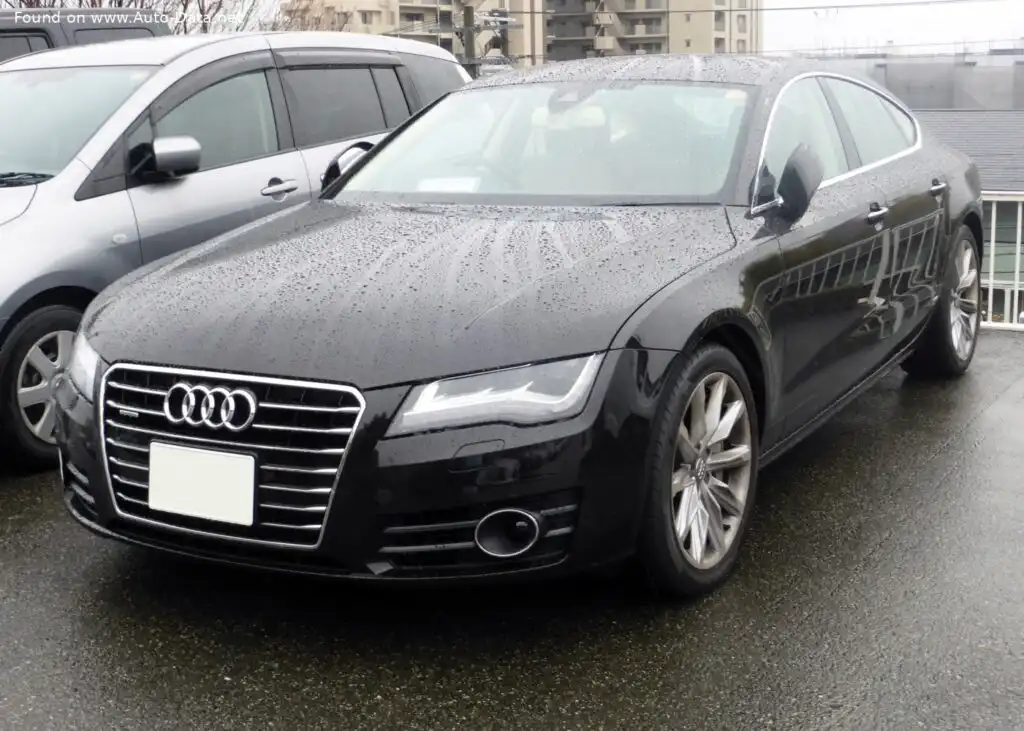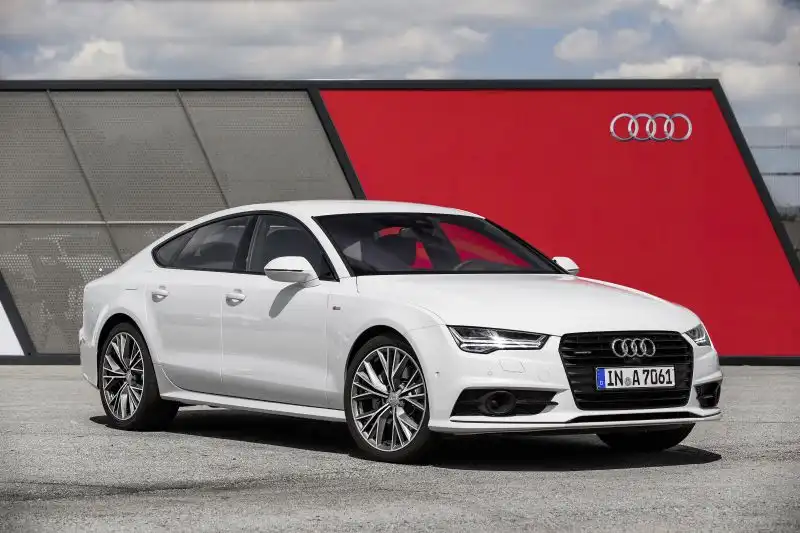
The Audi A7 Sportback (C7 facelift), specifically the 3.0 TDI V6 clean diesel variant with the S tronic transmission, represents a refined iteration of Audi’s luxury liftback. Produced from 2014 to 2017, this model year saw updates to the C7 generation, focusing on efficiency, technology, and styling. Positioned as a mid-to-upper trim level within the A7 range, it offered a balance between performance and fuel economy, appealing to buyers seeking a sophisticated grand tourer. This variant occupied a space between the more economical 2.0 TDI models and the performance-oriented 3.0 TFSI petrol versions.
Technical Specifications
| Brand | Audi |
| Model | A7 |
| Generation | A7 Sportback (C7, facelift 2014) |
| Type (Engine) | 3.0 TDI V6 clean diesel (218 Hp) S tronic |
| Start of production | 2014 |
| End of production | 2017 |
| Powertrain Architecture | Internal Combustion engine |
| Body type | Liftback |
| Seats | 5 |
| Doors | 5 |
| Fuel consumption (urban) | 6 l/100 km (39.2 US mpg, 47.1 UK mpg, 16.7 km/l) |
| Fuel consumption (extra urban) | 4.7 l/100 km (50 US mpg, 60.1 UK mpg, 21.3 km/l) |
| Fuel consumption (combined) | 5.2 l/100 km (45.2 US mpg, 54.3 UK mpg, 19.2 km/l) |
| CO2 emissions | 136 g/km |
| Fuel Type | Diesel |
| Acceleration 0 – 100 km/h | 6.8 sec |
| Acceleration 0 – 62 mph | 6.8 sec |
| Acceleration 0 – 60 mph | 6.5 sec |
| Maximum speed | 239 km/h (148.51 mph) |
| Emission standard | Euro 6 |
| Weight-to-power ratio | 8.4 kg/Hp, 119.5 Hp/tonne |
| Weight-to-torque ratio | 3.7 kg/Nm, 274 Nm/tonne |
| Power | 218 Hp @ 3250-4500 rpm |
| Power per litre | 73.5 Hp/l |
| Torque | 500 Nm @ 1250-3000 rpm (368.78 lb.-ft. @ 1250-3000 rpm) |
| Engine layout | Front, Longitudinal |
| Engine Model/Code | CZVA, CZVB |
| Engine displacement | 2967 cm3 (181.06 cu. in.) |
| Number of cylinders | 6 |
| Engine configuration | V-engine |
| Cylinder Bore | 83 mm (3.27 in.) |
| Piston Stroke | 91.4 mm (3.6 in.) |
| Compression ratio | 16:1 |
| Number of valves per cylinder | 4 |
| Fuel injection system | Diesel Commonrail |
| Engine aspiration | Turbocharger, Intercooler |
| Valvetrain | DOHC |
| Engine oil capacity | 6.1 l (6.45 US qt | 5.37 UK qt) |
| Coolant | 11.5 l (12.15 US qt | 10.12 UK qt) |
| Kerb Weight | 1825 kg (4023.44 lbs.) |
| Max. weight | 2435 kg (5368.26 lbs.) |
| Max load | 610 kg (1344.82 lbs.) |
| Trunk (boot) space – minimum | 535 l (18.89 cu. ft.) |
| Trunk (boot) space – maximum | 1390 l (49.09 cu. ft.) |
| Fuel tank capacity | 73 l (19.28 US gal | 16.06 UK gal) |
| Max. roof load | 100 kg (220.46 lbs.) |
| Permitted trailer load with brakes (8%) | 2100 kg (4629.71 lbs.) |
| Permitted trailer load with brakes (12%) | 2000 kg (4409.25 lbs.) |
| Permitted trailer load without brakes | 750 kg (1653.47 lbs.) |
| Permitted towbar download | 85 kg (187.39 lbs.) |
| Length | 4974 mm (195.83 in.) |
| Width | 1911 mm (75.24 in.) |
| Width including mirrors | 2139 mm (84.21 in.) |
| Height | 1420 mm (55.91 in.) |
| Wheelbase | 2914 mm (114.72 in.) |
| Front track | 1644 mm (64.72 in.) |
| Rear (Back) track | 1635 mm (64.37 in.) |
| Front overhang | 937 mm (36.89 in.) |
| Rear overhang | 1123 mm (44.21 in.) |
| Drag coefficient (Cd) | 0.29 |
| Minimum turning circle (turning diameter) | 11.9 m (39.04 ft.) |
| Drivetrain Architecture | The Internal combustion engine (ICE) drives the front wheels of the vehicle. |
| Drive wheel | Front wheel drive |
| Number of gears and type of gearbox | 7 gears, automatic transmission S-tronic |
| Front suspension | Independent multi-link suspension |
| Rear suspension | Independent on trapezoidal lever |
| Front brakes | Ventilated discs |
| Rear brakes | Ventilated discs |
| Assisting systems | ABS (Anti-lock braking system) |
| Steering type | Steering rack and pinion |
| Power steering | Electric Steering |
| Tires size | 255/45 R18 |
| Wheel rims size | 8.5J x 18 |
INTRODUCTION
The Audi A7 Sportback (C7 facelift) 3.0 TDI, launched in 2014 and continuing through 2017, is a five-door coupe that blends elegant design with practical functionality. Built on the Volkswagen Group’s A6/A7 platform (1HX0/A3), the facelift brought revised styling, updated technology, and more efficient engine options. The 3.0 TDI variant, equipped with the seven-speed S tronic dual-clutch transmission, was a popular choice in European markets, offering a compelling combination of performance, refinement, and fuel economy. It catered to drivers who desired a luxurious and capable vehicle for long-distance travel and everyday use.
Powertrain & Engine Architecture
At the heart of this A7 variant lies the 3.0-liter V6 diesel engine, specifically the CZVA or CZVB engine code depending on the specific market and production date. This engine is a common-rail direct injection diesel, utilizing piezo injectors for precise fuel delivery. The engine benefits from a variable geometry turbocharger (VGT) and intercooler, enhancing both power and efficiency. The V6 configuration provides inherent smoothness, while the 24-valve DOHC valvetrain ensures optimal gas exchange. The S tronic seven-speed dual-clutch transmission is a key component, offering rapid and seamless gear changes. This transmission features two separate clutches, one for odd and one for even gears, allowing for pre-selection of the next gear and minimizing interruption in power delivery. The transmission is electronically controlled and offers both automatic and manual shift modes.
Driving Characteristics
The 218 horsepower and 368 lb-ft of torque delivered by the 3.0 TDI engine provide brisk acceleration. The 0-60 mph sprint takes approximately 6.5 seconds, and the car feels confident at highway speeds. The S tronic transmission contributes to a responsive driving experience, with quick shifts and minimal torque interruption. Compared to the more powerful 3.0 TFSI petrol version, the TDI offers a more relaxed and fuel-efficient driving experience, with a broader, more accessible torque curve. While not as overtly sporty as the petrol variant, the TDI provides ample power for overtaking and comfortable cruising. The gear ratios are tuned for a balance between acceleration and fuel economy, with taller gears for efficient highway driving.
Equipment & Trim Levels
The A7 3.0 TDI typically came well-equipped, even in base trim. Standard features included leather upholstery, tri-zone automatic climate control, a multi-function steering wheel, and Audi’s MMI infotainment system with a central display screen. Optional extras were plentiful, including advanced driver-assistance systems like adaptive cruise control, lane departure warning, and a head-up display. Premium packages added features such as upgraded leather, wood trim, and a Bang & Olufsen sound system. The interior design emphasized luxury and sophistication, with high-quality materials and a driver-focused layout.
Chassis & Braking
The A7 Sportback features a sophisticated chassis design, with independent multi-link suspension at all four corners. This setup provides a comfortable ride while maintaining good handling characteristics. The front suspension utilizes aluminum components to reduce weight, and the rear suspension is optimized for stability. Braking duties are handled by ventilated discs on all four wheels, providing ample stopping power. Anti-lock braking system (ABS) and electronic stability control (ESC) are standard features, enhancing safety and control. The steering is a speed-sensitive electric power steering system, offering precise and responsive handling.
Market Reception & Comparison
The Audi A7 3.0 TDI was generally well-received by automotive critics. It was praised for its elegant design, refined interior, and efficient powertrain. The combination of performance and fuel economy was a key selling point, making it an attractive alternative to petrol-powered rivals. Compared to the 2.0 TDI models, the 3.0 TDI offered significantly more power and refinement. However, it came at a higher price point. Against competitors like the BMW 6 Series Gran Coupe and Mercedes-Benz CLS, the A7 offered a unique blend of style, practicality, and technology.
Legacy
The 3.0 TDI engine, in various iterations, has proven to be a reliable and durable powertrain. While diesel engines have faced increased scrutiny in recent years, the Audi 3.0 TDI remains a popular choice in the used car market. Regular maintenance, including timely oil changes and filter replacements, is crucial for long-term reliability. The S tronic transmission is generally robust, but requires periodic servicing to ensure smooth operation. The A7 Sportback (C7) continues to be appreciated for its timeless design and luxurious features, making it a desirable option for buyers seeking a sophisticated and capable grand tourer.