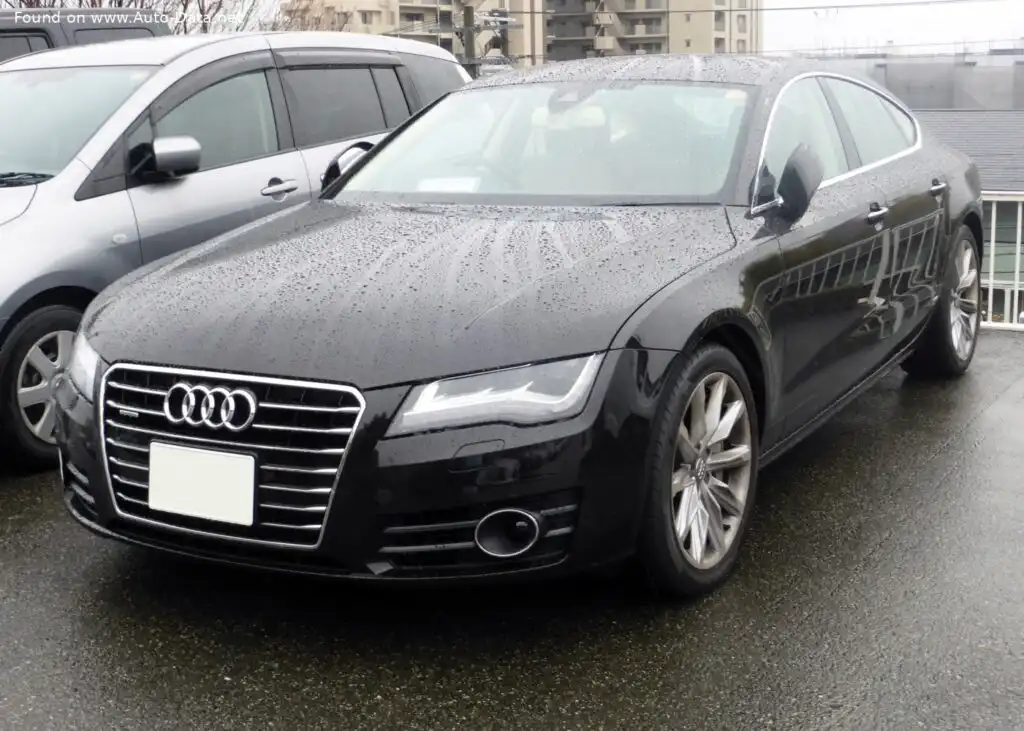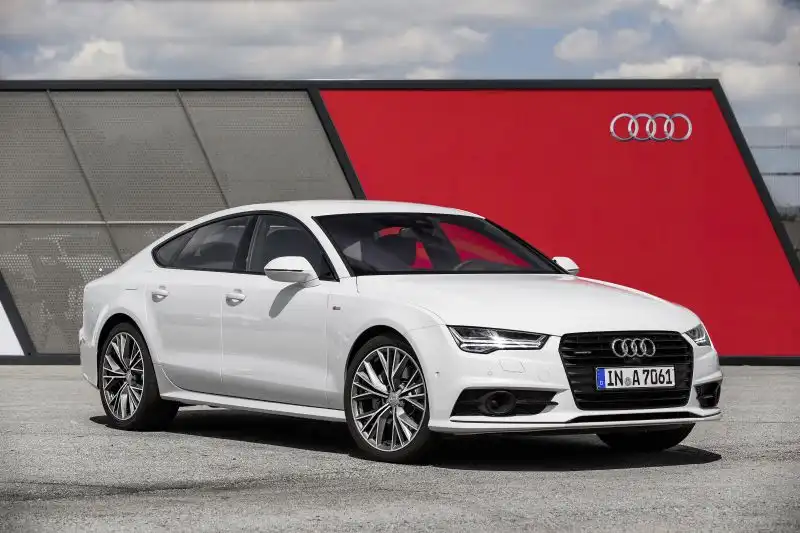
The Audi A7 Sportback Competition 3.0 BiTDI, produced from September 2014 to 2018, represented a high-performance variant within the C7 generation of Audi’s flagship four-door coupe. Positioned as a premium offering, it slotted above the standard 3.0 TDI models, offering increased power and a more focused driving experience. This model was primarily aimed at the European market, where demand for high-torque diesel engines remained strong. The “Competition” designation signified a performance-oriented trim level, emphasizing both power and dynamic handling. It built upon the facelifted C7 A7 released in 2014, incorporating updated styling and technology.
Technical Specifications
| Brand | Audi |
| Model | A7 |
| Generation | A7 Sportback (C7, facelift 2014) |
| Type (Engine) | Competition 3.0 BiTDI V6 (326 Hp) quattro Tiptronic |
| Start of production | September, 2014 |
| End of production | 2018 |
| Powertrain Architecture | Internal Combustion engine |
| Body type | Liftback |
| Seats | 5 |
| Doors | 5 |
| Fuel consumption (urban) | 7.4 l/100 km (31.8 US mpg, 38.2 UK mpg, 13.5 km/l) |
| Fuel consumption (extra urban) | 5.4 l/100 km (43.6 US mpg, 52.3 UK mpg, 18.5 km/l) |
| Fuel consumption (combined) | 6.1 l/100 km (38.6 US mpg, 46.3 UK mpg, 16.4 km/l) |
| CO2 emissions | 162 g/km |
| Fuel Type | Diesel |
| Acceleration 0 – 100 km/h | 5.1 sec |
| Acceleration 0 – 62 mph | 5.1 sec |
| Acceleration 0 – 60 mph | 4.8 sec |
| Maximum speed | 250 km/h (155.34 mph) |
| Emission standard | Euro 6 |
| Weight-to-power ratio | 5.9 kg/Hp, 169.4 Hp/tonne |
| Weight-to-torque ratio | 3 kg/Nm, 337.7 Nm/tonne |
| Power | 326 Hp @ 4000-4500 rpm |
| Power per litre | 109.9 Hp/l |
| Torque | 650 Nm @ 1400-2800 rpm (479.42 lb.-ft. @ 1400-2800 rpm) |
| Engine layout | Front, Longitudinal |
| Engine Model/Code | CVUB |
| Engine displacement | 2967 cm3 (181.06 cu. in.) |
| Number of cylinders | 6 |
| Engine configuration | V-engine |
| Cylinder Bore | 83 mm (3.27 in.) |
| Piston Stroke | 91.4 mm (3.6 in.) |
| Compression ratio | 15.5:1 |
| Number of valves per cylinder | 4 |
| Fuel injection system | Diesel Commonrail |
| Engine aspiration | BiTurbo, Intercooler |
| Engine oil capacity | 8 l (8.45 US qt | 7.04 UK qt) |
| Kerb Weight | 1925 kg (4243.9 lbs.) |
| Max. weight | 2535 kg (5588.72 lbs.) |
| Max load | 610 kg (1344.82 lbs.) |
| Trunk (boot) space – minimum | 535 l (18.89 cu. ft.) |
| Trunk (boot) space – maximum | 1390 l (49.09 cu. ft.) |
| Fuel tank capacity | 73 l (19.28 US gal | 16.06 UK gal) |
| Max. roof load | 100 kg (220.46 lbs.) |
| Permitted trailer load with brakes (8%) | 2100 kg (4629.71 lbs.) |
| Permitted trailer load without brakes | 750 kg (1653.47 lbs.) |
| Permitted towbar download | 85 kg (187.39 lbs.) |
| Length | 4974 mm (195.83 in.) |
| Width | 1911 mm (75.24 in.) |
| Width including mirrors | 2139 mm (84.21 in.) |
| Height | 1420 mm (55.91 in.) |
| Wheelbase | 2914 mm (114.72 in.) |
| Front track | 1644 mm (64.72 in.) |
| Rear (Back) track | 1635 mm (64.37 in.) |
| Front overhang | 937 mm (36.89 in.) |
| Rear overhang | 1123 mm (44.21 in.) |
| Drag coefficient (Cd) | 0.29 |
| Minimum turning circle (turning diameter) | 11.9 m (39.04 ft.) |
| Drive wheel | All wheel drive (4×4) |
| Number of gears and type of gearbox | 8 gears, automatic transmission Tiptronic |
| Front suspension | Independent multi-link suspension |
| Rear suspension | Independent on trapezoidal lever |
| Front brakes | Ventilated discs |
| Rear brakes | Ventilated discs |
| Assisting systems | ABS (Anti-lock braking system) |
| Steering type | Steering rack and pinion |
| Power steering | Electric Steering |
| Tires size | 235/55 R17 |
| Wheel rims size | 8.0J x 17 |
Powertrain & Engine Architecture
The heart of the A7 Sportback Competition 3.0 BiTDI is the CVUB engine, a 3.0-liter V6 diesel. This engine utilizes a sophisticated bi-turbocharger setup, employing two turbochargers of different sizes to optimize performance across the rev range. A smaller turbocharger provides quick response at low engine speeds, minimizing turbo lag, while a larger turbocharger delivers increased power at higher speeds. The engine features direct injection with a common rail system, operating at a high compression ratio of 15.5:1. This contributes to both power output and fuel efficiency. The engine produces 326 horsepower at 4000-4500 rpm and a substantial 650 Nm (479.42 lb-ft) of torque between 1400 and 2800 rpm. The transmission is an 8-speed Tiptronic automatic, offering both fully automatic operation and manual gear selection via steering wheel-mounted paddles. This transmission is known for its smooth shifts and responsiveness.
Driving Characteristics
The 3.0 BiTDI Competition, paired with the eight-speed Tiptronic, delivers a refined yet potent driving experience. The abundance of torque, available from very low engine speeds, provides effortless acceleration in everyday driving situations. The 0-60 mph sprint takes approximately 4.8 seconds, and the car feels significantly faster in real-world overtaking scenarios. Compared to the standard 3.0 TDI, the Competition model offers a noticeably more responsive throttle and a more engaging driving feel. While not as overtly sporty as the S7, it provides a compelling balance between performance and comfort. The Tiptronic transmission generally selects the appropriate gear for the driving conditions, but manual gear changes are readily available for more spirited driving. The quattro all-wheel-drive system ensures excellent traction in all weather conditions.
Equipment & Trim Levels
The Competition trim level added several distinctive features to the standard A7 Sportback. Standard equipment included sport seats upholstered in Valcona leather, brushed aluminum interior trim, and a three-spoke multifunction steering wheel. Exterior enhancements included unique 19-inch alloy wheels, a blacked-out grille, and subtle “Competition” badging. Optional extras included a Bang & Olufsen sound system, adaptive cruise control, a head-up display, and a panoramic sunroof. The interior layout was typical of Audi’s high-end offerings, with a focus on quality materials and a driver-focused design.
Chassis & Braking
The A7 Sportback Competition utilizes an independent multi-link suspension system at both the front and rear axles. This setup provides a comfortable ride while maintaining good handling characteristics. The suspension is tuned to be slightly firmer than the standard A7, contributing to a more controlled driving experience. Braking duties are handled by ventilated discs on all four wheels, providing ample stopping power. The electronic stability control (ESC) system is integrated with the quattro all-wheel-drive system to enhance stability and control.
Market Reception & Comparison
The A7 Sportback Competition 3.0 BiTDI was generally well-received by automotive critics. It was praised for its powerful engine, refined ride, and luxurious interior. Compared to the standard 3.0 TDI, the Competition model offered a significant performance upgrade. Fuel economy remained respectable, averaging around 38.6 US mpg in combined driving. Reliability was generally good, although the complex bi-turbo system and diesel particulate filter (DPF) required regular maintenance. Compared to petrol-powered alternatives like the S7, the Competition offered a more fuel-efficient option without sacrificing a significant amount of performance.
Legacy
The CVUB engine, while robust, requires diligent maintenance, particularly regarding the DPF and turbochargers. Long-term reliability is generally good if the car has been properly maintained. On the used car market, the A7 Sportback Competition 3.0 BiTDI holds its value relatively well, appealing to buyers seeking a blend of performance, luxury, and fuel efficiency. It remains a desirable option for those looking for a sophisticated and capable grand tourer.