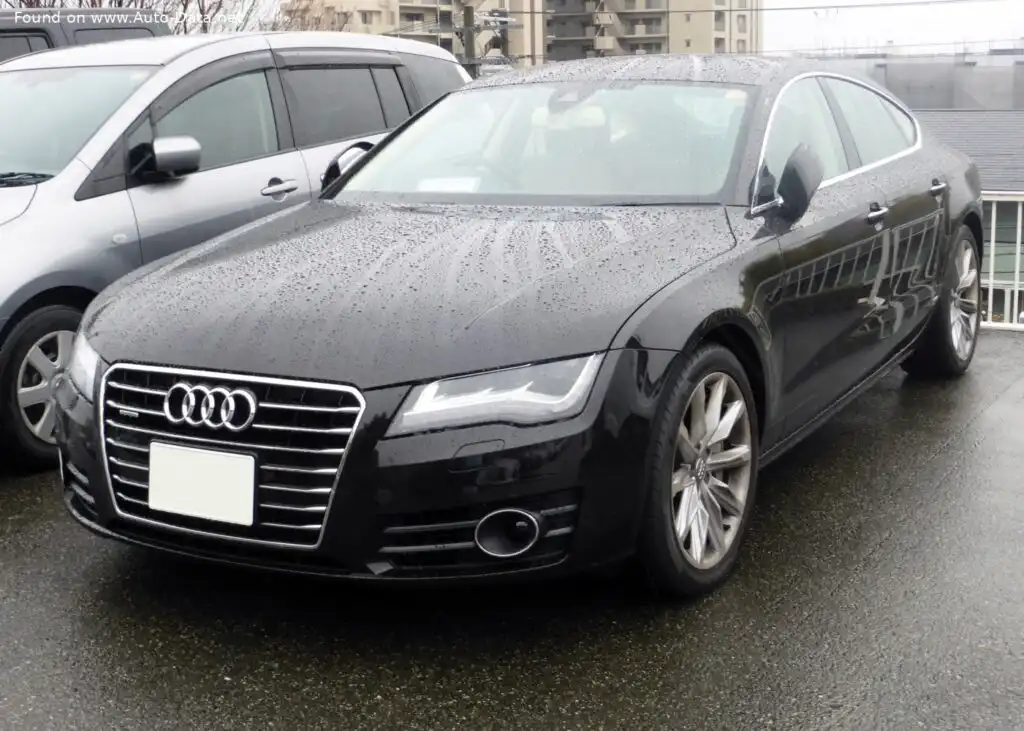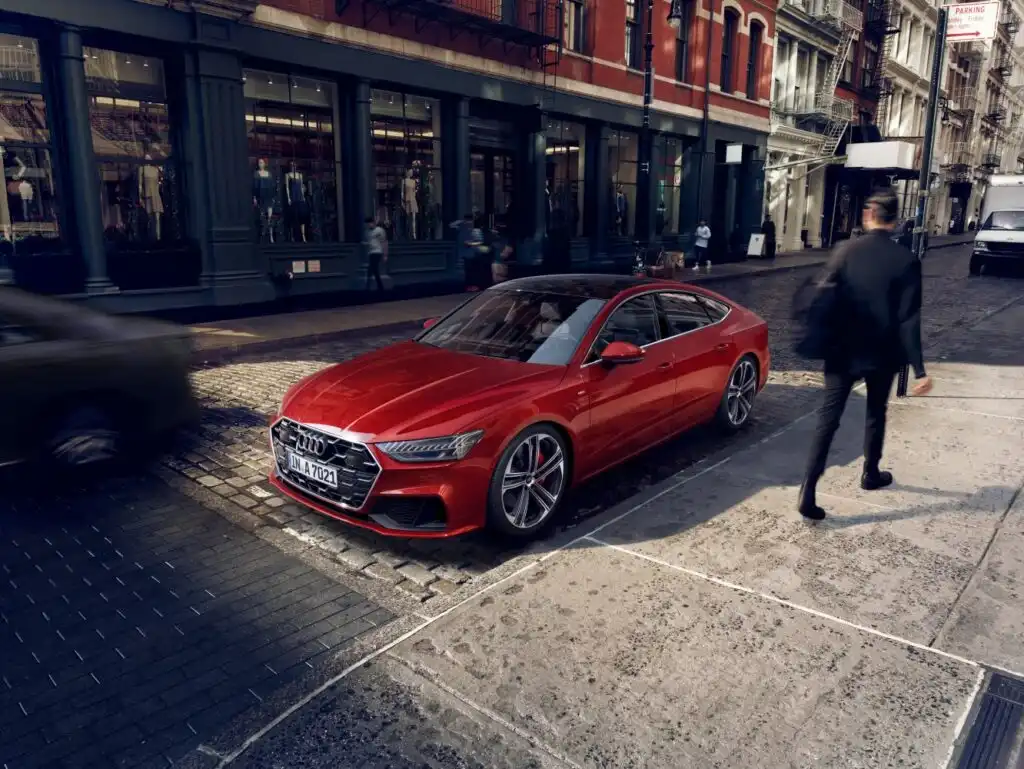
The Audi A7 Sportback (C8, facelift released in 2023) 45 TFSI represents a compelling blend of performance, efficiency, and luxury within the Audi A7 lineup. Introduced in June 2023 and continuing through March 2025, this variant occupies a mid-range position, offering a balance between the more accessible base models and the higher-performance S and RS trims. It builds upon the foundation of the C8 generation A7 Sportback, known for its elegant fastback design and sophisticated technology, incorporating updates from the 2023 facelift. The “45 TFSI” designation signifies its 2.0-liter turbocharged engine producing 265 horsepower, coupled with a mild hybrid system and Audi’s quattro ultra all-wheel-drive system, paired with a 7-speed S tronic dual-clutch transmission.
Technical Specifications
| Brand | Audi |
| Model | A7 |
| Generation | A7 Sportback (C8, facelift 2023) |
| Type (Engine) | 45 TFSI (265 Hp) Mild Hybrid quattro ultra S tronic |
| Start of production | June, 2023 |
| End of production | March, 2025 |
| Powertrain Architecture | MHEV (Mild Hybrid Electric Vehicle) |
| Body type | Liftback |
| Seats | 5 |
| Doors | 5 |
| Combined fuel consumption (WLTP) | 7.4-8.4 l/100 km (31.8 – 28 US mpg, 38.2 – 33.6 UK mpg, 13.5 – 11.9 km/l) |
| CO2 emissions (WLTP) | 168-190 g/km |
| Fuel Type | Petrol (Gasoline) |
| Acceleration 0 – 100 km/h | 6.2 sec |
| Acceleration 0 – 62 mph | 6.2 sec |
| Acceleration 0 – 60 mph | 5.9 sec |
| Maximum speed | 250 km/h (155.34 mph) |
| Emission standard | Euro 6e |
| Weight-to-power ratio | 6.6 kg/Hp, 150.6 Hp/tonne |
| Weight-to-torque ratio | 4.8 kg/Nm, 210.2 Nm/tonne |
| Net (usable) battery capacity | 0.15 kWh |
| Battery voltage | 12 V |
| Battery technology | Lithium-ion (Li-Ion) |
| Battery location | Under the front hood |
| Recuperation output | 6 kW |
| Electric motor power | 3 Hp |
| Electric motor Torque | 60 Nm (44.25 lb.-ft.) |
| Electric motor location | Front, Longitudinal |
| Power | 265 Hp @ 5250-6500 rpm |
| Torque | 370 Nm @ 1600-4500 rpm (272.9 lb.-ft. @ 1600-4500 rpm) |
| Engine layout | Front, Longitudinal |
| Engine Model/Code | EA888 |
| Engine displacement | 1984 cm3 (121.07 cu. in.) |
| Number of cylinders | 4 |
| Engine configuration | Inline |
| Cylinder Bore | 82.5 mm (3.25 in.) |
| Piston Stroke | 92.8 mm (3.65 in.) |
| Compression ratio | 9.6:1 |
| Number of valves per cylinder | 4 |
| Fuel injection system | Direct injection |
| Engine aspiration | Turbocharger, Intercooler |
| Valvetrain | DOHC |
| Engine oil capacity | 5.2 l (5.49 US qt | 4.58 UK qt) |
| Coolant | 8.7 l (9.19 US qt | 7.65 UK qt) |
| Kerb Weight | 1760 kg (3880.14 lbs.) |
| Max. weight | 2385 kg (5258.02 lbs.) |
| Max load | 625 kg (1377.89 lbs.) |
| Trunk (boot) space – minimum | 535 l (18.89 cu. ft.) |
| Trunk (boot) space – maximum | 1390 l (49.09 cu. ft.) |
| Fuel tank capacity | 63 l (16.64 US gal | 13.86 UK gal) |
| Max. roof load | 90 kg (198.42 lbs.) |
| Permitted trailer load with brakes (8%) | 2000 kg (4409.25 lbs.) |
| Permitted trailer load with brakes (12%) | 2000 kg (4409.25 lbs.) |
| Permitted trailer load without brakes | 750 kg (1653.47 lbs.) |
| Permitted towbar download | 95 kg (209.44 lbs.) |
| Length | 4969 mm (195.63 in.) |
| Width | 1908 mm (75.12 in.) |
| Width including mirrors | 2118 mm (83.39 in.) |
| Height | 1422 mm (55.98 in.) |
| Wheelbase | 2926 mm (115.2 in.) |
| Front track | 1651 mm (65 in.) |
| Rear (Back) track | 1637 mm (64.45 in.) |
| Front overhang | 927 mm (36.5 in.) |
| Rear overhang | 1116 mm (43.94 in.) |
| Drag coefficient (Cd) | 0.26 |
| Minimum turning circle (turning diameter) | 12.4 m (40.68 ft.) |
| Approach angle | 12.2° |
| Departure angle | 16.7° |
| Drivetrain Architecture | ICE and electric motor drive front wheels, rear drive via clutch |
| Drive wheel | All wheel drive (4×4) |
| Number of gears and type of gearbox | 7 gears, automatic transmission S tronic |
| Front suspension | Independent multi-link suspension |
| Rear suspension | Independent multi-link suspension |
| Front brakes | Ventilated discs, 338 mm |
| Rear brakes | Ventilated discs, 330 mm |
| Steering type | Steering rack and pinion |
| Power steering | Electric Steering |
| Tires size | 225/55 R18; 245/45 R19; 255/40 R20; 255/35 R21 |
| Wheel rims size | 8J x 18; 8.5J x 19; 8.5J x 20; 8.5J x 21 |
Powertrain & Engine Architecture
At the heart of the A7 45 TFSI lies the EA888 2.0-liter inline-four cylinder engine. This engine is a staple in the Volkswagen Group, known for its robust design and tuning potential. The EA888 in this application features direct fuel injection and a single turbocharger with an intercooler, delivering a balance of power and efficiency. The engine’s output of 265 horsepower and 370 Nm (272.9 lb-ft) of torque is achieved through careful calibration of the engine management system. The mild hybrid system, utilizing a 48-volt electrical architecture, incorporates a belt starter generator (BSG) that enables features like extended engine-off coasting, regenerative braking, and a smoother start-stop system. The 7-speed S tronic dual-clutch transmission provides rapid and seamless gear changes, contributing to both performance and fuel economy. This transmission is known for its efficiency and responsiveness, offering both automatic and manual shift modes.
Driving Characteristics
The A7 45 TFSI offers a refined and comfortable driving experience. While not as overtly sporty as the S7, the 265 hp engine provides ample power for everyday driving and confident highway passing. The S tronic transmission contributes to brisk acceleration, with a 0-60 mph time of around 5.9 seconds. The quattro ultra all-wheel-drive system intelligently distributes torque between the front and rear axles, enhancing traction and stability in various conditions. The gear ratios are tuned for a balance of acceleration and fuel efficiency, with the transmission generally holding lower gears for longer during spirited driving. Compared to higher-output versions, the 45 TFSI prioritizes smoothness and fuel economy over outright performance.
Equipment & Trim Levels
The A7 45 TFSI typically comes well-equipped as standard. Features generally include Audi’s Virtual Cockpit digital instrument cluster, a touchscreen infotainment system with navigation, leather upholstery, tri-zone automatic climate control, and a suite of driver-assistance systems such as adaptive cruise control, lane departure warning, and automatic emergency braking. Optional extras often include upgraded sound systems (Bang & Olufsen), massaging seats, a head-up display, and various cosmetic enhancements. Interior trim options range from aluminum and wood veneers to carbon fiber accents, allowing for a degree of personalization.
Chassis & Braking
The A7 Sportback utilizes an independent multi-link suspension setup at both the front and rear axles, providing a comfortable ride and precise handling. The suspension is tuned to balance comfort and control, offering a composed ride even on uneven surfaces. Braking duties are handled by ventilated discs on all four wheels, providing ample stopping power. The electronic stability control (ESC) system works in conjunction with the quattro all-wheel-drive system to maintain stability and control in challenging conditions.
Market Reception & Comparison
The A7 45 TFSI was generally well-received by automotive critics, praised for its refined driving experience, luxurious interior, and advanced technology. Compared to the more powerful S7, the 45 TFSI offered a more accessible price point and better fuel economy. Against competitors like the BMW 5 Series and Mercedes-Benz E-Class, the A7 45 TFSI stood out with its distinctive styling and sophisticated interior. Fuel economy figures of 7.4-8.4 l/100 km (31.8 – 28 US mpg) were competitive within its segment.
Legacy
The EA888 engine, in its various iterations, has proven to be a reliable and durable powerplant. The 7-speed S tronic transmission is also generally considered reliable with proper maintenance. The A7 45 TFSI, while not the most sought-after variant, represents a well-rounded and practical choice in the used car market. Its combination of luxury, technology, and reasonable running costs makes it an appealing option for buyers seeking a premium executive car. Regular maintenance, including oil changes and transmission servicing, is crucial to ensure the long-term reliability of this powertrain.