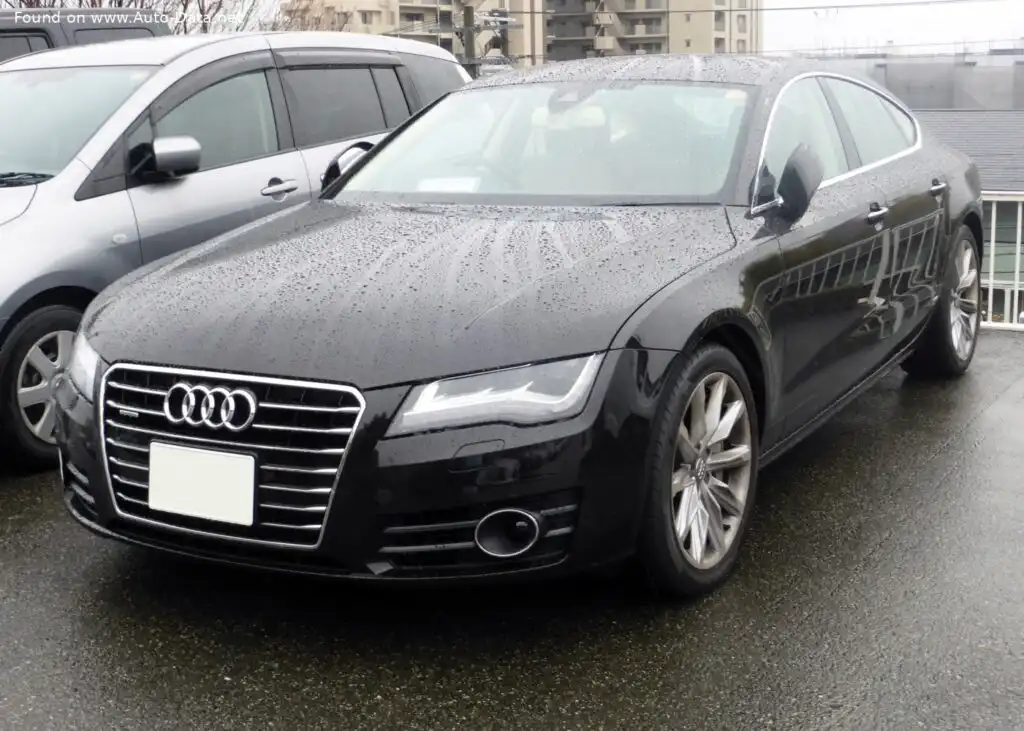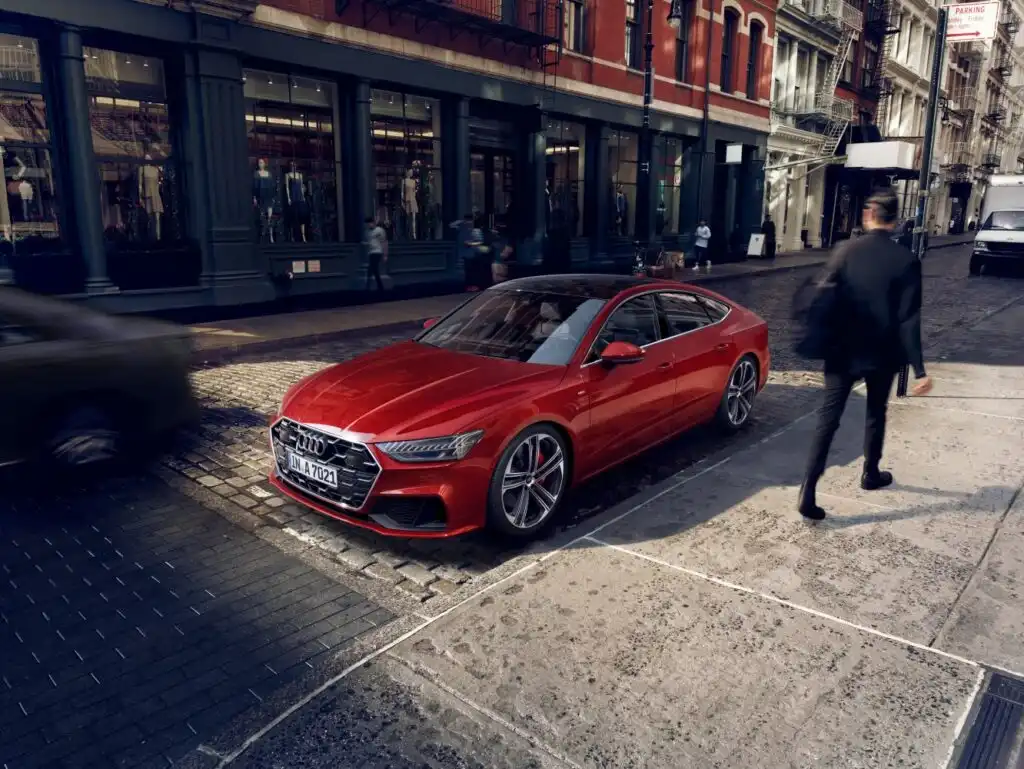
The Audi A7 Sportback (C8), particularly the facelifted 2023 model year 55 TFSI V6 variant, represents a sophisticated blend of performance, luxury, and technology within Audi’s executive liftback lineup. Introduced in June 2023 and continuing through 2025, this version occupies a prominent position as a mid-to-high-range offering, bridging the gap between the entry-level 45 TFSI models and the performance-oriented S7. It builds upon the foundation of the C8 platform (shared with the A6), offering a more dynamic and stylish alternative to traditional sedans.
Technical Specifications
| Brand | Audi |
| Model | A7 |
| Generation | A7 Sportback (C8, facelift 2023) |
| Type (Engine) | 55 TFSI V6 (340 Hp) Mild Hybrid quattro ultra S tronic |
| Start of production | June, 2023 |
| End of production | 2025 |
| Powertrain Architecture | MHEV (Mild Hybrid Electric Vehicle) |
| Body type | Liftback |
| Seats | 5 |
| Doors | 5 |
| Combined fuel consumption (WLTP) | 8-9 l/100 km (29.4 – 26.1 US mpg, 35.3 – 31.4 UK mpg, 12.5 – 11.1 km/l) |
| CO2 emissions (WLTP) | 182-204 g/km |
| Fuel Type | Petrol (Gasoline) |
| Acceleration 0 – 100 km/h | 5 sec |
| Acceleration 0 – 62 mph | 5 sec |
| Acceleration 0 – 60 mph | 4.8 sec |
| Maximum speed | 250 km/h (155.34 mph) |
| Emission standard | Euro 6e |
| Weight-to-power ratio | 5.3 kg/Hp, 187.3 Hp/tonne |
| Weight-to-torque ratio | 3.6 kg/Nm, 275.5 Nm/tonne |
| Net (usable) battery capacity | 0.5 kWh |
| Battery voltage | 48 V |
| Battery technology | Lithium-ion (Li-Ion) |
| Battery weight | 10 kg (22.05 lbs) |
| Battery location | Under the trunk |
| Recuperation output | 14 kW |
| Electric motor power | 8 Hp |
| Electric motor Torque | 60 Nm (44.25 lb.-ft.) |
| Electric motor location | Front, Longitudinal |
| Power | 340 Hp @ 5200-6400 rpm |
| Torque | 500 Nm @ 1370-4500 rpm (368.78 lb.-ft. @ 1370-4500 rpm) |
| Engine layout | Front, Longitudinal |
| Engine Model/Code | EA839 |
| Engine displacement | 2995 cm3 (182.77 cu. in.) |
| Number of cylinders | 6 |
| Engine configuration | V-engine |
| Cylinder Bore | 84.5 mm (3.33 in.) |
| Piston Stroke | 89 mm (3.5 in.) |
| Compression ratio | 11.2:1 |
| Number of valves per cylinder | 4 |
| Fuel injection system | Direct injection |
| Engine aspiration | Turbocharger, Intercooler |
| Valvetrain | DOHC |
| Engine oil capacity | 7.6 l (8.03 US qt | 6.69 UK qt) |
| Coolant | 11.5 l (12.15 US qt | 10.12 UK qt) |
| Kerb Weight | 1815 kg (4001.39 lbs) |
| Max. weight | 2470 kg (5445.42 lbs) |
| Max load | 655 kg (1444.03 lbs) |
| Trunk (boot) space – minimum | 525 l (18.54 cu. ft.) |
| Trunk (boot) space – maximum | 1380 l (48.73 cu. ft.) |
| Fuel tank capacity | 63 l (16.64 US gal | 13.86 UK gal) |
| Max. roof load | 90 kg (198.42 lbs) |
| Permitted trailer load with brakes (8%) | 2000 kg (4409.25 lbs) |
| Permitted trailer load with brakes (12%) | 2000 kg (4409.25 lbs) |
| Permitted trailer load without brakes | 750 kg (1653.47 lbs) |
| Permitted towbar download | 95 kg (209.44 lbs) |
| Length | 4969 mm (195.63 in.) |
| Width | 1908 mm (75.12 in.) |
| Width including mirrors | 2118 mm (83.39 in.) |
| Height | 1422 mm (55.98 in.) |
| Wheelbase | 2926 mm (115.2 in.) |
| Front track | 1651 mm (65 in.) |
| Rear (Back) track | 1637 mm (64.45 in.) |
| Front overhang | 927 mm (36.5 in.) |
| Rear overhang | 1116 mm (43.94 in.) |
| Drag coefficient (Cd) | 0.26 |
| Minimum turning circle (turning diameter) | 12.4 m (40.68 ft.) |
| Approach angle | 12.2° |
| Departure angle | 16.7° |
| Drivetrain Architecture | ICE and electric motor drive front wheels, rear drive via clutch |
| Drive wheel | All wheel drive (4×4) |
| Number of gears and type of gearbox | 7 gears, automatic transmission S tronic |
| Front suspension | Independent multi-link suspension |
| Rear suspension | Independent multi-link suspension |
| Front brakes | Ventilated discs, 375 mm |
| Rear brakes | Ventilated discs, 330 mm |
| Steering type | Steering rack and pinion |
| Power steering | Electric Steering |
| Tires size | 225/55 R18; 245/45 R19; 255/40 R20; 255/35 R21 |
| Wheel rims size | 8J x 18; 8.5J x 19; 8.5J x 20; 8.5J x 21 |
INTRODUCTION
The 2023 Audi A7 Sportback 55 TFSI represents the culmination of several years of refinement within the C8 generation. Introduced in 2018, the C8 A7 aimed to blend the practicality of a liftback with the luxurious appointments expected of an Audi flagship. The facelift in 2023 brought updated styling, enhanced technology, and a continued focus on efficient performance. The 55 TFSI trim, powered by a 3.0-liter turbocharged V6, is a key component of the A7 range, offering a balance between spirited driving and comfortable long-distance cruising. It’s positioned above the 45 TFSI models and below the higher-performance S7 and RS 7 variants.
Powertrain & Engine Architecture
At the heart of the A7 55 TFSI lies the EA839 3.0-liter V6 engine. This engine utilizes a direct injection system and is coupled with a single twin-scroll turbocharger and an intercooler to deliver 340 horsepower at 5200-6400 rpm and 500 Nm (368.78 lb-ft) of torque between 1370 and 4500 rpm. The engine incorporates Audi’s mild hybrid electric vehicle (MHEV) technology, featuring a 48V electrical system and a belt-driven starter generator (BSG). This system allows for extended start-stop operation, regenerative braking, and a small power boost during acceleration. The engine’s architecture is longitudinally mounted, driving all four wheels through Audi’s quattro all-wheel-drive system. The transmission is a seven-speed S tronic dual-clutch automatic, known for its quick and smooth shifts. This transmission is integral to the car’s performance and efficiency.
Driving Characteristics
The A7 55 TFSI delivers a refined and capable driving experience. The 340 hp and 369 lb-ft of torque provide ample power for confident acceleration, achieving 0-60 mph in approximately 4.8 seconds. The S tronic transmission contributes to this responsiveness, offering near-instantaneous gear changes. While not as overtly sporty as the S7, the 55 TFSI provides a satisfying level of performance for everyday driving and highway cruising. The quattro all-wheel-drive system ensures excellent traction in various weather conditions. The MHEV system contributes to a smooth and seamless driving experience, masking some of the engine start-stop transitions. Compared to the 45 TFSI models, the 55 TFSI offers a noticeable increase in power and torque, resulting in more effortless acceleration. Compared to the S7, it prioritizes comfort and fuel efficiency over outright performance.
Equipment & Trim Levels
The A7 55 TFSI typically comes well-equipped as standard. Features include Audi’s Virtual Cockpit digital instrument cluster, a large touchscreen infotainment system with navigation, leather upholstery, three-zone automatic climate control, and a suite of driver-assistance systems such as adaptive cruise control, lane departure warning, and automatic emergency braking. Optional extras include a Bang & Olufsen premium sound system, massaging front seats, a head-up display, and various cosmetic enhancements. Interior trim options range from brushed aluminum to wood veneers, allowing for a degree of personalization. The exterior styling features distinctive LED headlights and taillights, along with chrome accents and a sleek, coupe-like silhouette.
Chassis & Braking
The A7 55 TFSI utilizes an independent multi-link suspension setup at both the front and rear axles, providing a comfortable and controlled ride. The suspension is tuned to balance handling and comfort, offering a good compromise for both city driving and long-distance journeys. The car is equipped with ventilated disc brakes on all four wheels, providing ample stopping power. Front brake rotors measure 375mm, while rear rotors are 330mm. The electronic stability control (ESC) system and anti-lock braking system (ABS) work in conjunction to enhance safety and stability. The steering is an electric power-assisted rack and pinion system, offering precise and responsive control.
Market Reception & Comparison
The Audi A7 55 TFSI has generally received positive reviews from automotive critics. It’s praised for its stylish design, luxurious interior, refined driving experience, and advanced technology. Critics note that the 55 TFSI offers a compelling alternative to traditional luxury sedans, with its liftback body style providing added practicality. Fuel economy is respectable for a vehicle of this size and performance, with combined WLTP figures ranging from 8-9 l/100 km. Reliability has been generally good, although some owners have reported minor issues with the infotainment system. Compared to the 45 TFSI, the 55 TFSI offers a significant performance upgrade, justifying the higher price tag for those seeking more power. Compared to the BMW 5 Series and Mercedes-Benz E-Class, the A7 is often seen as offering a more modern and technologically advanced interior.
Legacy
The EA839 V6 engine, in various iterations, has proven to be a robust and reliable powerplant. The combination of this engine with the S tronic transmission and quattro all-wheel drive has established a strong reputation for durability. While the MHEV system is relatively new, early indications suggest it is functioning reliably. On the used car market, the 2023 A7 55 TFSI is expected to hold its value well due to its desirable combination of performance, luxury, and technology. Regular maintenance, including oil changes and adherence to Audi’s recommended service intervals, will be crucial for ensuring the long-term reliability of this vehicle.