
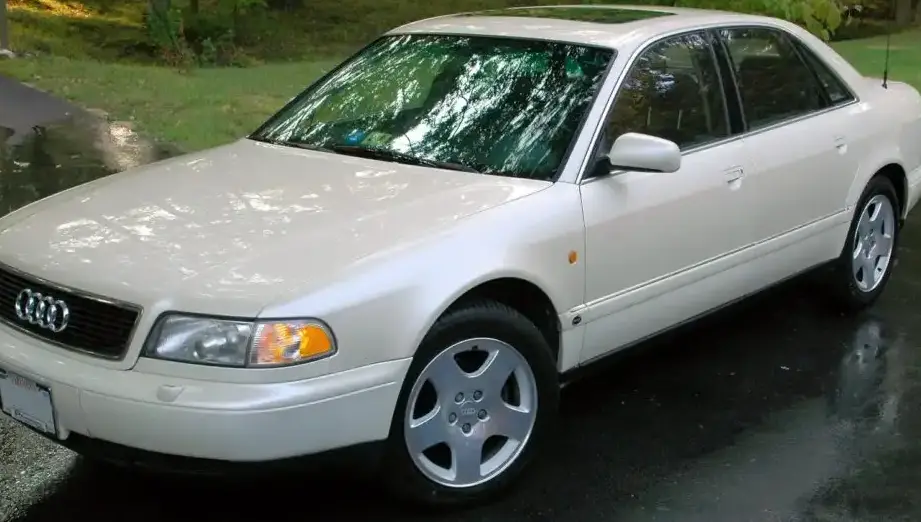
The Audi A8 (D2) 2.5 TDI V6 quattro tiptronic, produced from 1997 to 1998, represented a compelling blend of luxury and diesel efficiency within the flagship A8 range. Positioned as a mid-range offering, it slotted between the more powerful petrol V6 and V8 models, and the higher-output TDI variants. This iteration of the A8, internally designated the 4D chassis code, was the second generation of Audi’s full-size luxury sedan, building upon the groundbreaking innovations of the original A8 (D1). It was a key model in establishing Audi’s reputation for advanced technology and quattro all-wheel drive capability in the premium segment, particularly in European markets where diesel engines held significant popularity.
Technical Specifications
| Brand | Audi |
| Model | A8 |
| Generation | A8 (D2, 4D) |
| Type (Engine) | 2.5 TDI V6 (150 Hp) quattro tiptronic |
| Start of production | 1997 |
| End of production | 1998 |
| Powertrain Architecture | Internal Combustion engine |
| Body type | Sedan |
| Seats | 5 |
| Doors | 4 |
| Fuel consumption (economy) – urban (NEDC) | 12.7 l/100 km (18.5 US mpg, 22.2 UK mpg, 7.9 km/l) |
| Fuel consumption (economy) – extra urban (NEDC) | 6.7 l/100 km (35.1 US mpg, 42.2 UK mpg, 14.9 km/l) |
| Fuel consumption (economy) – combined (NEDC) | 8.9 l/100 km (26.4 US mpg, 31.7 UK mpg, 11.2 km/l) |
| CO2 emissions (NEDC) | 240 g/km |
| Fuel Type | Diesel |
| Acceleration 0 – 100 km/h | 11.3 sec |
| Acceleration 0 – 62 mph | 11.3 sec |
| Acceleration 0 – 60 mph | 10.7 sec |
| Maximum speed | 213 km/h (132.35 mph) |
| Emission standard | Euro 2 |
| Weight-to-power ratio | 11.4 kg/Hp, 88 Hp/tonne |
| Weight-to-torque ratio | 5.5 kg/Nm, 181.8 Nm/tonne |
| Power | 150 Hp @ 4000 rpm |
| Power per litre | 60.1 Hp/l |
| Torque | 310 Nm @ 1500-3200 rpm (228.64 lb.-ft. @ 1500-3200 rpm) |
| Engine layout | Front, Longitudinal |
| Engine Model/Code | AFB |
| Engine displacement | 2496 cm3 (152.32 cu. in.) |
| Number of cylinders | 6 |
| Engine configuration | V-engine |
| Cylinder Bore | 78.3 mm (3.08 in.) |
| Piston Stroke | 86.4 mm (3.4 in.) |
| Compression ratio | 19.5:1 |
| Number of valves per cylinder | 4 |
| Fuel injection system | Direct injection |
| Engine aspiration | Turbocharger, Intercooler |
| Valvetrain | DOHC |
| Engine oil capacity | 6 l (6.34 US qt | 5.28 UK qt) |
| Coolant | 10 l (10.57 US qt | 8.8 UK qt) |
| Kerb Weight | 1705 kg (3758.88 lbs.) |
| Max. weight | 2305 kg (5081.66 lbs.) |
| Max load | 600 kg (1322.77 lbs.) |
| Trunk (boot) space – minimum | 525 l (18.54 cu. ft.) |
| Fuel tank capacity | 90 l (23.78 US gal | 19.8 UK gal) |
| Max. roof load | 100 kg (220.46 lbs.) |
| Permitted trailer load with brakes (8%) | 2200 kg (4850.17 lbs.) |
| Permitted trailer load with brakes (12%) | 2200 kg (4850.17 lbs.) |
| Permitted trailer load without brakes | 750 kg (1653.47 lbs.) |
| Permitted towbar download | 95 kg (209.44 lbs.) |
| Length | 5034 mm (198.19 in.) |
| Width | 1880 mm (74.02 in.) |
| Width including mirrors | 1973 mm (77.68 in.) |
| Height | 1440 mm (56.69 in.) |
| Wheelbase | 2882 mm (113.46 in.) |
| Front track | 1597 mm (62.87 in.) |
| Rear (Back) track | 1586 mm (62.44 in.) |
| Drag coefficient (Cd) | 0.29 |
| Minimum turning circle (turning diameter) | 12.25 m (40.19 ft.) |
| Drivetrain Architecture | The Internal combustion engine (ICE) drives permanently the four wheels of the vehicle. |
| Drive wheel | All wheel drive (4×4) |
| Number of gears and type of gearbox | 5 gears, automatic transmission tiptronic |
| Front suspension | Independent multi-link suspension, Transverse stabilizer |
| Rear suspension | Independent on trapezoidal lever, Transverse stabilizer |
| Front brakes | Ventilated discs |
| Rear brakes | Ventilated discs |
| Assisting systems | ABS (Anti-lock braking system) |
| Steering type | Steering rack and pinion |
| Power steering | Hydraulic Steering |
| Tires size | 225/60 R16 |
| Wheel rims size | 7J x 16 |
Powertrain & Engine Architecture
The heart of the A8 2.5 TDI quattro tiptronic is the AFB engine code, a 2.5-liter V6 diesel engine. This engine utilized a direct injection system, a relatively advanced technology for its time, which improved fuel efficiency and reduced emissions compared to older indirect injection diesels. The engine featured a turbocharger with an intercooler, boosting power output to 150 horsepower and 310 Nm (228.64 lb-ft) of torque. The torque curve was notably flat, providing strong pulling power from as low as 1500 rpm. The engine employed a double overhead camshaft (DOHC) valvetrain with four valves per cylinder, optimizing gas flow and contributing to its performance. Paired with this engine was a five-speed tiptronic automatic transmission, offering both fully automatic operation and the ability for the driver to manually select gears for more control. This transmission was known for its smooth shifts, but could sometimes feel slightly hesitant compared to more modern automatics.
Driving Characteristics
The 2.5 TDI automatic A8 offered a comfortable and refined driving experience, prioritizing ease of use over outright performance. Acceleration from 0-60 mph took around 10.7 seconds, which was adequate for highway cruising but not particularly sporty. The tiptronic transmission, while smooth, did contribute to some power loss compared to the available manual transmission options. The quattro all-wheel drive system provided excellent traction in all weather conditions, enhancing stability and confidence. The flat torque curve of the engine meant that overtaking maneuvers were relatively effortless, even with a fully loaded vehicle. However, the engine could become somewhat noisy under hard acceleration, a characteristic of many diesel engines of that era.
Equipment & Trim Levels
The A8 2.5 TDI quattro tiptronic came standard with a generous array of features for a luxury car of its time. These included leather upholstery, power-adjustable front seats with memory function, automatic climate control, a premium sound system, and a sunroof. Optional extras included a navigation system, heated seats, and upgraded wood trim. The interior design was understated and elegant, focusing on quality materials and a comfortable layout. The tiptronic selector was integrated into the center console, providing easy access to manual gear selection.
Chassis & Braking
The A8 (D2) featured an independent suspension system on all four wheels, providing a comfortable ride and good handling. The front suspension utilized a multi-link design, while the rear suspension employed a trapezoidal lever setup. Both axles were equipped with a transverse stabilizer bar to reduce body roll. Braking duties were handled by ventilated disc brakes on all four wheels, providing ample stopping power. An Anti-lock Braking System (ABS) was standard, enhancing safety and control during emergency braking situations.
Market Reception & Comparison
The A8 2.5 TDI quattro tiptronic was generally well-received by automotive critics, who praised its comfortable ride, refined interior, and fuel efficiency. However, some critics noted that the performance was not as exhilarating as that of the petrol V6 or V8 models. Compared to the more powerful TDI variants, the 2.5 TDI offered a more affordable entry point into the A8 range. Its fuel economy was significantly better than the petrol engines, making it a popular choice for drivers who covered long distances. Reliability was generally good, although the complex direct injection system and automatic transmission could require occasional maintenance.
Legacy
The Audi A8 (D2) 2.5 TDI V6 quattro tiptronic remains a sought-after classic car today, particularly among enthusiasts who appreciate its blend of luxury, technology, and diesel efficiency. The AFB engine, while not without its quirks, proved to be relatively durable with proper maintenance. The quattro all-wheel drive system continues to be a hallmark of Audi vehicles, and the A8 (D2) helped to establish Audi’s reputation for all-weather capability. Well-maintained examples of this model are becoming increasingly rare, and are often valued for their historical significance and unique driving experience.
