
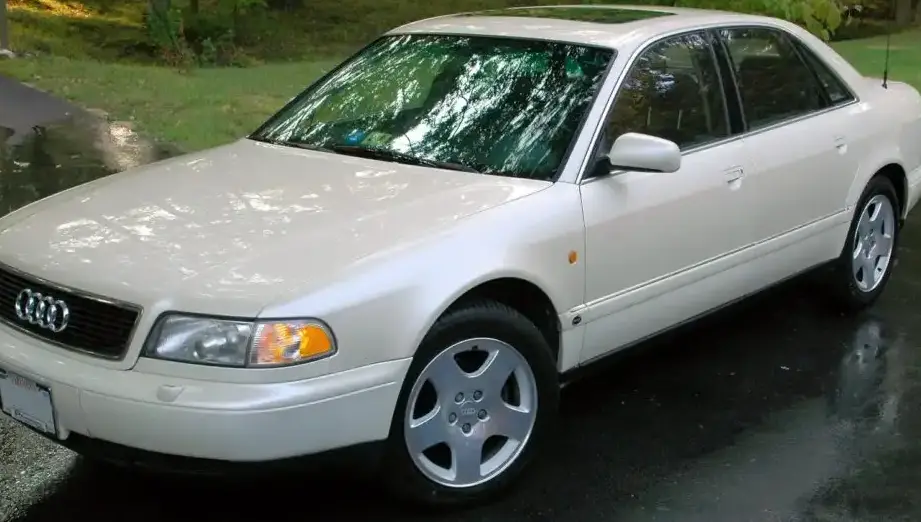
The Audi A8 (D2) 2.8 V6 30V, produced between 1996 and 1998, represented a significant entry point into Audi’s flagship luxury sedan range. Positioned below the more powerful V8 models, the 2.8-liter V6 offered a balance of performance and affordability within the D2 A8 generation (internally designated 4D). This model aimed to broaden the A8’s appeal, attracting buyers who desired the prestige and technology of the A8 without the higher price tag associated with the top-tier engines. It served as a crucial volume seller for Audi during its production run, competing with established luxury sedans from BMW and Mercedes-Benz.
Technical Specifications
| Brand | Audi |
| Model | A8 |
| Generation | A8 (D2, 4D) |
| Type (Engine) | 2.8 V6 30V (193 Hp) |
| Start of production | 1996 |
| End of production | 1998 |
| Powertrain Architecture | Internal Combustion engine |
| Body type | Sedan |
| Seats | 5 |
| Doors | 4 |
| Fuel consumption (economy) – urban (NEDC) | 14.2 l/100 km (16.6 US mpg, 19.9 UK mpg, 7 km/l) |
| Fuel consumption (economy) – extra urban (NEDC) | 7.4 l/100 km (31.8 US mpg, 38.2 UK mpg, 13.5 km/l) |
| Fuel consumption (economy) – combined (NEDC) | 9.9 l/100 km (23.8 US mpg, 28.5 UK mpg, 10.1 km/l) |
| CO2 emissions (NEDC) | 235 g/km |
| Fuel Type | Petrol (Gasoline) |
| Acceleration 0 – 100 km/h | 8.4 sec |
| Acceleration 0 – 62 mph | 8.4 sec |
| Acceleration 0 – 60 mph | 8 sec |
| Maximum speed | 236 km/h (146.64 mph) |
| Emission standard | Euro 2 |
| Weight-to-power ratio | 7.8 kg/Hp, 127.8 Hp/tonne |
| Weight-to-torque ratio | 5.4 kg/Nm, 185.4 Nm/tonne |
| Power | 193 Hp @ 6000 rpm |
| Power per litre | 69.6 Hp/l |
| Torque | 280 Nm @ 3200 rpm (206.52 lb.-ft. @ 3200 rpm) |
| Engine layout | Front, Longitudinal |
| Engine Model/Code | ACK, APR |
| Engine displacement | 2771 cm3 (169.1 cu. in.) |
| Number of cylinders | 6 |
| Engine configuration | V-engine |
| Cylinder Bore | 82.5 mm (3.25 in.) |
| Piston Stroke | 86.4 mm (3.4 in.) |
| Compression ratio | 10.6:1 |
| Number of valves per cylinder | 5 |
| Fuel injection system | Multi-port manifold injection |
| Engine aspiration | Naturally aspirated engine |
| Valvetrain | DOHC |
| Engine oil capacity | 5 l (5.28 US qt | 4.4 UK qt) |
| Coolant | 11 l (11.62 US qt | 9.68 UK qt) |
| Kerb Weight | 1510 kg (3328.98 lbs.) |
| Max. weight | 2110 kg (4651.75 lbs.) |
| Max load | 600 kg (1322.77 lbs.) |
| Trunk (boot) space – minimum | 525 l (18.54 cu. ft.) |
| Fuel tank capacity | 80 l (21.13 US gal | 17.6 UK gal) |
| Max. roof load | 100 kg (220.46 lbs.) |
| Permitted trailer load with brakes (8%) | 1900 kg (4188.78 lbs.) |
| Permitted trailer load with brakes (12%) | 1600 kg (3527.4 lbs.) |
| Permitted trailer load without brakes | 750 kg (1653.47 lbs.) |
| Permitted towbar download | 75 kg (165.35 lbs.) |
| Length | 5034 mm (198.19 in.) |
| Width | 1880 mm (74.02 in.) |
| Width including mirrors | 1973 mm (77.68 in.) |
| Height | 1440 mm (56.69 in.) |
| Wheelbase | 2882 mm (113.46 in.) |
| Front track | 1597 mm (62.87 in.) |
| Rear (Back) track | 1586 mm (62.44 in.) |
| Drag coefficient (Cd) | 0.30 |
| Minimum turning circle (turning diameter) | 12.3 m (40.35 ft.) |
| Drivetrain Architecture | The Internal combustion engine (ICE) drives the front wheels of the vehicle. |
| Drive wheel | Front wheel drive |
| Number of gears and type of gearbox | 5 gears, manual transmission |
| Front suspension | Independent multi-link suspension, Transverse stabilizer |
| Rear suspension | Independent on trapezoidal lever, Transverse stabilizer |
| Front brakes | Ventilated discs |
| Rear brakes | Ventilated discs |
| Assisting systems | ABS (Anti-lock braking system) |
| Steering type | Steering rack and pinion |
| Power steering | Hydraulic Steering |
| Tires size | 225/60 R16 |
| Wheel rims size | 7J x 16 |
Powertrain & Engine Architecture
The heart of the A8 2.8 V6 was the ACK or APR engine code, a 2.8-liter naturally aspirated V6 engine. This engine featured a 90-degree V-angle, contributing to a smooth power delivery. It employed a multi-port fuel injection system, delivering fuel directly into the intake ports, and a double overhead camshaft (DOHC) valvetrain with five valves per cylinder (three intake, two exhaust). This configuration maximized breathing efficiency and contributed to the engine’s respectable 193 horsepower output. The engine’s longitudinal mounting and front-wheel drive configuration were standard for Audi at the time. The 5-speed manual transmission was the standard offering, providing direct control over the engine’s power.
Driving Characteristics
The 2.8 V6 A8 offered a comfortable and refined driving experience, prioritizing smoothness over outright performance. While 193 horsepower was adequate for highway cruising and everyday driving, it wasn’t particularly sporty. Acceleration from 0-60 mph took around 8 seconds, which was competitive for the segment but noticeably slower than the V8-powered A8 models. The manual transmission allowed for more driver engagement, but the gear ratios were tuned for fuel efficiency and relaxed cruising rather than aggressive acceleration. Compared to the more powerful A8 variants, the 2.8 V6 felt less urgent in its response, but it provided a more economical and accessible entry point into the A8 range.
Equipment & Trim Levels
The A8 2.8 V6 typically came well-equipped, reflecting Audi’s commitment to luxury. Standard features included leather upholstery, power-adjustable front seats, automatic climate control, and an upgraded audio system. Wood trim was common throughout the interior, enhancing the sense of luxury. Optional extras included a sunroof, upgraded audio systems, and various driver assistance features. The trim level was generally consistent across the 2.8 V6 models, with options being the primary way to personalize the vehicle.
Chassis & Braking
The A8 D2 featured an independent suspension system on all four wheels, designed to provide a comfortable ride and stable handling. The front suspension utilized a multi-link setup, while the rear employed a trapezoidal lever design. Both ends were equipped with a transverse stabilizer bar to reduce body roll. Braking duties were handled by ventilated discs on all four wheels, coupled with an Anti-lock Braking System (ABS) for enhanced safety. The suspension tuning was geared towards comfort, prioritizing a smooth ride over sharp handling.
Market Reception & Comparison
The A8 2.8 V6 was generally well-received by automotive critics as a capable and comfortable luxury sedan. It was praised for its refined interior, smooth ride, and relatively affordable price point. However, some critics noted that the engine lacked the punch of the V8 models. Fuel economy was considered reasonable for a vehicle of its size and class, averaging around 24 mpg in combined driving. Compared to the A8 4.2 V8, the 2.8 V6 offered significantly better fuel economy and a lower purchase price, making it a more practical choice for many buyers. Reliability was generally good, although preventative maintenance was crucial to avoid issues with the engine’s timing belt and cooling system.
Legacy
The Audi A8 (D2) 2.8 V6 30V remains a sought-after classic among Audi enthusiasts. While not as collectible as the V8 models, the 2.8 V6 offers a more affordable entry point into A8 ownership. The ACK/APR engine is known for its durability when properly maintained, although the timing belt requires regular replacement. Today, these vehicles can be found in good condition, offering a unique blend of luxury, technology, and classic Audi styling. The D2 A8, in all its variants, is remembered as a pivotal model for Audi, establishing the brand as a serious competitor in the luxury car market.
