
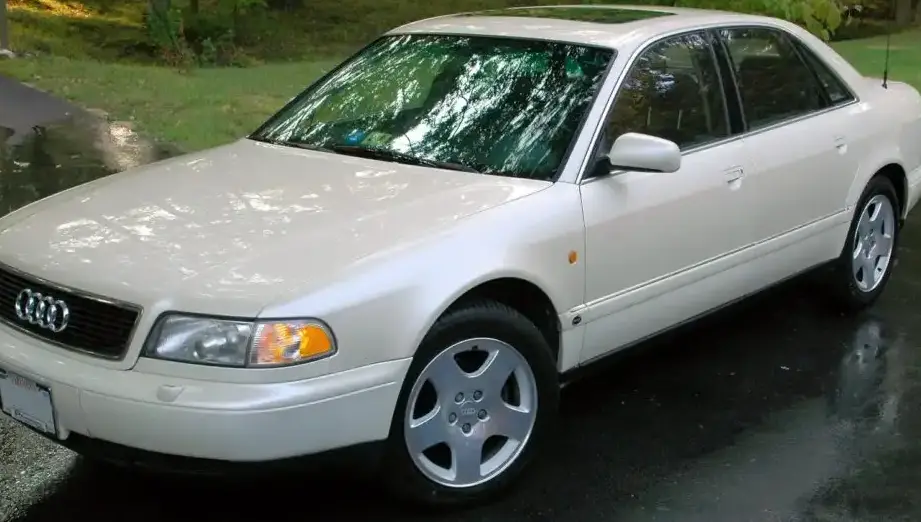
The Audi A8 (D2) 3.7 V8 quattro tiptronic, produced between 1995 and 1998, represented a significant step forward for Audi’s flagship sedan. Part of the D2 generation (internally designated 4D), this variant occupied a mid-to-upper position within the A8 range, offering a blend of performance, luxury, and all-weather capability. It was positioned above the base 2.8L V6 models and below the more potent 4.2L V8, catering to buyers seeking a refined driving experience without the outright performance of the top-tier model. The D2 A8 was Audi’s first full-size luxury car with all-wheel drive, and it established many of the technologies and design cues that would define the A8 lineage for decades to come.
Technical Specifications
| Brand | Audi |
| Model | A8 |
| Generation | A8 (D2, 4D) |
| Type (Engine) | 3.7 V8 32V (230 Hp) quattro tiptronic |
| Start of production | 1995 |
| End of production | 1998 |
| Powertrain Architecture | Internal Combustion engine |
| Body type | Sedan |
| Seats | 5 |
| Doors | 4 |
| Fuel consumption (economy) – urban (NEDC) | 19.6 l/100 km (12 US mpg, 14.4 UK mpg, 5.1 km/l) |
| Fuel consumption (economy) – extra urban (NEDC) | 9 l/100 km (26.1 US mpg, 31.4 UK mpg, 11.1 km/l) |
| Fuel consumption (economy) – combined (NEDC) | 12.9 l/100 km (18.2 US mpg, 21.9 UK mpg, 7.8 km/l) |
| CO2 emissions (NEDC) | 310 g/km |
| Fuel Type | Petrol (Gasoline) |
| Acceleration 0 – 100 km/h | 9.1 sec |
| Acceleration 0 – 62 mph | 9.1 sec |
| Acceleration 0 – 60 mph | 8.6 sec |
| Maximum speed | 245 km/h (152.24 mph) |
| Emission standard | Euro 2 |
| Weight-to-power ratio | 7.5 kg/Hp, 133.3 Hp/tonne |
| Weight-to-torque ratio | 5.5 kg/Nm, 182.6 Nm/tonne |
| Power | 230 Hp @ 5500 rpm |
| Power per litre | 62.2 Hp/l |
| Torque | 315 Nm @ 2700 rpm (232.33 lb.-ft. @ 2700 rpm) |
| Engine layout | Front, Longitudinal |
| Engine Model/Code | AEW, AKJ |
| Engine displacement | 3697 cm3 (225.6 cu. in.) |
| Number of cylinders | 8 |
| Engine configuration | V-engine |
| Cylinder Bore | 84.5 mm (3.33 in.) |
| Piston Stroke | 82.4 mm (3.24 in.) |
| Compression ratio | 10.8:1 |
| Number of valves per cylinder | 4 |
| Fuel injection system | Multi-port manifold injection |
| Engine aspiration | Naturally aspirated engine |
| Valvetrain | DOHC |
| Engine oil capacity | 7.5 l (7.93 US qt, 6.6 UK qt) |
| Coolant | 11 l (11.62 US qt, 9.68 UK qt) |
| Kerb Weight | 1725 kg (3802.97 lbs.) |
| Max. weight | 2325 kg (5125.75 lbs.) |
| Max load | 600 kg (1322.77 lbs.) |
| Trunk (boot) space – minimum | 525 l (18.54 cu. ft.) |
| Fuel tank capacity | 90 l (23.78 US gal, 19.8 UK gal) |
| Max. roof load | 100 kg (220.46 lbs.) |
| Permitted trailer load with brakes (8%) | 2150 kg (4739.94 lbs.) |
| Permitted trailer load with brakes (12%) | 1900 kg (4188.78 lbs.) |
| Permitted trailer load without brakes | 750 kg (1653.47 lbs.) |
| Permitted towbar download | 75 kg (165.35 lbs.) |
| Length | 5034 mm (198.19 in.) |
| Width | 1880 mm (74.02 in.) |
| Width including mirrors | 1973 mm (77.68 in.) |
| Height | 1440 mm (56.69 in.) |
| Wheelbase | 2882 mm (113.46 in.) |
| Front track | 1591 mm (62.64 in.) |
| Rear (Back) track | 1580 mm (62.2 in.) |
| Ride height (ground clearance) | 146 mm (5.75 in.) |
| Drag coefficient (Cd) | 0.30 |
| Minimum turning circle (turning diameter) | 12.3 m (40.35 ft.) |
| Drivetrain Architecture | The Internal combustion engine (ICE) drives permanently the four wheels of the vehicle. |
| Drive wheel | All wheel drive (4×4) |
| Number of gears and type of gearbox | 5 gears, automatic transmission tiptronic |
| Front suspension | Independent multi-link suspension, Transverse stabilizer |
| Rear suspension | Independent on trapezoidal lever, Transverse stabilizer |
| Front brakes | Ventilated discs |
| Rear brakes | Ventilated discs |
| Assisting systems | ABS (Anti-lock braking system) |
| Steering type | Steering rack and pinion |
| Power steering | Hydraulic Steering |
| Tires size | 225/60 R16 |
| Wheel rims size | 7.5J x 16 |
Powertrain & Engine Architecture
The heart of the A8 3.7 was the AEW or AKJ engine, a 3.7-liter naturally aspirated V8. This engine featured a 90-degree V-angle, four valves per cylinder (32V), and a double overhead camshaft (DOHC) design. Fuel delivery was handled by a Bosch Motronic multi-port fuel injection system. The engine’s architecture prioritized smooth power delivery and refinement over outright horsepower, though its 230 hp and 315 Nm (232 lb-ft) of torque were certainly adequate for a luxury sedan of its size. The ‘tiptronic’ transmission was a 5-speed automatic with a manual shift mode, allowing drivers some control over gear selection. This transmission was known for its smooth shifts and responsiveness, contributing to the overall refined driving experience.
Driving Characteristics
The 3.7 V8 tiptronic A8 offered a comfortable and composed driving experience. While not a sports sedan, the engine provided sufficient power for effortless cruising and confident overtaking. The automatic transmission, while smooth, did slightly diminish the sense of urgency compared to the 6-speed manual options available on other A8 models. The quattro all-wheel drive system provided excellent traction in all weather conditions, enhancing stability and safety. The gear ratios were tuned for relaxed highway driving, with a focus on minimizing engine revs at cruising speeds. Acceleration from 0-60 mph took around 8.6 seconds, respectable for the era but noticeably slower than the 4.2L V8 variant.
Equipment & Trim Levels
The A8 3.7 V8 quattro tiptronic came well-equipped as standard. Typical features included leather upholstery, power-adjustable front seats with memory function, automatic climate control, a premium sound system, and wood trim. Optional extras included a sunroof, upgraded leather, rear seat entertainment, and parking sensors. The interior was designed to provide a luxurious and comfortable environment for both driver and passengers. The dashboard layout was clean and functional, with a focus on ease of use.
Chassis & Braking
The D2 A8 featured an independent suspension system on all four wheels, utilizing a multi-link setup at the front and a trapezoidal lever arrangement at the rear. This provided a comfortable ride and good handling characteristics. Stabilizer bars were fitted front and rear to reduce body roll. Braking duties were handled by ventilated disc brakes on all four wheels, coupled with an Anti-lock Braking System (ABS) for enhanced safety. The suspension was tuned to prioritize ride comfort, making it a very pleasant car for long journeys.
Market Reception & Comparison
The A8 3.7 V8 quattro tiptronic was generally well-received by automotive critics. It was praised for its comfortable ride, refined engine, and luxurious interior. However, some reviewers noted that the engine lacked the outright performance of the 4.2L V8. Fuel economy was also a concern, with the 3.7L V8 consuming a significant amount of fuel, especially in urban driving. Compared to the 2.8L V6 models, the 3.7 offered a noticeable performance upgrade, but at a higher price point. Compared to the 4.2L V8, it represented a more sensible and economical choice for buyers who didn’t require the ultimate in performance.
Legacy
The Audi A8 (D2) 3.7 V8 quattro tiptronic, while not the most common variant, remains a desirable classic among Audi enthusiasts. The AEW and AKJ engines are generally considered reliable, although regular maintenance is essential. The tiptronic transmission, if properly maintained, can provide years of trouble-free service. Today, these cars are increasingly sought after by collectors and enthusiasts who appreciate their blend of luxury, performance, and technological innovation. Finding well-maintained examples can be challenging, but the A8 3.7 V8 offers a unique and rewarding driving experience for those willing to invest the time and effort.
