
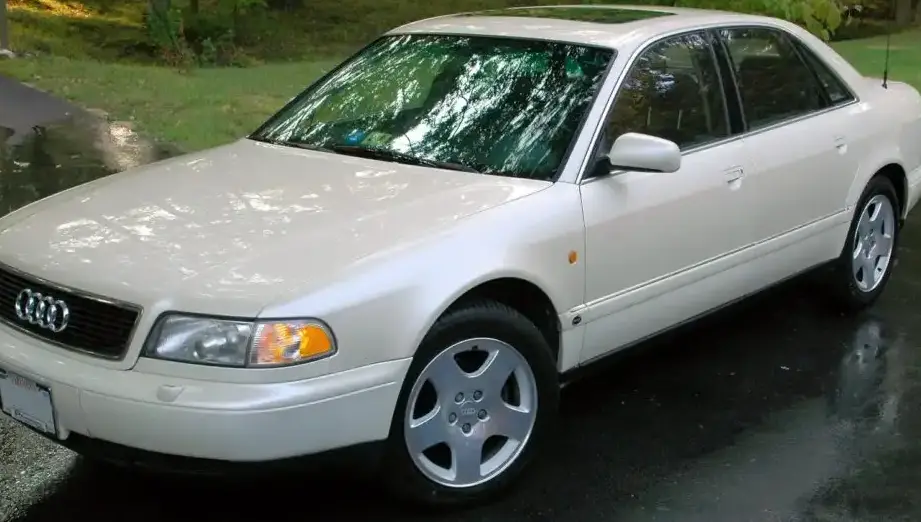
The Audi A8 (D2) 3.7 V8 tiptronic, produced between 1995 and 1998, represented a significant step forward for Audi’s flagship sedan. Part of the D2 generation (internally designated 4D), this variant occupied a mid-range position within the A8 lineup, slotting between the entry-level 2.8L V6 and the high-performance 4.2L V8 models. It was designed to offer a blend of luxury, performance, and advanced technology, appealing to buyers seeking a sophisticated and capable grand tourer. The D2 A8 was the first Audi to feature the brand’s signature quattro all-wheel drive system as an option, though the 3.7 V8 was primarily offered as a front-wheel drive configuration in many markets.
Technical Specifications
| Brand | Audi |
| Model | A8 |
| Generation | A8 (D2, 4D) |
| Type (Engine) | 3.7 V8 32V (230 Hp) tiptronic |
| Start of production | 1995 |
| End of production | 1998 |
| Powertrain Architecture | Internal Combustion engine |
| Body type | Sedan |
| Seats | 5 |
| Doors | 4 |
| Fuel consumption (economy) – urban (NEDC) | 18.6 l/100 km (12.6 US mpg, 15.2 UK mpg, 5.4 km/l) |
| Fuel consumption (economy) – extra urban (NEDC) | 8.5 l/100 km (27.7 US mpg, 33.2 UK mpg, 11.8 km/l) |
| Fuel consumption (economy) – combined (NEDC) | 12 l/100 km (19.6 US mpg, 23.5 UK mpg, 8.3 km/l) |
| CO2 emissions (NEDC) | 288 g/km |
| Fuel Type | Petrol (Gasoline) |
| Acceleration 0 – 100 km/h | 8.7 sec |
| Acceleration 0 – 62 mph | 8.7 sec |
| Acceleration 0 – 60 mph | 8.3 sec |
| Maximum speed | 247 km/h (153.48 mph) |
| Emission standard | Euro 2 |
| Weight-to-power ratio | 7.2 kg/Hp, 139.8 Hp/tonne |
| Weight-to-torque ratio | 5.2 kg/Nm, 191.5 Nm/tonne |
| Power | 230 Hp @ 5500 rpm |
| Power per litre | 62.2 Hp/l |
| Torque | 315 Nm @ 2700 rpm (232.33 lb.-ft. @ 2700 rpm) |
| Engine layout | Front, Longitudinal |
| Engine Model/Code | AEW, AKJ |
| Engine displacement | 3697 cm3 (225.6 cu. in.) |
| Number of cylinders | 8 |
| Engine configuration | V-engine |
| Cylinder Bore | 84.5 mm (3.33 in.) |
| Piston Stroke | 82.4 mm (3.24 in.) |
| Compression ratio | 10.8:1 |
| Number of valves per cylinder | 4 |
| Fuel injection system | Multi-port manifold injection |
| Engine aspiration | Naturally aspirated engine |
| Valvetrain | DOHC |
| Engine oil capacity | 7.5 l (7.93 US qt | 6.6 UK qt) |
| Coolant | 11 l (11.62 US qt | 9.68 UK qt) |
| Kerb Weight | 1645 kg (3626.6 lbs.) |
| Max. weight | 2245 kg (4949.38 lbs.) |
| Max load | 600 kg (1322.77 lbs.) |
| Trunk (boot) space – minimum | 525 l (18.54 cu. ft.) |
| Fuel tank capacity | 90 l (23.78 US gal | 19.8 UK gal) |
| Max. roof load | 100 kg (220.46 lbs.) |
| Permitted trailer load with brakes (8%) | 2000 kg (4409.25 lbs.) |
| Permitted trailer load with brakes (12%) | 1750 kg (3858.09 lbs.) |
| Permitted trailer load without brakes | 750 kg (1653.47 lbs.) |
| Permitted towbar download | 75 kg (165.35 lbs.) |
| Length | 5034 mm (198.19 in.) |
| Width | 1880 mm (74.02 in.) |
| Width including mirrors | 1973 mm (77.68 in.) |
| Height | 1440 mm (56.69 in.) |
| Wheelbase | 2882 mm (113.46 in.) |
| Front track | 1591 mm (62.64 in.) |
| Rear (Back) track | 1580 mm (62.2 in.) |
| Ride height (ground clearance) | 146 mm (5.75 in.) |
| Drag coefficient (Cd) | 0.30 |
| Minimum turning circle (turning diameter) | 12.3 m (40.35 ft.) |
| Drivetrain Architecture | The Internal combustion engine (ICE) drives the front wheels of the vehicle. |
| Drive wheel | Front wheel drive |
| Number of gears and type of gearbox | 5 gears, automatic transmission tiptronic |
| Front suspension | Independent multi-link suspension, Transverse stabilizer |
| Rear suspension | Independent on trapezoidal lever, Transverse stabilizer |
| Front brakes | Ventilated discs |
| Rear brakes | Ventilated discs |
| Assisting systems | ABS (Anti-lock braking system) |
| Steering type | Steering rack and pinion |
| Power steering | Hydraulic Steering |
| Tires size | 225/60 R16 |
| Wheel rims size | 7.5J x 16 |
Powertrain & Engine Architecture
The heart of the A8 3.7 V8 was the AEW or AKJ engine code, a 3.7-liter naturally aspirated V8. This engine featured a 90-degree V-angle, contributing to a smooth and balanced operation. It utilized a multi-port fuel injection system and a double overhead camshaft (DOHC) valvetrain with four valves per cylinder. The engine produced 230 horsepower at 5500 rpm and 315 Nm (232 lb-ft) of torque at 2700 rpm. The ‘tiptronic’ transmission was a 5-speed automatic with a manual shift mode, allowing drivers some control over gear selection. This transmission was known for its smooth shifts and responsiveness, though it wasn’t as sporty as some contemporary manual transmissions.
Driving Characteristics
The 3.7 V8 tiptronic offered a comfortable and refined driving experience. Acceleration from 0 to 60 mph took around 8.3 seconds, and top speed was electronically limited to 153 mph. While not a sports car, the engine provided ample power for effortless cruising and overtaking. The automatic transmission, while smooth, could feel somewhat hesitant during quick downshifts. Compared to the 2.8L V6, the 3.7 V8 offered significantly more power and torque, resulting in a more relaxed driving experience, especially on the highway. However, it lacked the outright performance of the 4.2L V8 models. The front-wheel drive configuration, common in this variant, provided good traction in most conditions but didn’t offer the same level of handling precision as the quattro all-wheel drive system.
Equipment & Trim Levels
The A8 3.7 V8 tiptronic came standard with a generous array of features, reflecting its luxury positioning. These included leather upholstery, power-adjustable front seats with memory function, automatic climate control, a premium sound system, and wood trim. Optional extras included a sunroof, heated seats, a navigation system, and upgraded leather options. The interior was designed with a focus on comfort and elegance, offering a spacious and well-appointed cabin.
Chassis & Braking
The A8 D2 featured an independent suspension system on all four wheels, utilizing multi-link setups at the front and trapezoidal levers at the rear. This provided a comfortable ride and good handling characteristics. The 3.7 V8 models were equipped with ventilated disc brakes on all four wheels, providing adequate stopping power. Anti-lock braking system (ABS) was standard. Stabilizer bars were fitted to both the front and rear axles to reduce body roll during cornering.
Market Reception & Comparison
The A8 3.7 V8 tiptronic was generally well-received by automotive critics. It was praised for its comfortable ride, refined interior, and smooth powertrain. However, some critics noted that the automatic transmission could be slow to respond at times. Fuel economy was a concern, with combined fuel consumption averaging around 19.6 US mpg. Compared to the 2.8L V6, the 3.7 V8 offered a significant performance upgrade, but at a higher price point. The 4.2L V8 models provided even more performance, but were considerably more expensive.
Legacy
The Audi A8 D2 3.7 V8 tiptronic remains a desirable classic car today. The AEW and AKJ engines are generally considered reliable, although regular maintenance is essential. Common issues include oil leaks and sensor failures. Parts availability can be a challenge, but a dedicated community of A8 enthusiasts helps to keep these cars on the road. The D2 A8 is remembered as a groundbreaking luxury sedan that helped establish Audi as a major player in the premium car market. Its advanced technology and elegant design continue to appeal to collectors and enthusiasts alike.
