
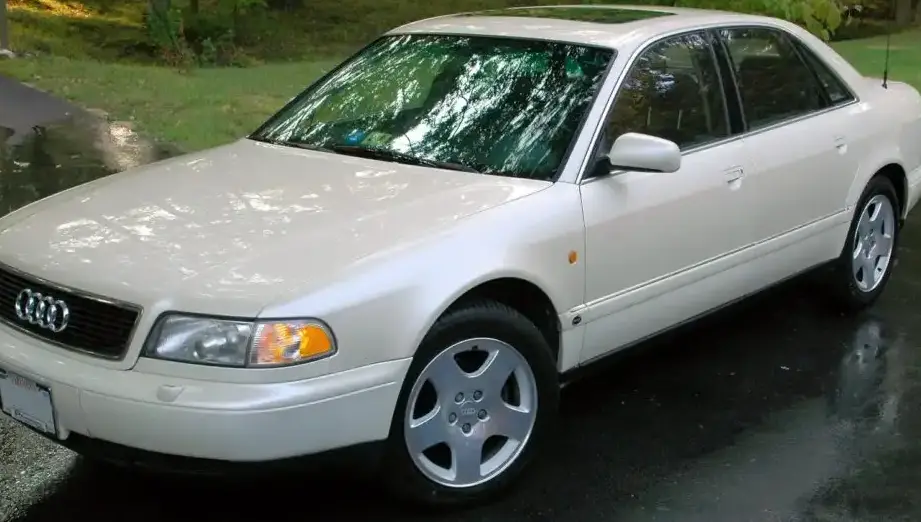
The Audi A8 (D2) 4.2 V8 32V quattro tiptronic, produced between 1994 and 1998, represented a significant step forward for Audi, establishing the brand firmly in the luxury sedan segment. Part of the first generation A8 series (chassis code 4D), this variant was positioned as the flagship model, offering a blend of performance, technology, and refinement. It was built on the Volkswagen Group’s D2 platform, also underpinning the first generation Volkswagen Phaeton. The 4.2 V8 model distinguished itself from the smaller engined A8s, offering a more powerful and sophisticated driving experience aimed at discerning buyers.
Technical Specifications
| Brand | Audi |
| Model | A8 |
| Generation | A8 (D2, 4D) |
| Type (Engine) | 4.2 V8 32V (300 Hp) quattro tiptronic |
| Start of production | 1994 |
| End of production | 1998 |
| Powertrain Architecture | Internal Combustion engine |
| Body type | Sedan |
| Seats | 5 |
| Doors | 4 |
| Fuel consumption (economy) – urban (NEDC) | 19.4 l/100 km (12.1 US mpg, 14.6 UK mpg, 5.2 km/l) |
| Fuel consumption (economy) – extra urban (NEDC) | 9.7 l/100 km (24.2 US mpg, 29.1 UK mpg, 10.3 km/l) |
| Fuel consumption (economy) – combined (NEDC) | 13.4 l/100 km (17.6 US mpg, 21.1 UK mpg, 7.5 km/l) |
| CO2 emissions (NEDC) | 317 g/km |
| Fuel Type | Petrol (Gasoline) |
| Acceleration 0 – 100 km/h | 7.3 sec |
| Acceleration 0 – 62 mph | 7.3 sec |
| Acceleration 0 – 60 mph | 6.9 sec |
| Maximum speed | 250 km/h (155.34 mph), Electronically limited |
| Emission standard | Euro 2 |
| Weight-to-power ratio | 5.8 kg/Hp, 171.4 Hp/tonne |
| Weight-to-torque ratio | 4.4 kg/Nm, 228.6 Nm/tonne |
| Power | 300 Hp @ 6000 rpm |
| Power per litre | 71.9 Hp/l |
| Torque | 400 Nm @ 3300 rpm (295.02 lb.-ft. @ 3300 rpm) |
| Engine layout | Front, Longitudinal |
| Engine Model/Code | ABZ, AKG |
| Engine displacement | 4172 cm3 (254.59 cu. in.) |
| Number of cylinders | 8 |
| Engine configuration | V-engine |
| Cylinder Bore | 84.5 mm (3.33 in.) |
| Piston Stroke | 93 mm (3.66 in.) |
| Compression ratio | 10.8:1 |
| Number of valves per cylinder | 4 |
| Fuel injection system | Multi-port manifold injection |
| Engine aspiration | Naturally aspirated engine |
| Valvetrain | DOHC |
| Engine oil capacity | 7.5 l (7.93 US qt | 6.6 UK qt) |
| Coolant | 11 l (11.62 US qt | 9.68 UK qt) |
| Kerb Weight | 1750 kg (3858.09 lbs.) |
| Max. weight | 2350 kg (5180.86 lbs.) |
| Max load | 600 kg (1322.77 lbs.) |
| Trunk (boot) space – minimum | 525 l (18.54 cu. ft.) |
| Fuel tank capacity | 90 l (23.78 US gal | 19.8 UK gal) |
| Max. roof load | 100 kg (220.46 lbs.) |
| Permitted trailer load with brakes (8%) | 2150 kg (4739.94 lbs.) |
| Permitted trailer load with brakes (12%) | 1950 kg (4299.01 lbs.) |
| Permitted trailer load without brakes | 750 kg (1653.47 lbs.) |
| Permitted towbar download | 75 kg (165.35 lbs.) |
| Length | 5034 mm (198.19 in.) |
| Width | 1880 mm (74.02 in.) |
| Width including mirrors | 1973 mm (77.68 in.) |
| Height | 1440 mm (56.69 in.) |
| Wheelbase | 2882 mm (113.46 in.) |
| Front track | 1591 mm (62.64 in.) |
| Rear (Back) track | 1580 mm (62.2 in.) |
| Ride height (ground clearance) | 146 mm (5.75 in.) |
| Drag coefficient (Cd) | 0.30 |
| Minimum turning circle (turning diameter) | 12.3 m (40.35 ft.) |
| Drivetrain Architecture | The Internal combustion engine (ICE) drives permanently the four wheels of the vehicle. |
| Drive wheel | All wheel drive (4×4) |
| Number of gears and type of gearbox | 4 gears, automatic transmission tiptronic |
| Front suspension | Independent multi-link suspension, Transverse stabilizer |
| Rear suspension | Independent on trapezoidal lever, Transverse stabilizer |
| Front brakes | Ventilated discs |
| Rear brakes | Ventilated discs |
| Assisting systems | ABS (Anti-lock braking system) |
| Steering type | Steering rack and pinion |
| Power steering | Hydraulic Steering |
| Tires size | 225/60 R16 |
| Wheel rims size | 7.5J x 16 |
INTRODUCTION
The Audi A8 D2 4.2 V8 quattro tiptronic, launched in 1994, was a landmark vehicle for Audi. It was the first full-size luxury car produced by the brand and showcased a number of innovative technologies. The D2 A8 represented a departure from Audi’s more conservative designs, adopting a sleek, rounded aesthetic. The 4.2 V8 model, equipped with Audi’s quattro all-wheel drive system and a five-speed tiptronic automatic transmission, was the range-topping variant, offering a compelling combination of performance and luxury. It aimed to compete directly with established players like the BMW 7 Series and Mercedes-Benz S-Class.
Powertrain & Engine Architecture
At the heart of the A8 4.2 V8 was the ABZ (and later AKG) engine code, a 4.2-liter naturally aspirated V8 engine. This engine produced 300 horsepower at 6000 rpm and 400 Nm (295 lb-ft) of torque at 3300 rpm. The engine featured a 90-degree V-angle, providing inherent smoothness. It utilized multi-port fuel injection and a double overhead camshaft (DOHC) valvetrain with four valves per cylinder. The tiptronic transmission, a four-speed automatic with a manual shift mode, was a key feature. This transmission allowed drivers to select gears manually for more spirited driving, while still offering the convenience of automatic operation. The quattro all-wheel drive system employed a Torsen differential, providing a variable distribution of torque between the front and rear axles for optimal traction.
Driving Characteristics
The A8 4.2 V8 tiptronic offered a refined and capable driving experience. While not overtly sporty, the engine provided ample power for effortless cruising and confident overtaking. The 0-60 mph acceleration time of around 6.9 seconds was respectable for the era. The tiptronic transmission, while smooth, wasn’t as quick-shifting as some later automatic transmissions. The quattro all-wheel drive system provided excellent grip in all weather conditions, enhancing stability and confidence. The suspension, tuned for comfort, absorbed bumps and imperfections in the road effectively, providing a smooth ride. Compared to the smaller engined A8 variants, the 4.2 V8 offered a significantly more powerful and responsive driving experience, but at the cost of increased fuel consumption.
Equipment & Trim Levels
The A8 4.2 V8 quattro tiptronic came generously equipped as standard. Features included leather upholstery, power-adjustable front seats with memory function, automatic climate control, a premium sound system, and a sunroof. Wood trim adorned the interior, adding to the luxurious ambiance. Optional extras included rear seat entertainment, upgraded leather packages, and a navigation system. The A8 was designed to offer a high level of customization, allowing buyers to tailor the car to their specific preferences.
Chassis & Braking
The A8 D2 featured an independent suspension system on all four wheels. The front suspension utilized a multi-link design, while the rear employed a trapezoidal link setup. Both ends were equipped with a transverse stabilizer bar to reduce body roll. Braking duties were handled by ventilated disc brakes on all four wheels, providing ample stopping power. An Anti-lock Braking System (ABS) was standard, enhancing safety and control. The chassis was designed to be rigid, contributing to the car’s stability and handling.
Market Reception & Comparison
The A8 4.2 V8 was generally well-received by automotive critics. It was praised for its luxurious interior, comfortable ride, and powerful engine. However, some critics noted that the tiptronic transmission could feel slightly sluggish at times. Compared to the 2.8L and 3.0L A8 variants, the 4.2 V8 offered significantly more performance, but also came with a higher price tag and increased running costs. Fuel economy was considerably lower than the smaller engined models, averaging around 17.6 US mpg combined. Reliability was generally good, although the complex electronics of the A8 could occasionally present issues.
Legacy
The Audi A8 D2 4.2 V8 quattro tiptronic remains a desirable classic car today. The ABZ/AKG engine is known for its durability, although regular maintenance is essential. The tiptronic transmission, while reliable, can be expensive to repair if issues arise. The A8 D2 established Audi as a serious contender in the luxury car market and paved the way for future generations of the A8. Well-maintained examples are increasingly sought after by collectors and enthusiasts, representing a piece of Audi’s engineering heritage. The car’s innovative features and luxurious appointments continue to impress, even by modern standards.
