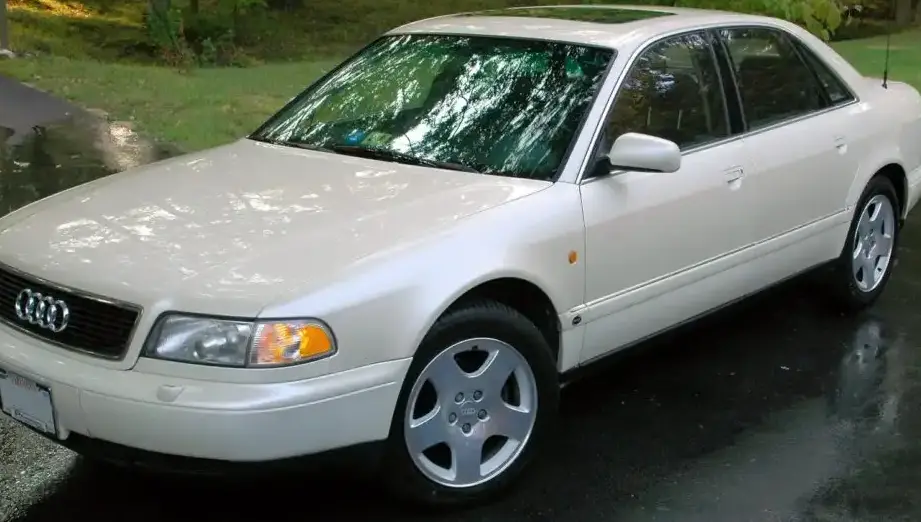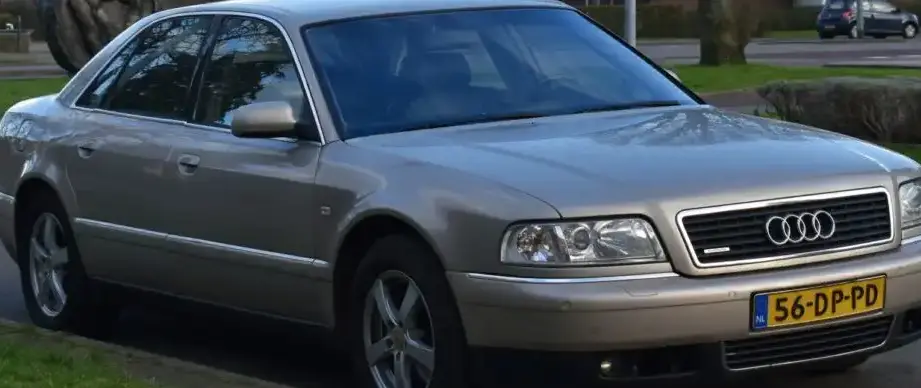
The Audi A8 (D2) facelift, produced from 1998 to 2002, represented a significant evolution of Audi’s flagship luxury sedan. The 2.8 V6 30V variant, powered by the ALG and AQD engine codes, occupied a middle ground in the A8 lineup, offering a balance between performance and affordability. Positioned below the more powerful 4.2 V8 models, it aimed to attract buyers seeking a refined luxury experience without the higher price tag and running costs associated with the larger engine. This generation of the A8, internally designated the 4D, built upon the success of the original D2 platform (1HX0) introduced in 1994, incorporating styling updates and technological enhancements.
Technical Specifications
| Brand | Audi |
| Model | A8 |
| Generation | A8 (D2, 4D, facelift 1998) |
| Type (Engine) | 2.8 V6 30V (193 Hp) |
| Start of production | 1998 |
| End of production | 2002 |
| Powertrain Architecture | Internal Combustion engine |
| Body type | Sedan |
| Seats | 5 |
| Doors | 4 |
| Fuel consumption (economy) – urban (NEDC) | 14.2 l/100 km (16.6 US mpg, 19.9 UK mpg, 7 km/l) |
| Fuel consumption (economy) – extra urban (NEDC) | 7.4 l/100 km (31.8 US mpg, 38.2 UK mpg, 13.5 km/l) |
| Fuel consumption (economy) – combined (NEDC) | 9.9 l/100 km (23.8 US mpg, 28.5 UK mpg, 10.1 km/l) |
| CO2 emissions (NEDC) | 238 g/km |
| Fuel Type | Petrol (Gasoline) |
| Acceleration 0 – 100 km/h | 8.4 sec |
| Acceleration 0 – 62 mph | 8.4 sec |
| Acceleration 0 – 60 mph | 8 sec |
| Maximum speed | 236 km/h (146.64 mph) |
| Emission standard | Euro 3 |
| Weight-to-power ratio | 8 kg/Hp, 125.3 Hp/tonne |
| Weight-to-torque ratio | 5.5 kg/Nm, 181.8 Nm/tonne |
| Power | 193 Hp @ 6000 rpm |
| Power per litre | 69.6 Hp/l |
| Torque | 280 Nm @ 3200 rpm (206.52 lb.-ft. @ 3200 rpm) |
| Engine layout | Front, Longitudinal |
| Engine Model/Code | ALG, AQD |
| Engine displacement | 2771 cm3 (169.1 cu. in.) |
| Number of cylinders | 6 |
| Engine configuration | V-engine |
| Cylinder Bore | 82.5 mm (3.25 in.) |
| Piston Stroke | 86.4 mm (3.4 in.) |
| Compression ratio | 10.6:1 |
| Number of valves per cylinder | 5 |
| Fuel injection system | Multi-port manifold injection |
| Engine aspiration | Naturally aspirated engine |
| Valvetrain | DOHC |
| Engine oil capacity | 5 l (5.28 US qt | 4.4 UK qt) |
| Coolant | 11 l (11.62 US qt | 9.68 UK qt) |
| Kerb Weight | 1540 kg (3395.12 lbs.) |
| Max. weight | 2140 kg (4717.89 lbs.) |
| Max load | 600 kg (1322.77 lbs.) |
| Trunk (boot) space – minimum | 525 l (18.54 cu. ft.) |
| Fuel tank capacity | 80 l (21.13 US gal | 17.6 UK gal) |
| Max. roof load | 100 kg (220.46 lbs.) |
| Permitted trailer load with brakes (8%) | 1900 kg (4188.78 lbs.) |
| Permitted trailer load with brakes (12%) | 1600 kg (3527.4 lbs.) |
| Permitted trailer load without brakes | 750 kg (1653.47 lbs.) |
| Permitted towbar download | 95 kg (209.44 lbs.) |
| Length | 5034 mm (198.19 in.) |
| Width | 1880 mm (74.02 in.) |
| Width including mirrors | 1973 mm (77.68 in.) |
| Height | 1438 mm (56.61 in.) |
| Wheelbase | 2880 mm (113.39 in.) |
| Front track | 1597 mm (62.87 in.) |
| Rear (Back) track | 1586 mm (62.44 in.) |
| Front overhang | 1018 mm (40.08 in.) |
| Rear overhang | 1136 mm (44.72 in.) |
| Drag coefficient (Cd) | 0.30 |
| Minimum turning circle (turning diameter) | 12.3 m (40.35 ft.) |
| Drivetrain Architecture | The Internal combustion engine (ICE) drives the front wheels of the vehicle. |
| Drive wheel | Front wheel drive |
| Number of gears and type of gearbox | 5 gears, manual transmission |
| Front suspension | Independent multi-link suspension, Transverse stabilizer |
| Rear suspension | Independent on trapezoidal lever, Transverse stabilizer |
| Front brakes | Ventilated discs |
| Rear brakes | Ventilated discs |
| Assisting systems | ABS (Anti-lock braking system) |
| Steering type | Steering rack and pinion |
| Power steering | Hydraulic Steering |
| Tires size | 225/60 R16 |
| Wheel rims size | 7J x 16 |
Powertrain & Engine Architecture
The heart of the A8 2.8 was the 2.8-liter V6 engine, available with either the ALG or AQD engine codes. Both were closely related, with minor differences in calibration. This engine featured a 90-degree V-angle, contributing to a smooth and balanced operation. The engine utilized a naturally aspirated, multi-port fuel injection system, delivering fuel directly into the intake ports. The cylinder head featured dual overhead camshafts (DOHC) and five valves per cylinder (three intake, two exhaust), optimizing airflow for improved performance. The 2.8L V6 produced 193 horsepower at 6000 rpm and 280 Nm (206.52 lb-ft) of torque at 3200 rpm. The engine was longitudinally mounted, driving the front wheels through a five-speed manual transmission. While an automatic transmission was available, the manual was favored by enthusiasts for its more engaging driving experience.
Driving Characteristics
The 2.8 V6 A8 offered a comfortable and refined driving experience, prioritizing smoothness over outright performance. Acceleration from 0 to 60 mph took approximately 8 seconds, making it competitive with other luxury sedans of the era. The five-speed manual transmission allowed for precise control, but the relatively low torque output meant that frequent downshifts were necessary for spirited driving. Compared to the 4.2 V8 models, the 2.8 felt less powerful, particularly during overtaking maneuvers. However, the lighter weight of the 2.8 contributed to improved handling and fuel economy. The front-wheel-drive configuration provided good traction in most conditions, but could exhibit torque steer under hard acceleration.
Equipment & Trim Levels
The A8 2.8 came standard with a generous array of features, befitting its luxury status. These included leather upholstery, power-adjustable front seats, automatic climate control, a premium sound system, and alloy wheels. Optional extras included a sunroof, navigation system, heated seats, and upgraded leather trim. The interior design was characterized by its understated elegance and high-quality materials. The dashboard layout was clean and functional, with intuitive controls. Trim levels were relatively limited, with most variations stemming from the addition of optional packages.
Chassis & Braking
The A8 2.8 featured an independent suspension system at all four wheels, providing a comfortable ride and good handling. The front suspension utilized a multi-link design, while the rear suspension employed a trapezoidal lever setup. Both ends were equipped with a transverse stabilizer bar to reduce body roll. Braking duties were handled by ventilated disc brakes on all four wheels, assisted by an Anti-lock Braking System (ABS). The braking system provided ample stopping power, but could feel slightly soft under heavy use.
Market Reception & Comparison
The A8 2.8 was generally well-received by automotive critics, who praised its comfortable ride, refined interior, and generous standard features. However, some critics noted that the engine lacked the power and prestige of the larger V8 models. Compared to its rivals, such as the BMW 7 Series and Mercedes-Benz S-Class, the A8 2.8 offered a compelling value proposition, providing a similar level of luxury and technology at a lower price point. Fuel economy was respectable for a vehicle of its size and class, averaging around 24 mpg in combined driving.
Legacy
The Audi A8 (D2) 2.8 V6 remains a popular choice among enthusiasts and collectors. The ALG and AQD engines are known for their reliability, provided they are properly maintained. Common issues include oil leaks and sensor failures, but these are generally straightforward to address. Today, well-maintained examples of the A8 2.8 can be found on the used car market at relatively affordable prices, making them an attractive option for those seeking a classic luxury sedan with modern features. The D2 A8 established Audi as a serious contender in the luxury car segment, paving the way for the brand’s continued success in the years to come.