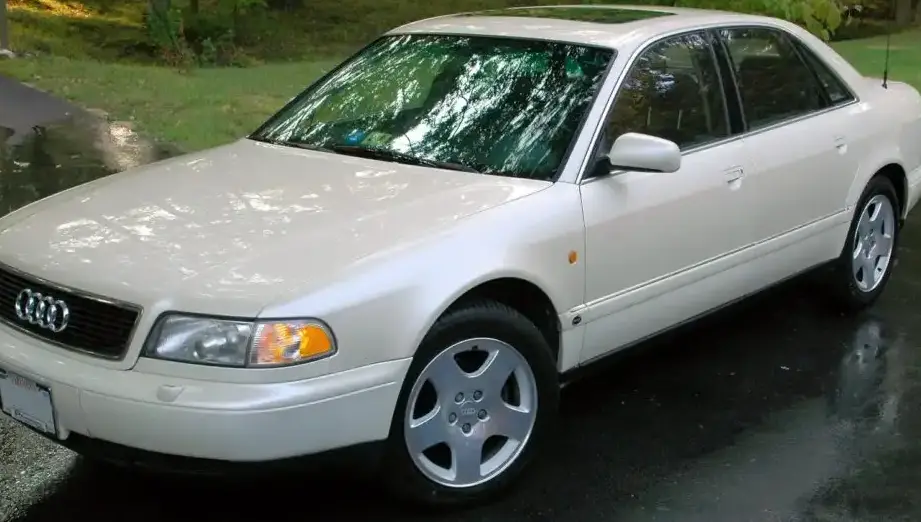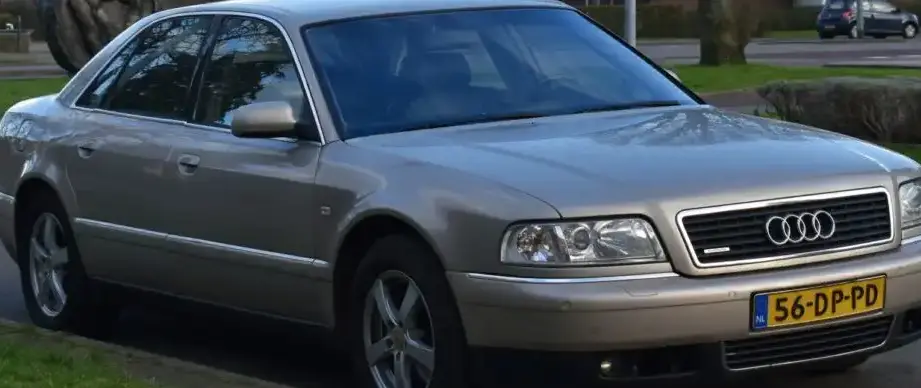
The Audi A8 (D2) 2.8 V6 30V tiptronic, produced from 1998 to 2002, represents a significant iteration of Audi’s flagship luxury sedan. This variant, part of the facelifted D2 generation (internally designated 4D), aimed to offer a balance between performance and accessibility within the A8 range. Positioned as a mid-range offering, it slotted between the entry-level 2.8 V6 with a manual transmission and the more potent 4.2 V8 models. The D2 A8 was Audi’s first full-size luxury car with front-wheel drive or quattro permanent all-wheel drive, and it introduced several innovative technologies for its time, including an aluminum space frame construction on some models.
Technical Specifications
| Brand | Audi |
| Model | A8 |
| Generation | A8 (D2, 4D, facelift 1998) |
| Type (Engine) | 2.8 V6 30V (193 Hp) tiptronic |
| Start of production | 1998 |
| End of production | 2002 |
| Powertrain Architecture | Internal Combustion engine |
| Body type | Sedan |
| Seats | 5 |
| Doors | 4 |
| Fuel consumption (urban) | 16.2 l/100 km (14.5 US mpg, 17.4 UK mpg, 6.2 km/l) |
| Fuel consumption (extra urban) | 7.5 l/100 km (31.4 US mpg, 37.7 UK mpg, 13.3 km/l) |
| Fuel consumption (combined) | 10.7 l/100 km (22 US mpg, 26.4 UK mpg, 9.3 km/l) |
| CO2 emissions | 257 g/km |
| Fuel Type | Petrol (Gasoline) |
| Acceleration 0 – 100 km/h | 9.9 sec |
| Acceleration 0 – 62 mph | 9.9 sec |
| Acceleration 0 – 60 mph | 9.4 sec |
| Maximum speed | 233 km/h (144.78 mph) |
| Emission standard | Euro 3 |
| Weight-to-power ratio | 8.3 kg/Hp, 120.6 Hp/tonne |
| Weight-to-torque ratio | 5.7 kg/Nm, 175 Nm/tonne |
| Power | 193 Hp @ 6000 rpm |
| Power per litre | 69.6 Hp/l |
| Torque | 280 Nm @ 3200 rpm (206.52 lb.-ft. @ 3200 rpm) |
| Engine layout | Front, Longitudinal |
| Engine Model/Code | ALG, AQD |
| Engine displacement | 2771 cm3 (169.1 cu. in.) |
| Number of cylinders | 6 |
| Engine configuration | V-engine |
| Cylinder Bore | 82.5 mm (3.25 in.) |
| Piston Stroke | 86.4 mm (3.4 in.) |
| Compression ratio | 10.6:1 |
| Number of valves per cylinder | 5 |
| Fuel injection system | Multi-port manifold injection |
| Engine aspiration | Naturally aspirated engine |
| Valvetrain | DOHC |
| Engine oil capacity | 5 l (5.28 US qt | 4.4 UK qt) |
| Coolant capacity | 11 l (11.62 US qt | 9.68 UK qt) |
| Kerb Weight | 1600 kg (3527.4 lbs.) |
| Max. weight | 2200 kg (4850.17 lbs.) |
| Max load | 600 kg (1322.77 lbs.) |
| Trunk (boot) space (minimum) | 525 l (18.54 cu. ft.) |
| Fuel tank capacity | 80 l (21.13 US gal | 17.6 UK gal) |
| Max. roof load | 100 kg (220.46 lbs.) |
| Permitted trailer load (brakes 8%) | 2100 kg (4629.71 lbs.) |
| Permitted trailer load (brakes 12%) | 1900 kg (4188.78 lbs.) |
| Permitted trailer load (no brakes) | 750 kg (1653.47 lbs.) |
| Permitted towbar download | 95 kg (209.44 lbs.) |
| Length | 5034 mm (198.19 in.) |
| Width | 1880 mm (74.02 in.) |
| Width including mirrors | 1973 mm (77.68 in.) |
| Height | 1438 mm (56.61 in.) |
| Wheelbase | 2880 mm (113.39 in.) |
| Front track | 1597 mm (62.87 in.) |
| Rear track | 1586 mm (62.44 in.) |
| Front overhang | 1018 mm (40.08 in.) |
| Rear overhang | 1136 mm (44.72 in.) |
| Drag coefficient (Cd) | 0.30 |
| Minimum turning circle | 12.3 m (40.35 ft.) |
| Drivetrain Architecture | ICE, Front wheel drive |
| Number of gears | 5 |
| Gearbox type | Automatic transmission tiptronic |
| Front suspension | Independent multi-link suspension, Transverse stabilizer |
| Rear suspension | Independent on trapezoidal lever, Transverse stabilizer |
| Front brakes | Ventilated discs |
| Rear brakes | Ventilated discs |
| Assisting systems | ABS (Anti-lock braking system) |
| Steering type | Steering rack and pinion |
| Power steering | Hydraulic Steering |
| Tires size | 225/60 R16 |
| Wheel rims size | 7J x 16 |
Powertrain & Engine Architecture
The 2.8 V6 engine, utilizing either the ALG or AQD engine code depending on the specific production year and market, is a naturally aspirated, 2.8-liter (2771 cc) V6. It features a 90-degree V-angle and employs a dual overhead camshaft (DOHC) valvetrain with five valves per cylinder (three intake, two exhaust). This 30V configuration was a hallmark of Audi’s engine technology at the time. Fuel delivery is managed by a multi-port fuel injection system. The engine produces 193 horsepower at 6000 rpm and 280 Nm (206.52 lb-ft) of torque at 3200 rpm. The engine is longitudinally mounted in the front of the vehicle. Paired with this engine is a 5-speed tiptronic automatic transmission. This transmission allows for both fully automatic operation and driver-selectable gear changes, offering a degree of control not found in traditional automatics.
Driving Characteristics
The 2.8 V6 tiptronic A8 offered a comfortable and refined driving experience, prioritizing smoothness and ease of use over outright performance. Acceleration from 0-60 mph took approximately 9.4 seconds, and top speed was limited to 144.78 mph. While not as quick as the 4.2 V8 models, the 2.8L provided adequate power for everyday driving and highway cruising. The tiptronic transmission, while offering manual shift capability, wasn’t particularly sporty in its operation. Gear changes were generally smooth but could feel somewhat hesitant during aggressive driving. The front-wheel-drive configuration, standard on this variant, contributed to a noticeable difference in handling compared to the quattro all-wheel-drive models, with a tendency towards understeer when pushed hard.
Equipment & Trim Levels
The 2.8 V6 tiptronic A8 came standard with a comprehensive list of features expected of a luxury sedan. These included leather upholstery, power-adjustable front seats with memory function, automatic climate control, a premium sound system, and alloy wheels. Optional extras included a sunroof, navigation system, upgraded leather packages, and rear seat entertainment. The interior trim was typically finished in wood or aluminum accents, offering a sophisticated ambiance.
Chassis & Braking
The D2 A8 featured an independent suspension system on all four wheels, utilizing a multi-link setup at the front and a trapezoidal lever arrangement at the rear. This provided a comfortable ride and good handling characteristics. Stabilizer bars were fitted to both axles to reduce body roll. Braking duties were handled by ventilated disc brakes on all four wheels, assisted by an Anti-lock Braking System (ABS). The suspension was tuned for comfort, prioritizing a smooth ride over sporty handling.
Market Reception & Comparison
The 2.8 V6 tiptronic A8 was generally well-received by automotive critics as a comfortable and well-equipped luxury sedan. However, it was often criticized for its lack of sporting character compared to its V8 siblings and competitors like the BMW 7 Series and Mercedes-Benz S-Class. Fuel economy was considered average for its class, with combined consumption around 22 US mpg. Reliability was generally good, although the tiptronic transmission could be prone to issues if not properly maintained. Compared to the manual transmission 2.8 V6, the tiptronic version offered greater convenience but at the expense of some fuel efficiency and performance.
Legacy
The Audi A8 (D2) 2.8 V6 tiptronic remains a sought-after classic among Audi enthusiasts. While not the most powerful or sporty variant, its combination of comfort, features, and relative affordability has made it a popular choice in the used car market. The ALG and AQD engines are generally considered reliable, but regular maintenance is crucial to prevent issues. The tiptronic transmission requires careful servicing to ensure smooth operation. Today, well-maintained examples of this A8 represent a piece of Audi’s engineering heritage and offer a luxurious and comfortable driving experience.