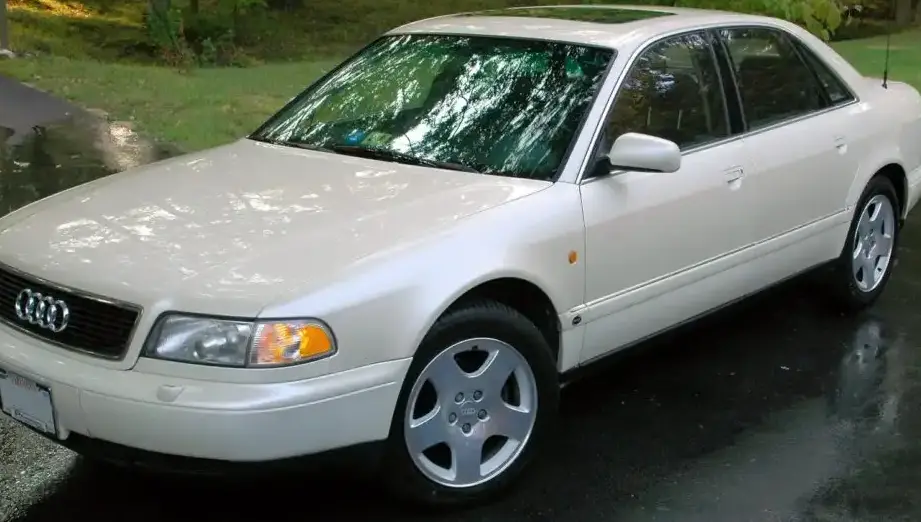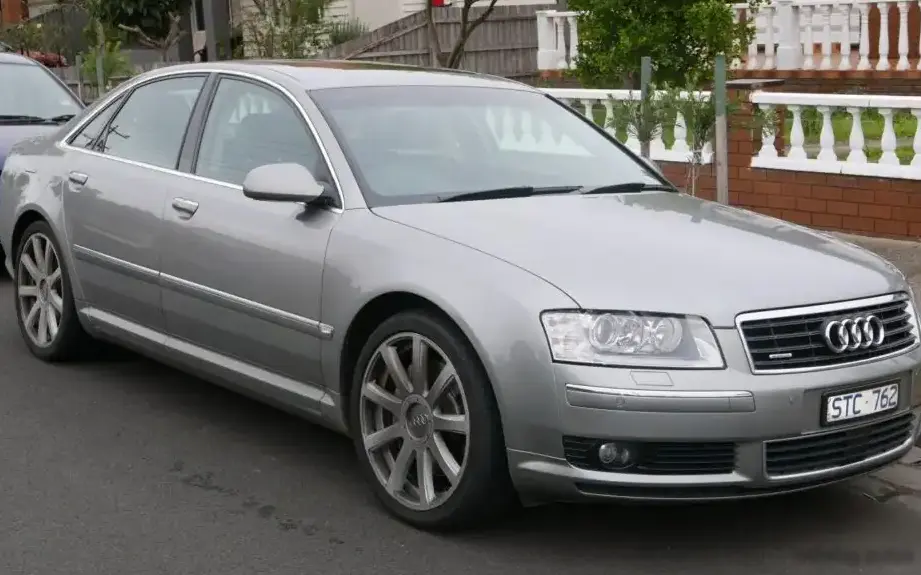
The Audi A8 (D3, 4E) 3.0i V6 with the Multitronic transmission represents a significant iteration of Audi’s flagship sedan, produced between July 2003 and May 2005. This variant occupied a middle ground within the D3 A8 range, offering a balance between performance and fuel efficiency. It was positioned as a more accessible entry point into the A8 lineup compared to the higher-performance 4.2-liter V8 models, while still providing the luxury and technology expected of a full-size Audi. The D3 generation A8, launched in 1994 and receiving a major facelift in 2003, was notable for its all-aluminum space frame construction – a pioneering feature at the time – and its advanced technology, including the Multitronic continuously variable transmission.
Technical Specifications
| Brand | Audi |
| Model | A8 |
| Generation | A8 (D3, 4E) |
| Type (Engine) | 3.0i V6 (220 Hp) Multitronic |
| Start of production | July, 2003 |
| End of production | May, 2005 |
| Powertrain Architecture | Internal Combustion engine |
| Body type | Sedan |
| Seats | 5 |
| Doors | 4 |
| Fuel consumption (urban) | 13.7 l/100 km (17.2 US mpg, 20.6 UK mpg, 7.3 km/l) |
| Fuel consumption (extra urban) | 7.2 l/100 km (32.7 US mpg, 39.2 UK mpg, 13.9 km/l) |
| Fuel consumption (combined) | 9.6 l/100 km (24.5 US mpg, 29.4 UK mpg, 10.4 km/l) |
| CO2 emissions | 230 g/km |
| Fuel Type | Petrol (Gasoline) |
| Acceleration 0 – 100 km/h | 7.9 sec |
| Acceleration 0 – 62 mph | 7.9 sec |
| Acceleration 0 – 60 mph | 7.5 sec |
| Maximum speed | 242 km/h (150.37 mph) |
| Emission standard | Euro 4 |
| Weight-to-power ratio | 7.6 kg/Hp, 131.7 Hp/tonne |
| Weight-to-torque ratio | 5.6 kg/Nm, 179.6 Nm/tonne |
| Power | 220 Hp @ 6300 rpm |
| Power per litre | 73.9 Hp/l |
| Torque | 300 Nm @ 3200 rpm (221.27 lb.-ft. @ 3200 rpm) |
| Engine layout | Front, Longitudinal |
| Engine Model/Code | ASN |
| Engine displacement | 2976 cm3 (181.61 cu. in.) |
| Number of cylinders | 6 |
| Engine configuration | V-engine |
| Cylinder Bore | 82.5 mm (3.25 in.) |
| Piston Stroke | 92.8 mm (3.65 in.) |
| Compression ratio | 10.5:1 |
| Number of valves per cylinder | 5 |
| Fuel injection system | Multi-port manifold injection |
| Engine aspiration | Naturally aspirated engine |
| Valvetrain | DOHC |
| Engine oil capacity | 6.3 l (6.66 US qt | 5.54 UK qt) |
| Coolant | 12.6 l (13.31 US qt | 11.09 UK qt) |
| Kerb Weight | 1670 kg (3681.72 lbs.) |
| Max. weight | 2270 kg (5004.49 lbs.) |
| Max load | 600 kg (1322.77 lbs.) |
| Trunk (boot) space – minimum | 500 l (17.66 cu. ft.) |
| Fuel tank capacity | 90 l (23.78 US gal | 19.8 UK gal) |
| Max. roof load | 100 kg (220.46 lbs.) |
| Permitted trailer load with brakes (8%) | 2100 kg (4629.71 lbs.) |
| Permitted trailer load with brakes (12%) | 1900 kg (4188.78 lbs.) |
| Permitted trailer load without brakes | 750 kg (1653.47 lbs.) |
| Permitted towbar download | 95 kg (209.44 lbs.) |
| Length | 5051 mm (198.86 in.) |
| Width | 1894 mm (74.57 in.) |
| Height | 1444 mm (56.85 in.) |
| Wheelbase | 2944 mm (115.91 in.) |
| Front track | 1629 mm (64.13 in.) |
| Rear (Back) track | 1615 mm (63.58 in.) |
| Drag coefficient (Cd) | 0.27 |
| Minimum turning circle (turning diameter) | 12.1 m (39.7 ft.) |
| Drivetrain Architecture | The Internal combustion engine (ICE) drives the front wheels of the vehicle. |
| Drive wheel | Front wheel drive |
| Number of gears and type of gearbox | automatic transmission Multitronic |
| Front suspension | Independent multi-link suspension |
| Rear suspension | Independent on trapezoidal lever |
| Front brakes | Ventilated discs |
| Rear brakes | Ventilated discs |
| Assisting systems | ABS (Anti-lock braking system) |
| Steering type | Steering rack and pinion |
| Power steering | Hydraulic Steering |
| Tires size | 235/60 R16 |
| Wheel rims size | 7.5J x 16 |
Powertrain & Engine Architecture
The 3.0i variant of the D3 A8 is powered by the ASN engine, a 2.976-liter naturally aspirated V6. This engine utilizes a cast iron block with an aluminum cylinder head, featuring five valves per cylinder (three intake, two exhaust) and double overhead camshafts (DOHC). Fuel delivery is managed by a multi-port fuel injection system. The ASN engine produces 220 horsepower at 6300 rpm and 300 Nm (221 lb-ft) of torque at 3200 rpm. A key feature of this variant is the Multitronic transmission, a continuously variable transmission (CVT) that offered smooth, stepless gear changes. Unlike traditional automatic transmissions with fixed gear ratios, the Multitronic uses a chain-driven system to provide an infinite number of ratios within its operating range. This design aimed to optimize engine efficiency and provide a more refined driving experience.
Driving Characteristics
The 3.0i Multitronic A8 offered a comfortable and refined driving experience, prioritizing smoothness over outright performance. Acceleration from 0 to 60 mph took approximately 7.5 seconds, and top speed was limited to 150 mph. The Multitronic transmission contributed to a seamless power delivery, eliminating the noticeable shifts associated with conventional automatics. However, some drivers found the transmission to be less engaging than a traditional automatic or manual gearbox, lacking the distinct gear changes. The engine, while adequate for everyday driving, wasn’t particularly powerful, and overtaking maneuvers required careful planning. Compared to the 4.2-liter V8 models, the 3.0i felt noticeably slower, but it offered significantly better fuel economy.
Equipment & Trim Levels
The 3.0i A8 typically came standard with a generous array of features, including leather upholstery, power-adjustable front seats with memory function, dual-zone automatic climate control, a premium sound system, and xenon headlights. Optional extras included a navigation system, rear seat entertainment, adaptive cruise control, and a sunroof. Trim levels were relatively limited, with most variations stemming from the selection of optional packages. The interior design was characterized by high-quality materials and a minimalist aesthetic, reflecting Audi’s commitment to understated luxury.
Chassis & Braking
The D3 A8’s all-aluminum space frame provided a lightweight and rigid chassis, contributing to its handling and safety. The 3.0i variant featured independent multi-link suspension at the front and an independent trapezoidal lever suspension at the rear, offering a comfortable ride and good handling characteristics. Braking duties were handled by ventilated disc brakes on all four wheels, assisted by ABS (Anti-lock Braking System). The suspension was tuned for comfort, prioritizing a smooth ride over sporty handling. Stabilizer bars were fitted front and rear to reduce body roll during cornering.
Market Reception & Comparison
The Audi A8 3.0i Multitronic was generally well-received by automotive critics, who praised its comfortable ride, refined interior, and advanced technology. However, some reviewers criticized its lack of outright performance and the somewhat detached feel of the Multitronic transmission. Compared to its rivals, such as the BMW 7 Series and Mercedes-Benz S-Class, the A8 offered a unique blend of technology and luxury. Fuel economy was a strong point, with the 3.0i achieving around 24.5 mpg in combined driving, making it more economical than the larger-engined competitors. Reliability was generally good, although the Multitronic transmission required regular maintenance and could be prone to issues if neglected.
Legacy
The Audi A8 (D3, 4E) 3.0i V6 Multitronic remains a desirable used car, particularly for those seeking a comfortable and technologically advanced luxury sedan. The ASN engine is generally considered reliable, although regular maintenance is essential. The Multitronic transmission, while innovative, requires careful attention and fluid changes to prevent premature failure. Today, these vehicles can be found at reasonable prices, offering a compelling value proposition for buyers willing to accept the potential maintenance costs associated with a complex, technologically advanced vehicle. The D3 A8’s pioneering all-aluminum construction and advanced features cemented its place as a significant milestone in automotive engineering.