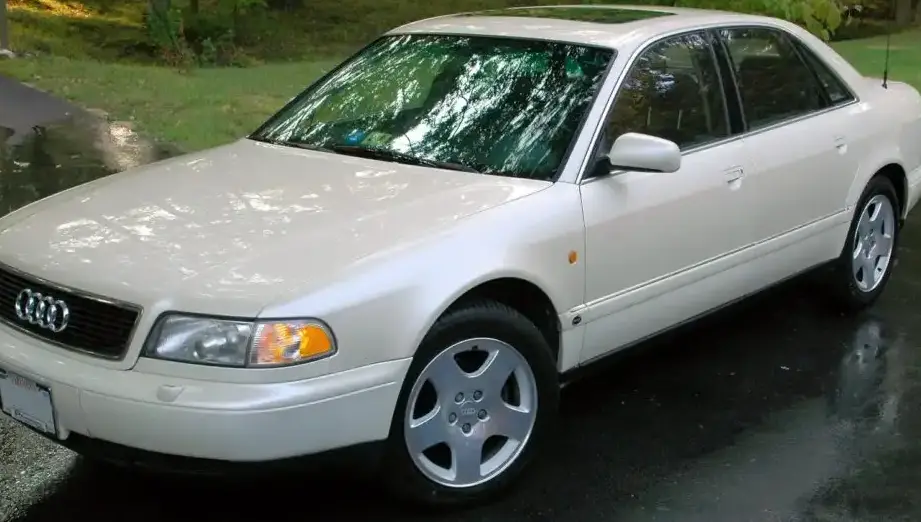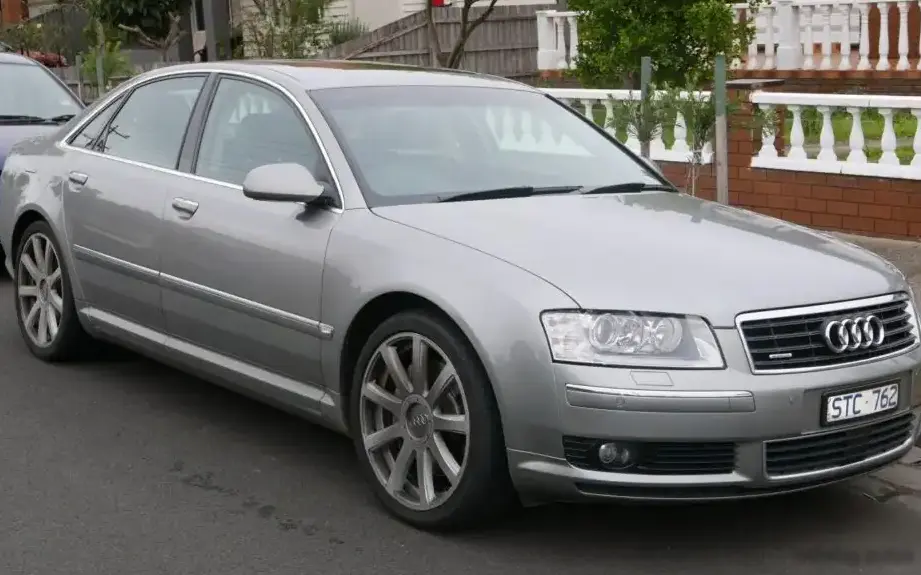
The Audi A8 (D3, 4E) 4.0 TDI V8 32V (275 Hp) quattro Tiptronic represents a significant iteration of Audi’s flagship luxury sedan, produced between May 2003 and July 2005. This variant occupied a premium position within the D3/4E A8 range, offering a potent diesel engine paired with Audi’s sophisticated Tiptronic automatic transmission and quattro all-wheel drive. It was primarily aimed at the European market, where diesel engines were – and continue to be – highly favored for their fuel efficiency and torque characteristics in long-distance grand touring vehicles. The D3 generation A8, launched in 1994 and receiving a substantial facelift in 2003 (designated 4E), aimed to blend cutting-edge technology with traditional luxury, and the 4.0 TDI exemplified this ambition.
Technical Specifications
| Brand | Audi |
| Model | A8 |
| Generation | A8 (D3, 4E) |
| Type (Engine) | 4.0 TDI V8 32V (275 Hp) quattro Tiptronic |
| Start of production | May, 2003 |
| End of production | July, 2005 |
| Powertrain Architecture | Internal Combustion engine |
| Body type | Sedan |
| Seats | 5 |
| Doors | 4 |
| Fuel consumption (urban) | 13.4 l/100 km (17.6 US mpg, 21.1 UK mpg, 7.5 km/l) |
| Fuel consumption (extra urban) | 7.5 l/100 km (31.4 US mpg, 37.7 UK mpg, 13.3 km/l) |
| Fuel consumption (combined) | 9.6 l/100 km (24.5 US mpg, 29.4 UK mpg, 10.4 km/l) |
| CO2 emissions | 259 g/km |
| Fuel Type | Diesel |
| Acceleration 0 – 100 km/h | 6.7 sec |
| Acceleration 0 – 62 mph | 6.7 sec |
| Acceleration 0 – 60 mph | 6.4 sec |
| Maximum speed | 250 km/h (155.34 mph) |
| Emission standard | Euro 3 |
| Weight-to-power ratio | 7.1 kg/Hp, 141.8 Hp/tonne |
| Weight-to-torque ratio | 3 kg/Nm, 335.1 Nm/tonne |
| Power | 275 Hp @ 3750 rpm |
| Power per litre | 69.9 Hp/l |
| Torque | 650 Nm @ 1800-2500 rpm (479.42 lb.-ft. @ 1800-2500 rpm) |
| Engine layout | Front, Longitudinal |
| Engine Model/Code | ASE |
| Engine displacement | 3936 cm3 (240.19 cu. in.) |
| Number of cylinders | 8 |
| Engine configuration | V-engine |
| Cylinder Bore | 81 mm (3.19 in.) |
| Piston Stroke | 95.5 mm (3.76 in.) |
| Compression ratio | 17.5:1 |
| Number of valves per cylinder | 4 |
| Fuel injection system | Diesel Commonrail |
| Engine aspiration | Turbocharger, Intercooler |
| Valvetrain | DOHC |
| Engine oil capacity | 12.5 l (13.21 US qt | 11 UK qt) |
| Coolant | 11.5 l (12.15 US qt | 10.12 UK qt) |
| Kerb Weight | 1940 kg (4276.97 lbs.) |
| Max. weight | 2540 kg (5599.74 lbs.) |
| Max load | 600 kg (1322.77 lbs.) |
| Trunk (boot) space – minimum | 500 l (17.66 cu. ft.) |
| Fuel tank capacity | 90 l (23.78 US gal | 19.8 UK gal) |
| Max. roof load | 100 kg (220.46 lbs.) |
| Permitted trailer load with brakes (8%) | 2300 kg (5070.63 lbs.) |
| Permitted trailer load with brakes (12%) | 2300 kg (5070.63 lbs.) |
| Permitted trailer load without brakes | 750 kg (1653.47 lbs.) |
| Permitted towbar download | 95 kg (209.44 lbs.) |
| Length | 5051 mm (198.86 in.) |
| Width | 1894 mm (74.57 in.) |
| Height | 1444 mm (56.85 in.) |
| Wheelbase | 2944 mm (115.91 in.) |
| Front track | 1629 mm (64.13 in.) |
| Rear (Back) track | 1615 mm (63.58 in.) |
| Drag coefficient (Cd) | 0.27 |
| Minimum turning circle (turning diameter) | 12.1 m (39.7 ft.) |
| Drive wheel | All wheel drive (4×4) |
| Number of gears and type of gearbox | 6 gears, automatic transmission Tiptronic |
| Front suspension | Independent multi-link suspension |
| Rear suspension | Independent on trapezoidal lever |
| Front brakes | Ventilated discs |
| Rear brakes | Ventilated discs |
| Assisting systems | ABS (Anti-lock braking system) |
| Steering type | Steering rack and pinion |
| Power steering | Hydraulic Steering |
| Tires size | 235/55 R17 |
| Wheel rims size | 8J x 17 |
Powertrain & Engine Architecture
The heart of this A8 variant is the 4.0-liter V8 TDI engine, designated ASE. This engine is a robust, all-aluminum alloy construction featuring a 17.5:1 compression ratio, indicative of a diesel powerplant. It utilizes a common rail direct injection system, delivering fuel at extremely high pressures for optimized combustion. The engine is turbocharged and intercooled, enhancing power and efficiency. The double overhead camshafts (DOHC) operate four valves per cylinder, contributing to the engine’s breathing efficiency. The 4.0 TDI produces 275 horsepower at 3750 rpm and a substantial 650 Nm (479 lb-ft) of torque between 1800 and 2500 rpm. This broad torque curve is a hallmark of diesel engines, providing strong pulling power across a wide range of engine speeds. The engine is longitudinally mounted in the front of the vehicle. The transmission is a six-speed Tiptronic automatic, allowing for both fully automatic operation and manual gear selection via steering wheel-mounted paddles or the gear selector.
Driving Characteristics
The 4.0 TDI Tiptronic A8 delivers a refined and powerful driving experience. The high torque output allows for effortless acceleration, even with the weight of the vehicle. While not as overtly sporty as some of its gasoline-powered siblings, the 4.0 TDI provides ample power for confident overtaking and highway cruising. The Tiptronic transmission shifts smoothly and responsively, although it may not be as quick or engaging as a dual-clutch transmission. The quattro all-wheel-drive system provides excellent traction in all weather conditions, enhancing stability and control. The gear ratios are tuned for a balance of performance and fuel economy, prioritizing comfortable long-distance travel. Compared to the 3.0 TDI, the 4.0 TDI offers significantly more power and torque, resulting in noticeably quicker acceleration. Compared to the gasoline-powered 4.2 FSI, the 4.0 TDI prioritizes torque and fuel efficiency over outright horsepower and engine responsiveness.
Equipment & Trim Levels
The 4.0 TDI quattro Tiptronic typically came equipped with a high level of standard features, befitting Audi’s flagship model. These included leather upholstery, power-adjustable front seats with memory function, dual-zone automatic climate control, a premium audio system, and a multi-function steering wheel. Optional extras included a sunroof, navigation system, adaptive cruise control, and upgraded interior trim materials. The A8 offered a range of customization options, allowing buyers to tailor the vehicle to their preferences. The interior design emphasized luxury and sophistication, with high-quality materials and meticulous attention to detail.
Chassis & Braking
The A8 (D3, 4E) features an independent multi-link suspension at the front and an independent trapezoidal lever suspension at the rear, providing a comfortable and controlled ride. The suspension is tuned to balance ride comfort with handling precision. Ventilated disc brakes are fitted to all four wheels, providing ample stopping power. The anti-lock braking system (ABS) and electronic stability control (ESC) enhance safety and stability. The chassis is constructed from a combination of high-strength steel and aluminum, contributing to its rigidity and lightweight construction.
Market Reception & Comparison
The Audi A8 4.0 TDI was generally well-received by automotive critics, who praised its powerful engine, refined ride, and luxurious interior. The diesel engine was particularly appreciated for its fuel efficiency and torque output. However, some critics noted that the Tiptronic transmission could feel slightly dated compared to newer automatic transmissions. In terms of fuel economy, the 4.0 TDI offered a significant advantage over the gasoline-powered A8 models. Reliability was generally good, although diesel engines can be more susceptible to issues with the fuel injection system and turbocharger over time.
Legacy
The Audi A8 (D3, 4E) 4.0 TDI V8 32V (275 Hp) quattro Tiptronic remains a desirable used car today, particularly for those seeking a luxurious and fuel-efficient grand tourer. The 4.0 TDI engine is known for its durability and longevity, provided it has been properly maintained. While parts availability may be becoming more challenging as the vehicle ages, the A8 continues to offer a compelling combination of performance, comfort, and technology. The engine’s robust design and relatively simple mechanicals (compared to later, more complex diesels) contribute to its continued appeal among enthusiasts and owners seeking a reliable and rewarding driving experience.