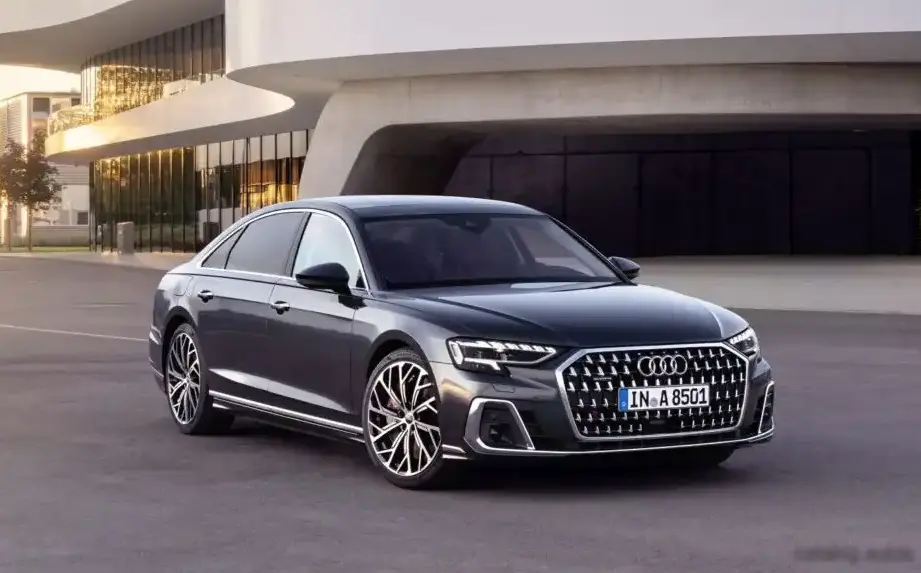
The Audi A8 L (D5, facelift) 55 TFSI V6, launched in December 2021, represents a significant evolution of Audi’s flagship luxury sedan. This variant, positioned as a mid-range offering within the D5 A8 L lineup, combines a potent 3.0-liter turbocharged V6 engine with a 48-volt mild hybrid system and Audi’s renowned quattro all-wheel-drive system. It caters to buyers seeking a blend of performance, efficiency, and sophisticated technology in a full-size luxury vehicle. The facelift brought updated styling, enhanced technology, and refined powertrain options to the already impressive A8 L.
Technical Specifications
| Brand | Audi |
| Model | A8 |
| Generation | A8L (D5, facelift 2021) |
| Type (Engine) | 55 TFSI V6 (340 Hp) Mild Hybrid quattro tiptronic |
| Start of production | December, 2021 |
| Powertrain Architecture | MHEV (Mild Hybrid Electric Vehicle) |
| Body type | Sedan |
| Seats | 4-5 |
| Doors | 4 |
| Combined fuel consumption (WLTP) | 9.1-10.2 l/100 km (25.8 – 23.1 US mpg) |
| CO2 emissions (WLTP) | 206-231 g/km |
| Fuel consumption (economy) – urban (NEDC) | 11.2-11.3 l/100 km (21 – 20.8 US mpg) |
| Fuel consumption (economy) – extra urban (NEDC) | 6.4-6.6 l/100 km (36.8 – 35.6 US mpg) |
| Fuel consumption (economy) – combined (NEDC) | 8.2-8.4 l/100 km (28.7 – 28 US mpg) |
| CO2 emissions (NEDC) | 187-191 g/km |
| Fuel Type | Petrol (Gasoline) |
| Acceleration 0 – 100 km/h | 5.7 sec |
| Acceleration 0 – 62 mph | 5.7 sec |
| Acceleration 0 – 60 mph | 5.4 sec |
| Maximum speed | 250 km/h (155.34 mph) |
| Emission standard | Euro 6d-ISC-FCM |
| Weight-to-power ratio | 5.8 kg/Hp |
| Weight-to-torque ratio | 4 kg/Nm |
| Power | 340 Hp @ 5000-6400 rpm |
| Torque | 500 Nm @ 1370-4500 rpm (368.78 lb.-ft.) |
| Engine layout | Front, Longitudinal |
| Engine Model/Code | EA839 / CZSE |
| Engine displacement | 2995 cm3 (182.77 cu. in.) |
| Number of cylinders | 6 |
| Engine configuration | V-engine |
| Cylinder Bore | 84.5 mm (3.33 in.) |
| Piston Stroke | 89 mm (3.5 in.) |
| Compression ratio | 11.2:1 |
| Number of valves per cylinder | 4 |
| Fuel injection system | Direct injection |
| Engine aspiration | Turbocharger, Intercooler |
| Valvetrain | DOHC |
| Engine oil capacity | 7.6 l (8.03 US qt | 6.69 UK qt) |
| Coolant | 12.1 l (12.79 US qt | 10.65 UK qt) |
| Kerb Weight | 1980 kg (4365.15 lbs.) |
| Max. weight | 2755 kg (6073.74 lbs.) |
| Max load | 775 kg (1708.58 lbs.) |
| Trunk (boot) space – minimum | 505 l (17.83 cu. ft.) |
| Fuel tank capacity | 82 l (21.66 US gal | 18.04 UK gal) |
| Max. roof load | 75 kg (165.35 lbs.) |
| Permitted trailer load with brakes (8%) | 2300 kg (5070.63 lbs.) |
| Permitted trailer load without brakes | 750 kg (1653.47 lbs.) |
| Length | 5320 mm (209.45 in.) |
| Width | 1945 mm (76.57 in.) |
| Width including mirrors | 2130 mm (83.86 in.) |
| Height | 1488 mm (58.58 in.) |
| Wheelbase | 3128 mm (123.15 in.) |
| Front track | 1645 mm (64.76 in.) |
| Rear (Back) track | 1633 mm (64.29 in.) |
| Drag coefficient (Cd) | 0.26 |
| Minimum turning circle | 12.9 m (42.32 ft.) |
| Number of gears and type of gearbox | 8 gears, automatic transmission tiptronic |
INTRODUCTION
The Audi A8 L 55 TFSI V6 Mild Hybrid quattro tiptronic, introduced with the D5 facelift in late 2021, builds upon the fourth-generation A8 (D5) launched in 2017. The “L” designation signifies the long-wheelbase version, prioritizing rear passenger space and comfort. This variant occupies a crucial position in the A8 L range, offering a compelling balance between performance and efficiency for buyers who may not require the outright power of the 60 TFSI V8 model. It’s designed to compete with other flagship luxury sedans like the BMW 7 Series, Mercedes-Benz S-Class, and Lexus LS.
Powertrain & Engine Architecture
At the heart of the A8 L 55 TFSI lies the EA839 3.0-liter V6 engine. This engine utilizes a direct injection system and is coupled with a twin-scroll turbocharger and an intercooler to deliver a robust 340 horsepower and 500 Nm (368.78 lb-ft) of torque. The “TFSI” designation indicates Turbocharged Fuel Stratified Injection. Crucially, this engine incorporates a 48-volt mild hybrid system. This system features a belt alternator-starter (BAS) and a small lithium-ion battery, enabling features like extended engine-off coasting, smoother start-stop operation, and a slight power boost during acceleration. The engine code CZSE is commonly associated with this specific configuration.
Power is transmitted to all four wheels via Audi’s quattro all-wheel-drive system and an eight-speed tiptronic automatic transmission. The tiptronic transmission offers both fully automatic operation and the ability for the driver to manually select gears via steering wheel-mounted paddles or the gear selector. The transmission is tuned for smooth and refined shifts, prioritizing comfort in typical driving situations.
Driving Characteristics
The A8 L 55 TFSI delivers a driving experience that prioritizes comfort and refinement. The 340 hp engine provides ample power for effortless cruising and confident overtaking maneuvers. Acceleration from 0 to 60 mph takes approximately 5.4 seconds. While not as overtly sporty as some competitors, the A8 L offers a composed and stable ride, thanks in part to its sophisticated suspension system (detailed below). The eight-speed automatic transmission is generally responsive, although it may occasionally exhibit a slight hesitation during downshifts. The mild hybrid system contributes to improved fuel economy and a more seamless driving experience, particularly in urban environments.
Equipment & Trim Levels
The A8 L 55 TFSI typically comes standard with a comprehensive suite of luxury features, including leather upholstery, heated and ventilated front seats with massage function, a panoramic sunroof, a premium sound system, and a fully digital instrument cluster (Audi Virtual Cockpit). Infotainment is handled by dual touchscreen displays, controlling navigation, climate control, and vehicle settings. Optional extras include upgraded leather packages, rear-seat entertainment systems, and advanced driver-assistance features such as adaptive cruise control, lane keeping assist, and a 360-degree camera system. Trim levels often vary by market, but generally offer increasing levels of luxury and technology.
Chassis & Braking
The A8 L utilizes an independent multi-link suspension system at both the front and rear axles. A key feature is the adaptive air suspension, which allows the ride height to be adjusted and provides a remarkably smooth and comfortable ride. The suspension continuously adjusts damping rates based on road conditions and driving style. Braking duties are handled by ventilated disc brakes at all four corners. The A8 L also incorporates a range of electronic stability control systems, including ABS (Anti-lock Braking System) and traction control, to enhance safety and handling.
Market Reception & Comparison
The A8 L 55 TFSI V6 Mild Hybrid has been generally well-received by automotive critics. It’s praised for its comfortable ride, refined interior, and advanced technology. Compared to the higher-output 60 TFSI V8, the 55 TFSI offers a more fuel-efficient option without sacrificing a significant amount of performance. The mild hybrid system contributes to improved fuel economy, although real-world figures can vary depending on driving conditions. Reliability has been generally good, although some owners have reported minor issues with the infotainment system.
Legacy
The Audi A8 L 55 TFSI V6 Mild Hybrid represents a significant step forward in luxury sedan technology. The integration of a mild hybrid system demonstrates Audi’s commitment to improving fuel efficiency and reducing emissions. While still relatively new to the used car market, these models are expected to hold their value well due to their reputation for quality and refinement. The EA839 engine, when properly maintained, is known for its durability, and the quattro all-wheel-drive system provides excellent all-weather capability. As technology continues to evolve, the A8 L 55 TFSI will likely be remembered as a transitional model, bridging the gap between traditional internal combustion engines and fully electric vehicles.