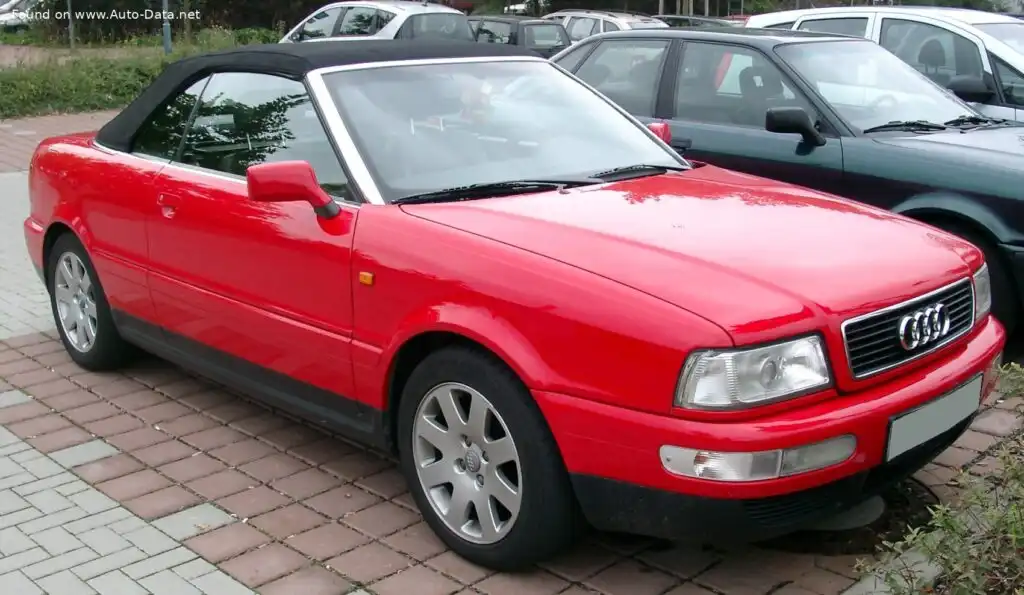
The Audi Cabriolet (B3 8G) 1.9 TDI, produced from July 1995 to 1997, represented a unique offering within the broader B3 Cabriolet range. Positioned as an economy-focused variant, it combined the open-air enjoyment of the Cabriolet body style with the fuel efficiency and torque characteristics of a turbocharged diesel engine. This model occupied the lower to mid-range of the B3 Cabriolet lineup, appealing to buyers prioritizing practicality and running costs over outright performance. It was built on the Audi 80 (B3) platform, sharing many components with its coupe and sedan siblings, but distinguished by its fully automatic, electro-hydraulic folding soft top.
Technical Specifications
| Brand | Audi |
| Model | Cabriolet |
| Generation | Cabriolet (B3 8G) |
| Type (Engine) | 1.9 TDI (90 Hp) |
| Start of production | July, 1995 |
| End of production | 1997 |
| Powertrain Architecture | Internal Combustion engine |
| Body type | Cabriolet |
| Seats | 4 |
| Doors | 2 |
| Fuel consumption (urban) | 7.5 l/100 km (31.4 US mpg, 37.7 UK mpg, 13.3 km/l) |
| Fuel consumption (extra urban) | 5.2 l/100 km (45.2 US mpg, 54.3 UK mpg, 19.2 km/l) |
| Fuel consumption (combined) | 5.6 l/100 km (42 US mpg, 50.4 UK mpg, 17.9 km/l) |
| Fuel Type | Diesel |
| Acceleration 0 – 100 km/h | 14.7 sec |
| Acceleration 0 – 62 mph | 14.7 sec |
| Acceleration 0 – 60 mph | 14 sec |
| Maximum speed | 175 km/h (108.74 mph) |
| Weight-to-power ratio | 15.6 kg/Hp, 64.3 Hp/tonne |
| Weight-to-torque ratio | 6.9 kg/Nm, 144.3 Nm/tonne |
| Power | 90 Hp @ 4000 rpm |
| Power per litre | 47.5 Hp/l |
| Torque | 202 Nm @ 1900 rpm (148.99 lb.-ft. @ 1900 rpm) |
| Engine layout | Front, Longitudinal |
| Engine Model/Code | 1Z |
| Engine displacement | 1896 cm3 (115.7 cu. in.) |
| Number of cylinders | 4 |
| Engine configuration | Inline |
| Cylinder Bore | 79.5 mm (3.13 in.) |
| Piston Stroke | 95.5 mm (3.76 in.) |
| Compression ratio | 19.5:1 |
| Number of valves per cylinder | 2 |
| Fuel injection system | Direct injection |
| Engine aspiration | Turbocharger, Intercooler |
| Valvetrain | OHC |
| Engine oil capacity | 3.8 l (4.02 US qt | 3.34 UK qt) |
| Coolant | 6.5 l (6.87 US qt | 5.72 UK qt) |
| Kerb Weight | 1400 kg (3086.47 lbs.) |
| Max. weight | 1800 kg (3968.32 lbs.) |
| Max load | 400 kg (881.85 lbs.) |
| Trunk (boot) space – minimum | 230 l (8.12 cu. ft.) |
| Fuel tank capacity | 70 l (18.49 US gal | 15.4 UK gal) |
| Permitted trailer load with brakes (8%) | 1000 kg (2204.62 lbs.) |
| Permitted trailer load with brakes (12%) | 1000 kg (2204.62 lbs.) |
| Permitted trailer load without brakes | 640 kg (1410.96 lbs.) |
| Permitted towbar download | 50 kg (110.23 lbs.) |
| Length | 4366 mm (171.89 in.) |
| Width | 1716 mm (67.56 in.) |
| Height | 1379 mm (54.29 in.) |
| Wheelbase | 2556 mm (100.63 in.) |
| Front track | 1453 mm (57.2 in.) |
| Rear (Back) track | 1447 mm (56.97 in.) |
| Ride height (ground clearance) | 127 mm (5 in.) |
| Drag coefficient (Cd) | 0.36 |
| Minimum turning circle (turning diameter) | 11.1 m (36.42 ft.) |
| Drivetrain Architecture | The Internal combustion engine (ICE) drives the front wheels of the vehicle. |
| Drive wheel | Front wheel drive |
| Number of gears and type of gearbox | 5 gears, manual transmission |
| Front suspension | Independent, type McPherson with coil spring and anti-roll bar |
| Rear suspension | Semi-independent, coil spring |
| Front brakes | Ventilated discs |
| Rear brakes | Disc |
| Assisting systems | ABS (Anti-lock braking system) |
| Steering type | Steering rack and pinion |
| Power steering | Hydraulic Steering |
| Tires size | 195/65 R15 |
| Wheel rims size | 15 |
Powertrain & Engine Architecture
The heart of the 1.9 TDI Cabriolet is the 1Z engine, a 1.9-liter inline-four cylinder diesel engine. This engine is a direct-injection diesel, utilizing a Bosch VE injection pump to deliver fuel directly into the combustion chamber at extremely high pressure. This technology, relatively advanced for its time, contributed to improved fuel efficiency and reduced emissions compared to older indirect injection diesels. The 1Z features an overhead camshaft (OHC) valvetrain operating two valves per cylinder. A turbocharger with an intercooler is employed to increase power output, boosting the engine to 90 horsepower at 4000 rpm and 202 Nm (148.99 lb-ft) of torque at 1900 rpm. The engine is longitudinally mounted in the front of the vehicle. The transmission is a five-speed manual gearbox, chosen for its efficiency and cost-effectiveness. While an automatic transmission was available on other B3 Cabriolet models, it was not offered with the 1.9 TDI engine.
Driving Characteristics
The 1.9 TDI Cabriolet offered a distinctly different driving experience compared to its gasoline-powered counterparts. While lacking the outright acceleration of the 1.8-liter or 2.0-liter petrol engines, the TDI provided a substantial amount of low-end torque. This made it surprisingly capable in everyday driving situations, offering effortless cruising and decent overtaking ability. The five-speed manual transmission was well-matched to the engine’s characteristics, allowing drivers to keep the engine in its optimal torque band. However, the engine could feel strained at higher RPMs, and the overall driving experience was more about relaxed, economical motoring than sporty performance. The 0-60 mph time of around 14 seconds and a top speed of 175 km/h (108.74 mph) reflect this focus.
Equipment & Trim Levels
The 1.9 TDI Cabriolet typically came with a relatively basic level of equipment, reflecting its position as an entry-level model. Standard features generally included power steering, central locking, and a basic stereo system. Interior upholstery was typically cloth, and the dashboard featured a functional, if somewhat spartan, design. Optional extras included alloy wheels, upgraded stereo systems, and leather upholstery. The Cabriolet’s defining feature, the electro-hydraulic folding soft top, was standard equipment. The interior trim was generally consistent with other B3 Cabriolet models, but the TDI variant often lacked some of the more luxurious touches found in higher-spec versions.
Chassis & Braking
The B3 Cabriolet chassis featured independent front suspension with McPherson struts and coil springs, providing a comfortable ride. The rear suspension utilized a semi-independent torsion beam setup, which was a cost-effective solution for maintaining a reasonable level of handling. Braking duties were handled by ventilated discs at the front and solid discs at the rear. Anti-lock braking system (ABS) was standard, enhancing safety. The suspension setup was tuned for comfort rather than outright sportiness, prioritizing a smooth ride over sharp handling. The relatively modest power output of the 1.9 TDI engine meant that the braking system was generally adequate for the car’s performance.
Market Reception & Comparison
The Audi Cabriolet 1.9 TDI was generally well-received by critics as a practical and economical open-top car. It offered a compelling alternative to more expensive and less fuel-efficient Cabriolets. Compared to the gasoline-powered versions, the TDI provided significantly better fuel economy, making it an attractive option for drivers covering long distances. However, it was often criticized for its lack of outright performance and its somewhat agricultural engine noise. The 1.8-liter petrol engine offered more power and refinement, while the 2.0-liter provided even greater performance, but at the cost of increased fuel consumption. The TDI appealed to a different type of buyer – one who valued practicality and economy over sporty thrills.
Legacy
The 1.9 TDI engine, in its various iterations, proved to be remarkably durable and reliable. The 1Z engine found in the B3 Cabriolet is known for its longevity, and well-maintained examples can still be found on the road today. The 1.9 TDI Cabriolet has developed a cult following among diesel enthusiasts and those seeking a classic, economical open-top car. In the used car market, these models are generally affordable, but prices have been steadily increasing as demand for classic Audis grows. The combination of a robust engine, a comfortable chassis, and a practical body style has ensured that the 1.9 TDI Cabriolet remains a desirable and enjoyable car for many years to come.