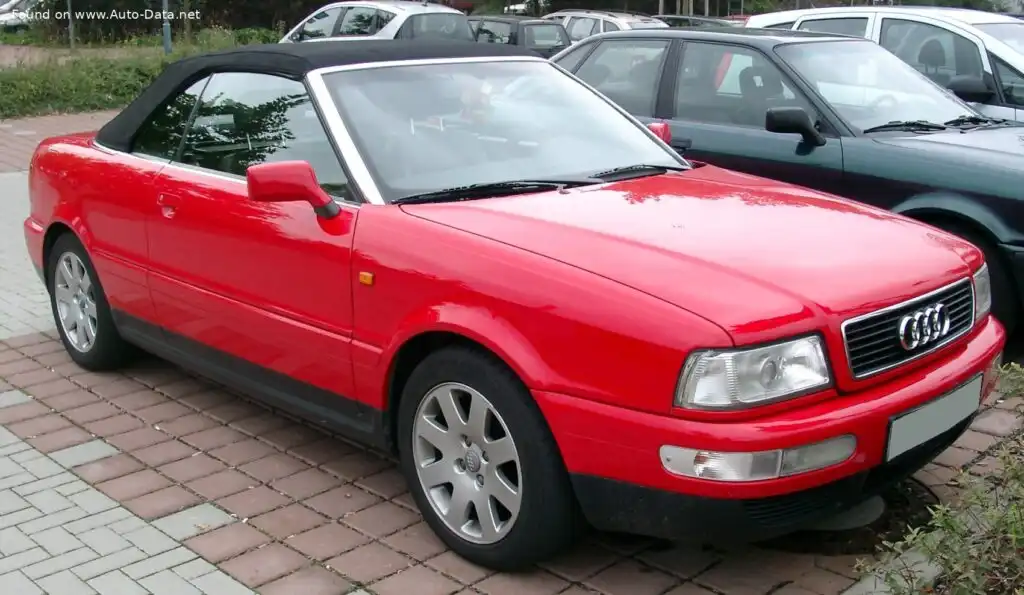
The Audi Cabriolet (B3 8G) 2.8 V6 E, produced between November 1992 and 1996, represented a significant offering in Audi’s open-top lineup. This variant, powered by the 2.8-liter V6 engine producing 174 horsepower, occupied a premium position within the B3 Cabriolet range, slotting above the four-cylinder models and serving as a more accessible alternative to the higher-performance S2 Cabriolet. The B3 Cabriolet itself was based on the Audi 80 (B3) platform, sharing its mechanical underpinnings and offering a blend of practicality and open-air driving enjoyment. It was Audi’s first modern open-top car since the Audi 100 Typ C from 1959.
Technical Specifications
| Brand | Audi |
| Model | Cabriolet |
| Generation | Cabriolet (B3 8G) |
| Type (Engine) | 2.8 V6 E (174 Hp) |
| Start of production | November, 1992 |
| End of production | 1996 |
| Powertrain Architecture | Internal Combustion engine |
| Body type | Cabriolet |
| Seats | 4 |
| Doors | 2 |
| Fuel consumption (urban) | 14.8 l/100 km (15.9 US mpg, 19.1 UK mpg, 6.8 km/l) |
| Fuel consumption (extra urban) | 8.6 l/100 km (27.4 US mpg, 32.8 UK mpg, 11.6 km/l) |
| Fuel consumption (combined) | 10.9 l/100 km (21.6 US mpg, 25.9 UK mpg, 9.2 km/l) |
| Fuel Type | Petrol (Gasoline) |
| Acceleration 0 – 100 km/h | 9.8 sec |
| Acceleration 0 – 62 mph | 9.8 sec |
| Acceleration 0 – 60 mph | 9.3 sec |
| Maximum speed | 218 km/h (135.46 mph) |
| Weight-to-power ratio | 8.4 kg/Hp, 119.6 Hp/tonne |
| Weight-to-torque ratio | 5.8 kg/Nm, 171.8 Nm/tonne |
| Power | 174 Hp @ 5500 rpm |
| Power per litre | 62.8 Hp/l |
| Torque | 250 Nm @ 3000 rpm (184.39 lb.-ft. @ 3000 rpm) |
| Engine layout | Front, Longitudinal |
| Engine Model/Code | AAH |
| Engine displacement | 2771 cm3 (169.1 cu. in.) |
| Number of cylinders | 6 |
| Engine configuration | V-engine |
| Cylinder Bore | 82.5 mm (3.25 in.) |
| Piston Stroke | 86.4 mm (3.4 in.) |
| Compression ratio | 10.3:1 |
| Number of valves per cylinder | 2 |
| Fuel injection system | Multi-port manifold injection |
| Engine aspiration | Naturally aspirated engine |
| Valvetrain | OHC |
| Engine oil capacity | 5 l (5.28 US qt | 4.4 UK qt) |
| Coolant | 11 l (11.62 US qt | 9.68 UK qt) |
| Kerb Weight | 1455 kg (3207.73 lbs.) |
| Max. weight | 1855 kg (4089.57 lbs.) |
| Max load | 400 kg (881.85 lbs.) |
| Trunk (boot) space – minimum | 230 l (8.12 cu. ft.) |
| Fuel tank capacity | 70 l (18.49 US gal | 15.4 UK gal) |
| Permitted trailer load with brakes (8%) | 1000 kg (2204.62 lbs.) |
| Permitted trailer load with brakes (12%) | 1000 kg (2204.62 lbs.) |
| Permitted trailer load without brakes | 640 kg (1410.96 lbs.) |
| Permitted towbar download | 50 kg (110.23 lbs.) |
| Length | 4366 mm (171.89 in.) |
| Width | 1716 mm (67.56 in.) |
| Height | 1379 mm (54.29 in.) |
| Wheelbase | 2556 mm (100.63 in.) |
| Front track | 1453 mm (57.2 in.) |
| Rear (Back) track | 1447 mm (56.97 in.) |
| Drag coefficient (Cd) | 0.36 |
| Minimum turning circle (turning diameter) | 11.1 m (36.42 ft.) |
| Drivetrain Architecture | The Internal combustion engine (ICE) drives the front wheels of the vehicle. |
| Drive wheel | Front wheel drive |
| Number of gears and type of gearbox | 5 gears, manual transmission |
| Front suspension | Independent, type McPherson with coil spring and anti-roll bar |
| Rear suspension | Semi-independent, coil spring |
| Front brakes | Ventilated discs |
| Rear brakes | Disc |
| Assisting systems | ABS (Anti-lock braking system) |
| Steering type | Steering rack and pinion |
| Power steering | Hydraulic Steering |
| Tires size | 205/60 R15 |
| Wheel rims size | 7J x 15 |
Powertrain & Engine Architecture
The heart of the 2.8 V6 E Cabriolet is the AAH engine, a 2.8-liter (2771 cc) naturally aspirated V6. This engine is a 90-degree V6, known for its relatively smooth operation and decent power output. It utilizes a multi-port fuel injection system, delivering fuel directly to each intake port. The engine features a single overhead camshaft (OHC) design per cylinder bank, operating two valves per cylinder (intake and exhaust). The AAH engine was a common sight in various Audi and Volkswagen models of the era, known for its reliability when properly maintained. The engine’s longitudinal mounting allowed for a front-wheel-drive configuration, a hallmark of Audi’s engineering philosophy. The five-speed manual transmission was the standard offering, providing a direct connection between the engine and the front wheels.
Driving Characteristics
The 2.8 V6 E Cabriolet offered a noticeable step up in performance compared to the base four-cylinder models. Acceleration from 0 to 60 mph took approximately 9.3 seconds, and it could reach a top speed of 135 mph. While not a sports car, the V6 provided ample power for comfortable cruising and overtaking maneuvers. The five-speed manual transmission allowed drivers to effectively utilize the engine’s torque curve. The front-wheel-drive layout, while providing good traction in most conditions, could exhibit some torque steer under hard acceleration. The overall driving experience was refined and comfortable, prioritizing a balance between performance and everyday usability.
Equipment & Trim Levels
The 2.8 V6 E Cabriolet typically came equipped with a respectable level of standard features. These included power windows, central locking, and a decent audio system. Interior upholstery was typically cloth, although leather options were available. Optional extras included heated front seats, a sunroof (in addition to the convertible top), and upgraded audio systems. The dashboard layout was typical of early 1990s Audis, with a functional and straightforward design. The trim level generally positioned this variant as a mid-range offering, appealing to buyers who desired more performance and refinement than the base models but didn’t want to pay the premium for the S2 Cabriolet.
Chassis & Braking
The B3 Cabriolet utilized a McPherson strut front suspension and a semi-independent coil spring rear suspension. This setup provided a comfortable ride quality while maintaining reasonable handling characteristics. The 2.8 V6 models typically featured ventilated disc brakes at the front and solid discs at the rear. Anti-lock braking system (ABS) was standard, enhancing safety and control during braking. The chassis was reinforced to compensate for the lack of a fixed roof, ensuring adequate structural rigidity. Stabilizer bars were fitted to both the front and rear axles to reduce body roll during cornering.
Market Reception & Comparison
The Audi Cabriolet 2.8 V6 E was generally well-received by automotive critics. It was praised for its stylish design, comfortable ride, and refined engine. Compared to the four-cylinder models, the V6 offered a significant improvement in performance. However, it was often criticized for its relatively high price compared to competitors. Fuel economy, at around 21.6 US mpg combined, was typical for a V6 engine of that era. The V6 engine was considered more reliable than the turbocharged engines found in the S2 Cabriolet, making it a more practical choice for everyday use.
Legacy
The Audi B3 Cabriolet 2.8 V6 E remains a popular choice among classic Audi enthusiasts. The AAH engine is known for its durability and relatively straightforward maintenance. Parts availability is generally good, although some specific trim pieces can be difficult to find. Well-maintained examples command a reasonable price in the used car market. The B3 Cabriolet represents a significant milestone in Audi’s history, marking the return of an open-top model to the brand’s lineup and showcasing Audi’s commitment to quality and engineering excellence. The combination of a smooth V6 engine, comfortable ride, and stylish design ensures that the B3 Cabriolet 2.8 V6 E continues to be appreciated by car enthusiasts today.