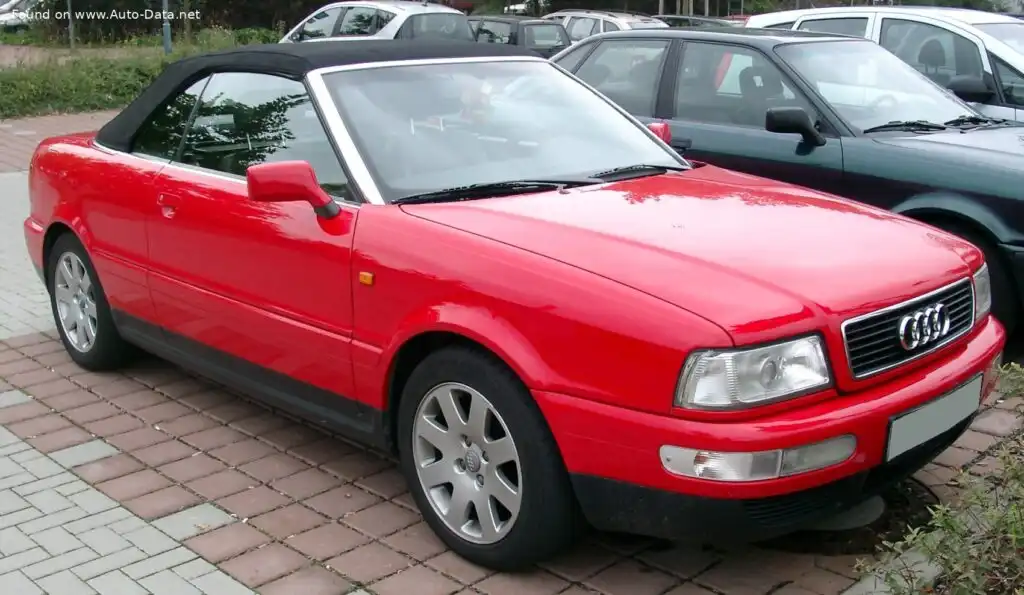
Technical Specifications
| Brand | Audi |
| Model | Cabriolet |
| Generation | Cabriolet (B3 8G) |
| Type (Engine) | 2.8 V6 E (174 Hp) Automatic |
| Start of production | November, 1992 |
| End of production | 1996 |
| Powertrain Architecture | Internal Combustion engine |
| Body type | Cabriolet |
| Seats | 4 |
| Doors | 2 |
| Fuel consumption (urban) | 14.1 l/100 km (16.7 US mpg, 20 UK mpg, 7.1 km/l) |
| Fuel consumption (extra urban) | 7.8 l/100 km (30.2 US mpg, 36.2 UK mpg, 12.8 km/l) |
| Fuel consumption (combined) | 10.5 l/100 km (22.4 US mpg, 26.9 UK mpg, 9.5 km/l) |
| Fuel Type | Petrol (Gasoline) |
| Acceleration 0 – 100 km/h | 11.1 sec |
| Acceleration 0 – 62 mph | 11.1 sec |
| Acceleration 0 – 60 mph | 10.5 sec |
| Maximum speed | 217 km/h (134.84 mph) |
| Weight-to-power ratio | 8.4 kg/Hp, 119.6 Hp/tonne |
| Weight-to-torque ratio | 5.8 kg/Nm, 171.8 Nm/tonne |
| Power | 174 Hp @ 5500 rpm |
| Power per litre | 62.8 Hp/l |
| Torque | 250 Nm @ 3000 rpm (184.39 lb.-ft. @ 3000 rpm) |
| Engine layout | Front, Longitudinal |
| Engine Model/Code | AAH |
| Engine displacement | 2771 cm3 (169.1 cu. in.) |
| Number of cylinders | 6 |
| Engine configuration | V-engine |
| Cylinder Bore | 82.5 mm (3.25 in.) |
| Piston Stroke | 86.4 mm (3.4 in.) |
| Compression ratio | 10.3:1 |
| Number of valves per cylinder | 2 |
| Fuel injection system | Multi-port manifold injection |
| Engine aspiration | Naturally aspirated engine |
| Valvetrain | OHC |
| Engine oil capacity | 5 l (5.28 US qt | 4.4 UK qt) |
| Coolant | 11 l (11.62 US qt | 9.68 UK qt) |
| Kerb Weight | 1455 kg (3207.73 lbs.) |
| Max. weight | 1855 kg (4089.57 lbs.) |
| Max load | 400 kg (881.85 lbs.) |
| Trunk (boot) space – minimum | 230 l (8.12 cu. ft.) |
| Fuel tank capacity | 70 l (18.49 US gal | 15.4 UK gal) |
| Permitted trailer load with brakes (8%) | 1000 kg (2204.62 lbs.) |
| Permitted trailer load with brakes (12%) | 1000 kg (2204.62 lbs.) |
| Permitted trailer load without brakes | 640 kg (1410.96 lbs.) |
| Permitted towbar download | 50 kg (110.23 lbs.) |
| Length | 4366 mm (171.89 in.) |
| Width | 1716 mm (67.56 in.) |
| Height | 1379 mm (54.29 in.) |
| Wheelbase | 2556 mm (100.63 in.) |
| Front track | 1453 mm (57.2 in.) |
| Rear (Back) track | 1447 mm (56.97 in.) |
| Ride height (ground clearance) | 113 mm (4.45 in.) |
| Drag coefficient (Cd) | 0.36 |
| Minimum turning circle (turning diameter) | 11.1 m (36.42 ft.) |
| Drivetrain Architecture | The Internal combustion engine (ICE) drives the front wheels of the vehicle. |
| Drive wheel | Front wheel drive |
| Number of gears and type of gearbox | 4 gears, automatic transmission |
| Front suspension | Independent, type McPherson with coil spring and anti-roll bar |
| Rear suspension | Semi-independent, coil spring |
| Front brakes | Ventilated discs |
| Rear brakes | Disc |
| Assisting systems | ABS (Anti-lock braking system) |
| Steering type | Steering rack and pinion |
| Power steering | Hydraulic Steering |
| Tires size | 205/60 R15 |
| Wheel rims size | 7J x 15 |
The Audi Cabriolet (B3 8G) 2.8 V6 E Automatic, produced between November 1992 and 1996, represented a sophisticated offering in the premium open-top market. This variant, powered by the AAH engine code, occupied a mid-to-upper position within the B3 Cabriolet range, offering a blend of performance and comfort. It was built on the Audi 80 (B3) platform, sharing many components with its coupe and sedan siblings, but distinguished by its fully automatic retractable soft top. The “E” designation signified the engine variant and fuel injection system. This model was primarily aimed at the European market, where open-top cars enjoyed significant popularity, though a limited number were imported to North America.
Powertrain & Engine Architecture
The heart of the 2.8 V6 E Cabriolet is the AAH engine, a 2.8-liter naturally aspirated V6. This engine utilizes a cast iron block with an aluminum cylinder head, a common configuration for Audi engines of the era. It features a single overhead camshaft (OHC) per cylinder bank, operating two valves per cylinder (intake and exhaust). The AAH engine employed Bosch Motronic fuel injection, a multi-port system that precisely meters fuel into the intake manifold. This system, coupled with electronic ignition, contributed to relatively smooth power delivery and acceptable fuel efficiency for the time. The engine’s 90-degree V-angle provided inherent balance, reducing vibrations. Paired with this engine was a four-speed automatic transmission, offering convenient operation but sacrificing some of the responsiveness found in manual transmission variants. This automatic transmission was designed for smooth shifts and ease of use, prioritizing comfort over outright performance.
Driving Characteristics
The 2.8 V6 Automatic Cabriolet offered a comfortable and refined driving experience. While not a sports car, the 174 horsepower and 184 lb-ft of torque provided adequate acceleration, reaching 60 mph in around 10.5 seconds. The automatic transmission, while smooth, did result in some power loss compared to the five-speed manual option. Gear ratios were tuned for relaxed cruising, making it well-suited for long highway journeys. The front-wheel-drive configuration provided predictable handling, although it lacked the dynamic balance of rear-wheel-drive alternatives. The power delivery was linear, with peak torque available at 3000 rpm, making it easy to drive in everyday traffic. Compared to the base 1.8L four-cylinder models, the V6 offered a significant performance upgrade, but it came at the cost of increased fuel consumption.
Equipment & Trim Levels
The 2.8 V6 E Automatic typically came well-equipped, reflecting its position as a premium variant. Standard features included power windows, central locking, power steering, and an anti-lock braking system (ABS). Interior upholstery was typically cloth, though leather was available as an option. The dashboard featured a classic Audi design with clear instrumentation. Optional extras included a sunroof, upgraded audio system, and heated front seats. The trim level often included alloy wheels, adding to the car’s aesthetic appeal. The Cabriolet’s soft top was fully automatic, operated by an electric motor, and featured a glass rear window with a heated element.
Chassis & Braking
The B3 Cabriolet utilized a McPherson strut front suspension with coil springs and an anti-roll bar, providing a comfortable ride and decent handling. The rear suspension was a semi-independent torsion beam setup, which was cost-effective but less sophisticated than a fully independent system. Braking duties were handled by ventilated discs at the front and solid discs at the rear, providing adequate stopping power for the car’s weight and performance. The ABS system enhanced braking performance, particularly on slippery surfaces. The steering was a rack-and-pinion system with hydraulic power assistance, offering light and precise steering feel.
Market Reception & Comparison
The Audi Cabriolet 2.8 V6 Automatic was generally well-received by automotive critics. It was praised for its comfortable ride, refined engine, and well-appointed interior. However, some critics noted that the automatic transmission dulled the engine’s performance and that the front-wheel-drive configuration limited its handling potential. Compared to the 1.8L models, the V6 offered a significant performance boost, but fuel economy suffered. Against competitors like the BMW 3 Series Convertible and Mercedes-Benz SLK, the Audi Cabriolet offered a compelling combination of value, style, and practicality.
Legacy
The Audi Cabriolet B3 8G, particularly the 2.8 V6 Automatic variant, has developed a following among classic Audi enthusiasts. The AAH engine is generally considered reliable, although regular maintenance is crucial. Common issues include oil leaks and wear on the timing belt. The automatic transmission, if properly maintained, can provide years of service. Today, these cars are sought after for their classic styling, comfortable ride, and relatively affordable price point. Finding well-maintained examples can be challenging, but the 2.8 V6 Automatic Cabriolet remains a desirable and enjoyable classic car.