
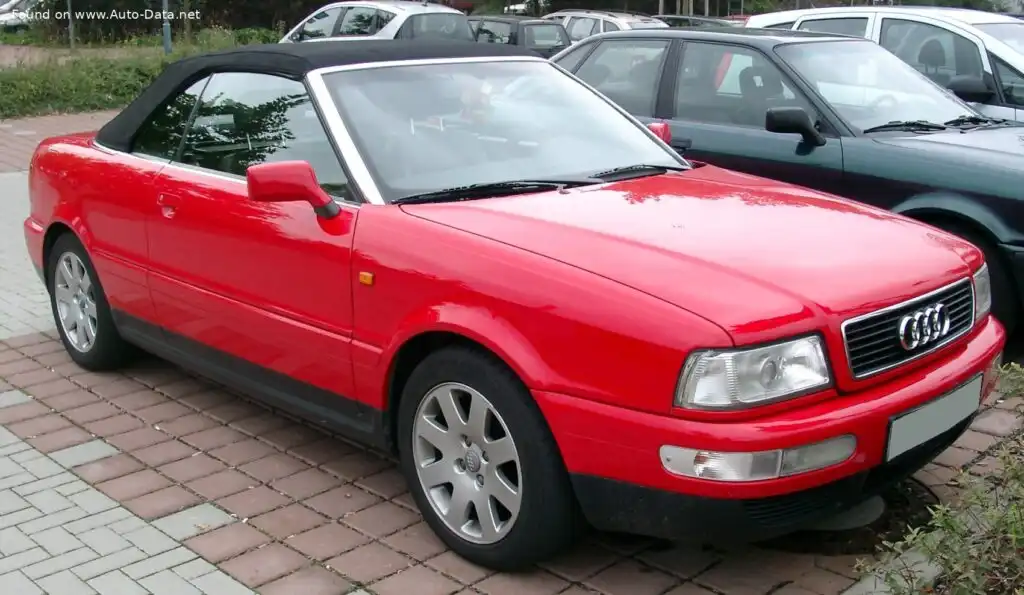
The Audi Cabriolet, specifically the B3 8G facelift model produced from 1997 to 2001, represented a significant step forward for Audi in the premium open-top market. This iteration, featuring the 1.8-liter 20-valve engine paired with an automatic transmission, occupied a middle ground within the Cabriolet range, offering a balance between performance, comfort, and affordability. It was positioned as a more accessible entry point into Audi’s convertible lineup compared to the more powerful and expensive variants, like those equipped with the larger 2.8-liter V6 engine. The B3 Cabriolet was built on the Volkswagen Golf Mk3 platform (1HX0/A3), sharing many components but distinguished by its more refined styling and upscale interior.
Technical Specifications
| Brand | Audi |
| Model | Cabriolet |
| Generation | Cabriolet (B3 8G, facelift 1997) |
| Type (Engine) | 1.8 20V (125 Hp) Automatic |
| Start of production | 1997 |
| End of production | 2001 |
| Powertrain Architecture | Internal Combustion engine |
| Body type | Cabriolet |
| Seats | 4 |
| Doors | 2 |
| Fuel consumption (urban) | 13 l/100 km (18.1 US mpg, 21.7 UK mpg, 7.7 km/l) |
| Fuel consumption (extra urban) | 7.4 l/100 km (31.8 US mpg, 38.2 UK mpg, 13.5 km/l) |
| Fuel consumption (combined) | 9.4 l/100 km (25 US mpg, 30.1 UK mpg, 10.6 km/l) |
| CO2 emissions | 226 g/km |
| Fuel Type | Petrol (Gasoline) |
| Acceleration 0 – 100 km/h | 13.3 sec |
| Acceleration 0 – 62 mph | 13.3 sec |
| Acceleration 0 – 60 mph | 12.6 sec |
| Maximum speed | 192 km/h (119.3 mph) |
| Weight-to-power ratio | 11.1 kg/Hp, 89.9 Hp/tonne |
| Weight-to-torque ratio | 8 kg/Nm, 124.5 Nm/tonne |
| Power | 125 Hp @ 5800 rpm |
| Power per litre | 70.2 Hp/l |
| Torque | 173 Nm @ 3950 rpm (127.6 lb.-ft. @ 3950 rpm) |
| Engine layout | Front, Longitudinal |
| Engine Model/Code | ADR |
| Engine displacement | 1781 cm3 (108.68 cu. in.) |
| Number of cylinders | 4 |
| Engine configuration | Inline |
| Cylinder Bore | 81 mm (3.19 in.) |
| Piston Stroke | 86.4 mm (3.4 in.) |
| Compression ratio | 10.3:1 |
| Number of valves per cylinder | 5 |
| Fuel injection system | Multi-port manifold injection |
| Engine aspiration | Naturally aspirated engine |
| Valvetrain | DOHC |
| Engine oil capacity | 3.5 l (3.7 US qt | 3.08 UK qt) |
| Coolant | 6.5 l (6.87 US qt | 5.72 UK qt) |
| Kerb Weight | 1390 kg (3064.43 lbs.) |
| Max. weight | 1790 kg (3946.27 lbs.) |
| Max load | 400 kg (881.85 lbs.) |
| Trunk (boot) space – minimum | 230 l (8.12 cu. ft.) |
| Fuel tank capacity | 70 l (18.49 US gal | 15.4 UK gal) |
| Permitted trailer load with brakes (8%) | 1000 kg (2204.62 lbs.) |
| Permitted trailer load with brakes (12%) | 1000 kg (2204.62 lbs.) |
| Permitted trailer load without brakes | 730 kg (1609.37 lbs.) |
| Permitted towbar download | 40 kg (88.18 lbs.) |
| Length | 4366 mm (171.89 in.) |
| Width | 1716 mm (67.56 in.) |
| Height | 1379 mm (54.29 in.) |
| Wheelbase | 2556 mm (100.63 in.) |
| Front track | 1453 mm (57.2 in.) |
| Rear (Back) track | 1447 mm (56.97 in.) |
| Drag coefficient (Cd) | 0.36 |
| Minimum turning circle (turning diameter) | 11.1 m (36.42 ft.) |
| Drivetrain Architecture | The Internal combustion engine (ICE) drives the front wheels of the vehicle. |
| Drive wheel | Front wheel drive |
| Number of gears and type of gearbox | 4 gears, automatic transmission |
| Front suspension | Independent, type McPherson with coil spring and anti-roll bar |
| Rear suspension | Semi-independent, coil spring |
| Front brakes | Ventilated discs |
| Rear brakes | Disc |
| Assisting systems | ABS (Anti-lock braking system) |
| Steering type | Steering rack and pinion |
| Power steering | Hydraulic Steering |
| Tires size | 195/65 R15 |
| Wheel rims size | 15 |
Powertrain & Engine Architecture
The heart of this Cabriolet variant is the 1.8-liter, 20-valve inline-four cylinder engine, designated the ADR engine code. This engine is a naturally aspirated unit featuring multi-port fuel injection. The 20-valve configuration (five valves per cylinder – three intake, two exhaust) was a key feature, enhancing breathing and contributing to improved power output compared to earlier 8-valve versions. The engine utilizes a double overhead camshaft (DOHC) design, further optimizing valve control. The automatic transmission employed was typically a four-speed unit, designed to provide smooth shifts and ease of driving. While not offering the sporty engagement of a manual gearbox, it catered to drivers prioritizing comfort and convenience.
Driving Characteristics
The 1.8-liter automatic Cabriolet delivered a comfortable and relaxed driving experience. With 125 horsepower and 127.6 lb-ft of torque, acceleration was adequate but not particularly brisk. The 0-60 mph time of around 12.6 seconds reflects this. The automatic transmission, while smooth, did contribute to some power loss compared to the manual versions. Gear ratios were tuned for fuel efficiency and everyday usability rather than outright performance. Compared to the more powerful 2.8-liter V6 models, the 1.8 felt noticeably less responsive, especially during overtaking maneuvers. However, it offered a more forgiving and less demanding driving experience, making it well-suited for urban driving and leisurely cruising.
Equipment & Trim Levels
The 1.8-liter automatic Cabriolet typically came equipped with a reasonable level of standard features. This included power windows, central locking, and a basic audio system. Interior upholstery was usually cloth, although leather options were available as upgrades. The dashboard layout was typical of Audi at the time, featuring a clean and functional design. Optional extras included alloy wheels, a more sophisticated audio system, and climate control. The specific trim level could vary depending on the market, but generally, this variant represented a mid-range offering, bridging the gap between the base models and the more luxurious trims.
Chassis & Braking
The Cabriolet’s chassis featured independent McPherson strut suspension at the front and a semi-independent coil spring setup at the rear. This configuration provided a good balance between ride comfort and handling. The front brakes were ventilated discs, offering good stopping power, while the rear brakes were solid discs. Anti-lock Braking System (ABS) was standard, enhancing safety. The suspension was tuned to prioritize comfort, resulting in a relatively soft ride. Stabilizer bars were fitted to both axles to reduce body roll during cornering.
Market Reception & Comparison
The 1.8-liter automatic Cabriolet was generally well-received by critics as a practical and affordable entry into the Audi convertible market. It was praised for its comfortable ride, ease of use, and relatively good fuel economy (around 25 US mpg combined). However, some reviewers noted its lack of outright performance compared to the V6 models. In terms of reliability, the ADR engine proved to be generally robust, although regular maintenance was essential. Compared to the 1.9 TDI diesel variant, the 1.8 offered a smoother and quieter driving experience but at the cost of significantly lower fuel economy.
Legacy
Today, the Audi B3 Cabriolet 1.8 20V Automatic holds a place as a desirable classic. The ADR engine, when properly maintained, continues to be relatively reliable. These cars are increasingly sought after by enthusiasts and collectors, particularly those looking for a stylish and affordable open-top experience. While not the fastest or most technologically advanced Cabriolet variant, its balance of comfort, practicality, and classic Audi styling ensures its continued appeal in the used car market. Parts availability is generally good, thanks to the shared components with other Volkswagen Group vehicles of the era.

