
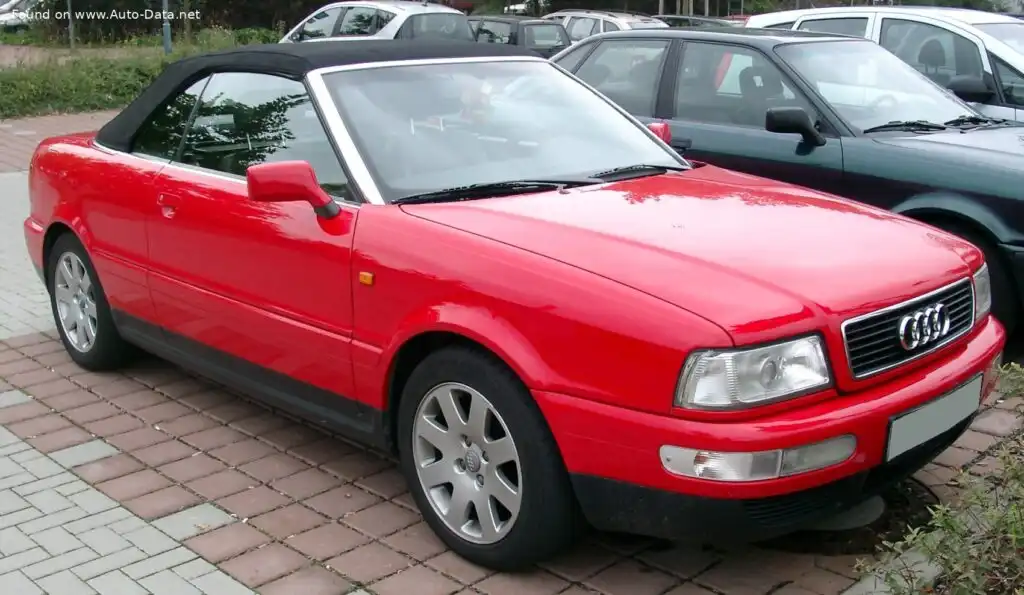
The Audi Cabriolet, specifically the B3 8G facelift model produced from 1997 to 1998 with the 2.0 E (115 hp) engine, represents a significant iteration of Audi’s open-top offering. Positioned as a mid-range option within the Cabriolet lineup, it bridged the gap between the more economical base models and the higher-performance variants. This generation, built on the B3 platform (also known as the Audi 80/90 platform), aimed to deliver a blend of style, comfort, and reasonable performance in a package that appealed to a broad audience. The facelift brought subtle but noticeable cosmetic updates, enhancing the car’s modern appeal. Production of this specific variant was relatively short-lived, ending in September 1998.
Technical Specifications
| Brand | Audi |
| Model | Cabriolet |
| Generation | Cabriolet (B3 8G, facelift 1997) |
| Type (Engine) | 2.0 E (115 Hp) |
| Start of production | 1997 |
| End of production | September, 1998 |
| Powertrain Architecture | Internal Combustion engine |
| Body type | Cabriolet |
| Seats | 4 |
| Doors | 2 |
| Fuel consumption (urban) | 12.9 l/100 km (18.2 US mpg, 21.9 UK mpg, 7.8 km/l) |
| Fuel consumption (extra urban) | 7.8 l/100 km (30.2 US mpg, 36.2 UK mpg, 12.8 km/l) |
| Fuel consumption (combined) | 9.7 l/100 km (24.2 US mpg, 29.1 UK mpg, 10.3 km/l) |
| CO2 emissions | 231 g/km |
| Fuel Type | Petrol (Gasoline) |
| Acceleration 0 – 100 km/h | 12.9 sec |
| Acceleration 0 – 62 mph | 12.9 sec |
| Acceleration 0 – 60 mph | 12.3 sec |
| Maximum speed | 187 km/h (116.2 mph) |
| Emission standard | Euro 2 |
| Weight-to-power ratio | 11.7 kg/Hp, 85.2 Hp/tonne |
| Weight-to-torque ratio | 8.2 kg/Nm, 122.2 Nm/tonne |
| Power | 115 Hp @ 5400 rpm |
| Power per litre | 58 Hp/l |
| Torque | 165 Nm @ 3200 rpm (121.7 lb.-ft. @ 3200 rpm) |
| Engine layout | Front, Longitudinal |
| Engine Model/Code | ABK |
| Engine displacement | 1984 cm3 (121.07 cu. in.) |
| Number of cylinders | 4 |
| Engine configuration | Inline |
| Cylinder Bore | 82.5 mm (3.25 in.) |
| Piston Stroke | 92.8 mm (3.65 in.) |
| Compression ratio | 10.4:1 |
| Number of valves per cylinder | 2 |
| Fuel injection system | Multi-port manifold injection |
| Engine aspiration | Naturally aspirated engine |
| Valvetrain | OHC |
| Engine oil capacity | 3 l (3.17 US qt | 2.64 UK qt) |
| Coolant | 6.5 l (6.87 US qt | 5.72 UK qt) |
| Kerb Weight | 1350 kg (2976.24 lbs.) |
| Max. weight | 1750 kg (3858.09 lbs.) |
| Max load | 400 kg (881.85 lbs.) |
| Trunk (boot) space – minimum | 230 l (8.12 cu. ft.) |
| Fuel tank capacity | 70 l (18.49 US gal | 15.4 UK gal) |
| Permitted trailer load with brakes (8%) | 1000 kg (2204.62 lbs.) |
| Permitted trailer load with brakes (12%) | 1000 kg (2204.62 lbs.) |
| Permitted trailer load without brakes | 640 kg (1410.96 lbs.) |
| Permitted towbar download | 50 kg (110.23 lbs.) |
| Length | 4366 mm (171.89 in.) |
| Width | 1716 mm (67.56 in.) |
| Height | 1379 mm (54.29 in.) |
| Wheelbase | 2556 mm (100.63 in.) |
| Front track | 1453 mm (57.2 in.) |
| Rear (Back) track | 1447 mm (56.97 in.) |
| Drag coefficient (Cd) | 0.36 |
| Minimum turning circle (turning diameter) | 11.1 m (36.42 ft.) |
| Drivetrain Architecture | The Internal combustion engine (ICE) drives the front wheels of the vehicle. |
| Drive wheel | Front wheel drive |
| Number of gears and type of gearbox | 5 gears, manual transmission |
| Front suspension | Independent, type McPherson with coil spring and anti-roll bar |
| Rear suspension | Semi-independent, coil spring |
| Front brakes | Ventilated discs |
| Rear brakes | Disc |
| Assisting systems | ABS (Anti-lock braking system) |
| Steering type | Steering rack and pinion |
| Power steering | Hydraulic Steering |
| Tires size | 195/65 R15 |
| Wheel rims size | 6J x 15 |
Powertrain & Engine Architecture
The heart of the 2.0 E Cabriolet is the Audi ABK engine, a 1.984-liter inline-four cylinder gasoline engine. This engine utilizes a multi-port fuel injection system, delivering fuel directly into the intake ports. The ABK engine features a single overhead camshaft (OHC) design operating two valves per cylinder. This configuration was a common choice for Audi during this period, balancing cost-effectiveness with acceptable performance. The engine’s longitudinal mounting within the front-wheel-drive chassis contributed to a favorable weight distribution. The 5-speed manual transmission was the standard offering, providing a relatively direct connection between the engine and the front wheels. The transmission’s gear ratios were tuned for a balance of acceleration and fuel efficiency, though not optimized for outright performance.
Driving Characteristics
The 115 hp and 165 Nm (121.7 lb-ft) of torque produced by the 2.0 E engine translated to adequate, but not exhilarating, performance. Acceleration from 0 to 60 mph took around 12.3 seconds, and the top speed was approximately 116.2 mph. Compared to the more powerful variants, such as those equipped with the 2.8-liter V6 engine, the 2.0 E felt noticeably slower. However, it offered a more relaxed driving experience, particularly in urban environments. The manual transmission allowed for reasonable control over the engine’s power band, but the relatively long gearing meant that frequent downshifts were necessary for brisk acceleration. The 2.0 E was generally considered more fuel-efficient than its higher-powered siblings, making it a practical choice for everyday driving.
Equipment & Trim Levels
The 2.0 E Cabriolet typically came equipped with a respectable level of standard features. Interior appointments included cloth upholstery, power windows, and central locking. Air conditioning was often included, though it could be an optional extra depending on the specific market. The dashboard layout was typical of Audi’s design language of the era, with a functional and understated aesthetic. Optional extras included leather upholstery, upgraded audio systems, and alloy wheels. The trim level was generally considered a step above the base models, offering a more refined interior and a slightly more comprehensive equipment list.
Chassis & Braking
The B3 Cabriolet utilized a McPherson strut front suspension and a semi-independent coil spring rear suspension. This setup provided a comfortable ride quality, though it wasn’t particularly sporty. The front brakes were ventilated discs, offering good stopping power, while the rear brakes were solid discs. ABS (Anti-lock Braking System) was standard, enhancing safety and stability during braking. The chassis was reinforced to compensate for the lack of a fixed roof, providing adequate torsional rigidity. Stabilizer bars were fitted to both the front and rear axles to reduce body roll during cornering.
Market Reception & Comparison
The 2.0 E Cabriolet was generally well-received by automotive critics as a sensible and stylish open-top car. It was praised for its comfortable ride, decent fuel economy, and relatively affordable price. However, it was often criticized for its lack of outright performance compared to the more powerful variants. Compared to the V6 models, the 2.0 E offered a significant fuel economy advantage, but at the cost of acceleration and overall driving excitement. The 2.0 E appealed to buyers who prioritized comfort, style, and practicality over performance.
Legacy
The Audi B3 Cabriolet 2.0 E, while not the most powerful or sought-after variant, has proven to be a relatively reliable and durable classic car. The ABK engine is known for its longevity, provided it has been properly maintained. Today, these cars are increasingly popular among enthusiasts and collectors, particularly those seeking a classic Audi experience without the high price tag of the V6 models. Parts availability is generally good, though some specific trim pieces may be difficult to find. The 2.0 E Cabriolet represents a charming and accessible entry point into the world of classic Audi convertibles.

