
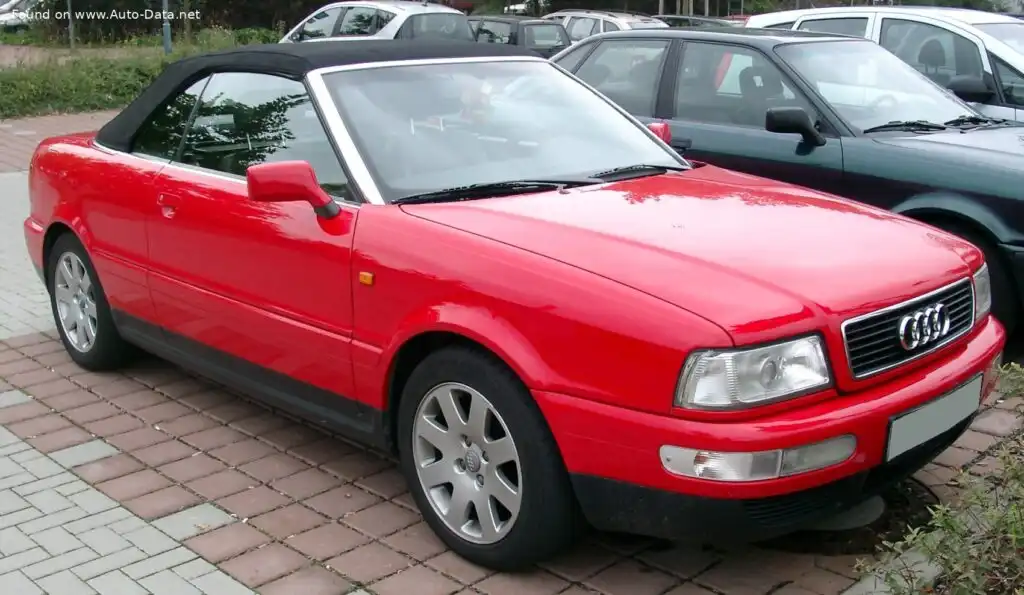
The Audi Cabriolet (B3 8G), particularly the facelifted version introduced in 1997, represented a significant step forward for Audi in the premium open-top market. Produced from 1997 through August 2000, this generation built upon the success of the original B3 Cabriolet, offering enhanced refinement and a wider range of engine options. The 2.6 V6 model, producing 150 horsepower, occupied a middle ground in the lineup, offering a balance of performance and relative affordability compared to the more potent 2.8-liter V6 variants. It was positioned as a comfortable and stylish cruiser, appealing to buyers who prioritized open-air motoring over outright speed.
Technical Specifications
| Brand | Audi |
| Model | Cabriolet |
| Generation | Cabriolet (B3 8G, facelift 1997) |
| Type (Engine) | 2.6 V6 (150 Hp) |
| Start of production | 1997 |
| End of production | August, 2000 |
| Powertrain Architecture | Internal Combustion engine |
| Body type | Cabriolet |
| Seats | 4 |
| Doors | 2 |
| Fuel consumption (urban) | 14.8 l/100 km (15.9 US mpg, 19.1 UK mpg, 6.8 km/l) |
| Fuel consumption (extra urban) | 7.9 l/100 km (29.8 US mpg, 35.8 UK mpg, 12.7 km/l) |
| Fuel consumption (combined) | 10.4 l/100 km (22.6 US mpg, 27.2 UK mpg, 9.6 km/l) |
| CO2 emissions | 248 g/km |
| Fuel Type | Petrol (Gasoline) |
| Acceleration 0 – 100 km/h | 10.2 sec |
| Acceleration 0 – 62 mph | 10.2 sec |
| Acceleration 0 – 60 mph | 9.7 sec |
| Maximum speed | 209 km/h (129.87 mph) |
| Emission standard | Euro 2 |
| Weight-to-power ratio | 9.4 kg/Hp, 106 Hp/tonne |
| Weight-to-torque ratio | 6.3 kg/Nm, 159 Nm/tonne |
| Power | 150 Hp @ 5500 rpm |
| Power per litre | 57.7 Hp/l |
| Torque | 225 Nm @ 3500 rpm (165.95 lb.-ft. @ 3500 rpm) |
| Engine layout | Front, Longitudinal |
| Engine Model/Code | ABC |
| Engine displacement | 2598 cm3 (158.54 cu. in.) |
| Number of cylinders | 6 |
| Engine configuration | V-engine |
| Cylinder Bore | 82.5 mm (3.25 in.) |
| Piston Stroke | 81 mm (3.19 in.) |
| Compression ratio | 10:1 |
| Number of valves per cylinder | 2 |
| Fuel injection system | Multi-port manifold injection |
| Engine aspiration | Naturally aspirated engine |
| Valvetrain | OHC |
| Engine oil capacity | 5 l (5.28 US qt | 4.4 UK qt) |
| Coolant | 11 l (11.62 US qt | 9.68 UK qt) |
| Kerb Weight | 1415 kg (3119.54 lbs.) |
| Max. weight | 1815 kg (4001.39 lbs.) |
| Max load | 400 kg (881.85 lbs.) |
| Trunk (boot) space – minimum | 230 l (8.12 cu. ft.) |
| Fuel tank capacity | 70 l (18.49 US gal | 15.4 UK gal) |
| Permitted trailer load with brakes (8%) | 1000 kg (2204.62 lbs.) |
| Permitted trailer load with brakes (12%) | 1000 kg (2204.62 lbs.) |
| Permitted trailer load without brakes | 740 kg (1631.42 lbs.) |
| Permitted towbar download | 40 kg (88.18 lbs.) |
| Length | 4366 mm (171.89 in.) |
| Width | 1716 mm (67.56 in.) |
| Height | 1379 mm (54.29 in.) |
| Wheelbase | 2556 mm (100.63 in.) |
| Front track | 1453 mm (57.2 in.) |
| Rear (Back) track | 1447 mm (56.97 in.) |
| Drag coefficient (Cd) | 0.36 |
| Minimum turning circle (turning diameter) | 11.1 m (36.42 ft.) |
| Drivetrain Architecture | The Internal combustion engine (ICE) drives the front wheels of the vehicle. |
| Drive wheel | Front wheel drive |
| Number of gears and type of gearbox | 5 gears, manual transmission |
| Front suspension | Independent, type McPherson with coil spring and anti-roll bar |
| Rear suspension | Semi-independent, coil spring |
| Front brakes | Ventilated discs |
| Rear brakes | Disc |
| Assisting systems | ABS (Anti-lock braking system) |
| Steering type | Steering rack and pinion |
| Power steering | Hydraulic Steering |
| Tires size | 205/60 R15 |
| Wheel rims size | 7J x 15 |
Powertrain & Engine Architecture
The heart of the 2.6 V6 Cabriolet was the ABC engine code, a 2.6-liter naturally aspirated V6. This engine featured a 90-degree V-angle, contributing to its smooth operation. It utilized multi-port fuel injection and a single overhead camshaft (OHC) design per cylinder bank. The engine produced 150 horsepower at 5500 rpm and 225 Nm (166 lb-ft) of torque at 3500 rpm. The engine’s longitudinal mounting and front-wheel drive configuration were typical for Audi at the time. The 5-speed manual transmission was the standard offering, providing a relatively direct connection to the engine. While an automatic transmission was available, it impacted performance and fuel economy.
Driving Characteristics
The 2.6 V6 Cabriolet offered a comfortable and refined driving experience. Acceleration from 0-60 mph took around 9.7 seconds, and top speed was approximately 129.87 mph. While not a sports car, the engine provided adequate power for relaxed cruising and overtaking. The manual transmission allowed for greater driver control, while the automatic, though convenient, resulted in noticeable power loss. The gear ratios were tuned for fuel efficiency and comfortable highway driving, rather than aggressive acceleration. Compared to the more powerful 2.8 V6 models, the 2.6 felt less urgent, but it offered a more manageable and fuel-efficient experience.
Equipment & Trim Levels
The 2.6 V6 Cabriolet typically came equipped with features such as power windows, central locking, and a basic audio system. Leather upholstery and alloy wheels were often optional extras. The interior design was functional and well-built, reflecting Audi’s reputation for quality. Higher trim levels added features like automatic climate control, upgraded audio systems, and more luxurious interior materials. The convertible top was manually operated, although some models were equipped with an optional power-operated top.
Chassis & Braking
The B3 Cabriolet utilized a McPherson strut front suspension and a semi-independent rear suspension. This setup provided a good balance of ride comfort and handling. The front brakes were ventilated discs, while the rear brakes were solid discs. Anti-lock braking system (ABS) was standard, enhancing safety. The chassis was reinforced to provide adequate rigidity for a convertible, minimizing body flex. The steering was rack and pinion with hydraulic power assistance, offering precise and responsive control.
Market Reception & Comparison
The 2.6 V6 Cabriolet was generally well-received by automotive critics as a stylish and comfortable open-top car. It was praised for its build quality and refined driving experience. However, some critics noted that the engine lacked the outright performance of its larger 2.8-liter sibling. Fuel economy was considered average for its class. Compared to the 1.8-liter four-cylinder models, the 2.6 V6 offered a significant performance upgrade, but at a higher price point. The 2.8 V6 provided even more power, but also came with a higher price tag and increased running costs.
Legacy
The Audi B3 Cabriolet, including the 2.6 V6 variant, remains a popular choice among classic car enthusiasts. The ABC engine is generally considered reliable, although regular maintenance is essential. Common issues include oil leaks and wear on the timing belt. The availability of parts is generally good, but some components can be expensive. Today, these cars are valued for their classic styling, open-air driving experience, and Audi’s reputation for build quality. A well-maintained 2.6 V6 Cabriolet represents a relatively affordable entry point into the world of classic Audi convertibles.

