
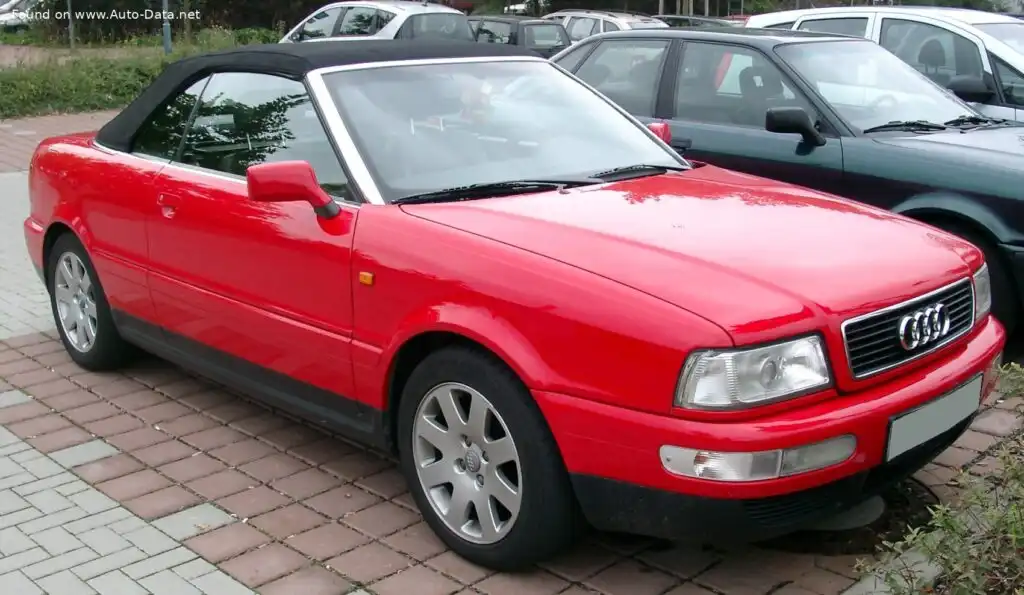
The Audi Cabriolet (B3 8G), particularly the facelifted version produced from 1997 onwards, represented a significant step forward for Audi in the premium open-top market. The 2.8 V6 E variant, powered by the AAH engine and producing 174 horsepower, was introduced in 1998 and continued in production through August 2000. This model occupied a mid-to-upper position within the Cabriolet range, offering a blend of performance, refinement, and open-air driving enjoyment. It was a key offering in Europe, where the demand for compact, stylish convertibles was strong, and represented Audi’s commitment to providing a luxurious alternative to rivals like the BMW 3 Series Convertible and Mercedes-Benz SLK.
Technical Specifications
| Brand | Audi |
| Model | Cabriolet |
| Generation | Cabriolet (B3 8G, facelift 1997) |
| Type (Engine) | 2.8 V6 E (174 Hp) |
| Start of production | 1998 |
| End of production | August, 2000 |
| Powertrain Architecture | Internal Combustion engine |
| Body type | Cabriolet |
| Seats | 4 |
| Doors | 2 |
| Fuel consumption (urban) | 14.8 l/100 km (15.9 US mpg, 19.1 UK mpg, 6.8 km/l) |
| Fuel consumption (extra urban) | 8.6 l/100 km (27.4 US mpg, 32.8 UK mpg, 11.6 km/l) |
| Fuel consumption (combined) | 10.8 l/100 km (21.8 US mpg, 26.2 UK mpg, 9.3 km/l) |
| CO2 emissions | 254 g/km |
| Fuel Type | Petrol (Gasoline) |
| Acceleration 0 – 100 km/h | 9.8 sec |
| Acceleration 0 – 62 mph | 9.8 sec |
| Acceleration 0 – 60 mph | 9.3 sec |
| Maximum speed | 218 km/h (135.46 mph) |
| Weight-to-power ratio | 8.2 kg/Hp, 121.7 Hp/tonne |
| Weight-to-torque ratio | 5.7 kg/Nm, 174.8 Nm/tonne |
| Power | 174 Hp @ 5500 rpm |
| Power per litre | 62.8 Hp/l |
| Torque | 250 Nm @ 3000 rpm (184.39 lb.-ft. @ 3000 rpm) |
| Engine layout | Front, Longitudinal |
| Engine Model/Code | AAH |
| Engine displacement | 2771 cm3 (169.1 cu. in.) |
| Number of cylinders | 6 |
| Engine configuration | V-engine |
| Cylinder Bore | 82.5 mm (3.25 in.) |
| Piston Stroke | 86.4 mm (3.4 in.) |
| Compression ratio | 10.3:1 |
| Number of valves per cylinder | 2 |
| Fuel injection system | Multi-port manifold injection |
| Engine aspiration | Naturally aspirated engine |
| Valvetrain | OHC |
| Engine oil capacity | 5 l (5.28 US qt | 4.4 UK qt) |
| Coolant | 11 l (11.62 US qt | 9.68 UK qt) |
| Kerb Weight | 1430 kg (3152.61 lbs.) |
| Max. weight | 1830 kg (4034.46 lbs.) |
| Max load | 400 kg (881.85 lbs.) |
| Trunk (boot) space – minimum | 230 l (8.12 cu. ft.) |
| Fuel tank capacity | 70 l (18.49 US gal | 15.4 UK gal) |
| Permitted trailer load with brakes (8%) | 1000 kg (2204.62 lbs.) |
| Permitted trailer load with brakes (12%) | 1000 kg (2204.62 lbs.) |
| Permitted trailer load without brakes | 750 kg (1653.47 lbs.) |
| Permitted towbar download | 40 kg (88.18 lbs.) |
| Length | 4366 mm (171.89 in.) |
| Width | 1716 mm (67.56 in.) |
| Height | 1379 mm (54.29 in.) |
| Wheelbase | 2556 mm (100.63 in.) |
| Front track | 1453 mm (57.2 in.) |
| Rear (Back) track | 1447 mm (56.97 in.) |
| Drag coefficient (Cd) | 0.36 |
| Minimum turning circle (turning diameter) | 11.1 m (36.42 ft.) |
| Drivetrain Architecture | The Internal combustion engine (ICE) drives the front wheels of the vehicle. |
| Drive wheel | Front wheel drive |
| Number of gears and type of gearbox | 5 gears, manual transmission |
| Front suspension | Independent, type McPherson with coil spring and anti-roll bar |
| Rear suspension | Semi-independent, coil spring |
| Front brakes | Ventilated discs |
| Rear brakes | Disc |
| Assisting systems | ABS (Anti-lock braking system) |
| Steering type | Steering rack and pinion |
| Power steering | Hydraulic Steering |
| Tires size | 205/60 R15 |
| Wheel rims size | 7J x 15 |
Powertrain & Engine Architecture
The heart of the 2.8 V6 E Cabriolet is the AAH engine, a 2.8-liter naturally aspirated V6. This engine utilizes a 90-degree V-angle, contributing to its smooth operation and relatively compact size. It features a cast iron block and aluminum cylinder heads, a common configuration for Audi engines of this era. Fuel delivery is managed by a Bosch Motronic multi-port fuel injection system, optimizing fuel efficiency and power output. The engine employs a single overhead camshaft (OHC) design per cylinder bank, operating two valves per cylinder (intake and exhaust). The AAH engine is known for its robust construction and relatively simple design, making it easier to maintain compared to some of its more technologically advanced counterparts. The five-speed manual transmission was standard, providing precise gear changes and a direct connection to the engine.
Driving Characteristics
The 2.8 V6 E Cabriolet offered a noticeably more refined driving experience than the base 1.8-liter models. The extra displacement and six cylinders delivered a substantial increase in torque, making it more effortless to accelerate and maintain speed, especially when fully loaded. While not a sports car, the 0-60 mph time of around 9.3 seconds was respectable for the time. The manual transmission allowed for greater driver control, and the gear ratios were well-matched to the engine’s powerband. Compared to the later 1.8T turbocharged models, the 2.8 V6 offered a more linear power delivery, lacking the turbocharger’s lag but providing a predictable and engaging driving experience.
Equipment & Trim Levels
The 2.8 V6 E Cabriolet typically came well-equipped, reflecting its position as a premium model. Standard features included power windows, central locking, power steering, and an anti-lock braking system (ABS). Interior upholstery was typically cloth, but leather was available as an option. Optional extras included a sunroof, upgraded audio systems, and heated front seats. The dashboard layout was typical of Audi’s design language at the time, with a clean and functional design.
Chassis & Braking
The B3 Cabriolet utilized a McPherson strut front suspension and a semi-independent torsion beam rear suspension. This setup provided a good balance between ride comfort and handling. The front suspension incorporated a stabilizer bar to reduce body roll during cornering. Braking duties were handled by ventilated discs at the front and solid discs at the rear, providing adequate stopping power for the vehicle’s weight and performance. The hydraulic power steering offered a light and precise steering feel.
Market Reception & Comparison
The Audi Cabriolet 2.8 V6 E was generally well-received by automotive critics. It was praised for its stylish design, comfortable ride, and refined engine. However, some critics noted that the handling wasn’t as sharp as some of its rivals, such as the BMW 3 Series Convertible. Fuel economy was also a concern, with combined fuel consumption averaging around 21.8 US mpg. Compared to the 1.8-liter models, the 2.8 V6 offered significantly more performance and refinement, but at a higher price point. The 1.8T turbocharged models, introduced later, offered a similar level of performance with improved fuel economy, eventually eclipsing the 2.8 V6 in popularity.
Legacy
The Audi Cabriolet 2.8 V6 E, while not the most common variant, remains a desirable classic car. The AAH engine is known for its reliability, provided it is properly maintained. Common issues include oil leaks and occasional sensor failures. Today, these cars are sought after by enthusiasts who appreciate their classic styling, open-air driving experience, and relatively simple mechanicals. The 2.8 V6 variant offers a unique blend of performance and refinement that sets it apart from the more basic models, making it a rewarding and enjoyable classic to own and drive.

