
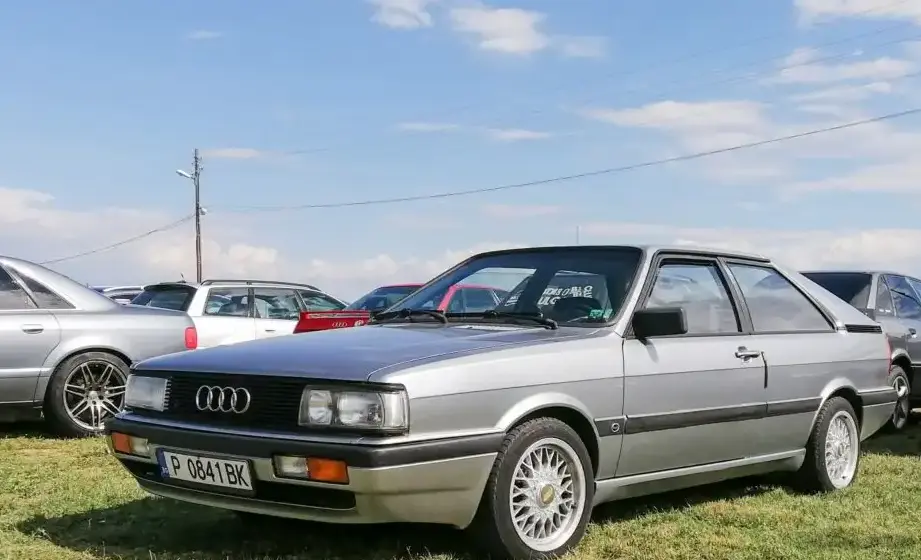
The Audi Coupe (B2), produced from 1980 to 1988, represented a significant step forward for Audi, blending sporty styling with advanced engineering. The 2.2-liter (120 hp) quattro CAT variant, introduced in January 1985 and continuing through July 1988, occupied a key position within the B2 lineup. It offered a compelling combination of performance, all-wheel drive capability, and relative affordability, appealing to buyers seeking a sophisticated and capable grand tourer. This model was part of the broader B2 generation (chassis codes 81 and 85), which benefited from a 1984 facelift that refined the exterior and interior design.
Technical Specifications
| Brand | Audi |
| Model | Coupe |
| Generation | Coupe (B2 81, 85, facelift 1984) |
| Type (Engine) | 2.2 (120 Hp) quattro CAT |
| Start of production | January, 1985 |
| End of production | July, 1988 |
| Powertrain Architecture | Internal Combustion engine |
| Body type | Coupe |
| Seats | 5 |
| Doors | 2 |
| Fuel Type | Petrol (Gasoline) |
| Acceleration 0 – 100 km/h | 9.6 sec |
| Acceleration 0 – 62 mph | 9.6 sec |
| Acceleration 0 – 60 mph | 9.1 sec |
| Maximum speed | 191 km/h (118.68 mph) |
| Weight-to-power ratio | 10 kg/Hp, 100 Hp/tonne |
| Weight-to-torque ratio | 7.1 kg/Nm, 141.7 Nm/tonne |
| Power | 120 Hp @ 5500 rpm |
| Power per litre | 53.9 Hp/l |
| Torque | 170 Nm @ 3000 rpm (125.39 lb.-ft. @ 3000 rpm) |
| Engine layout | Front, Transverse |
| Engine Model/Code | KX |
| Engine displacement | 2226 cm3 (135.84 cu. in.) |
| Number of cylinders | 5 |
| Engine configuration | Inline |
| Cylinder Bore | 81 mm (3.19 in.) |
| Piston Stroke | 86.4 mm (3.4 in.) |
| Compression ratio | 8.5:1 |
| Number of valves per cylinder | 2 |
| Fuel injection system | Multi-port manifold injection |
| Engine aspiration | Naturally aspirated engine |
| Engine oil capacity | 4.5 l (4.76 US qt | 3.96 UK qt) |
| Kerb Weight | 1200 kg (2645.55 lbs.) |
| Max. weight | 1660 kg (3659.67 lbs.) |
| Max load | 460 kg (1014.13 lbs.) |
| Trunk (boot) space – minimum | 391 l (13.81 cu. ft.) |
| Fuel tank capacity | 70 l (18.49 US gal | 15.4 UK gal) |
| Length | 4421 mm (174.06 in.) |
| Width | 1682 mm (66.22 in.) |
| Height | 1350 mm (53.15 in.) |
| Wheelbase | 2538 mm (99.92 in.) |
| Front track | 1403 mm (55.24 in.) |
| Rear (Back) track | 1407 mm (55.39 in.) |
| Ride height (ground clearance) | 120 mm (4.72 in.) |
| Drag coefficient (Cd) | 0.36 |
| Minimum turning circle (turning diameter) | 11 m (36.09 ft.) |
| Drive wheel | All wheel drive (4×4) |
| Number of gears and type of gearbox | 5 gears, manual transmission |
| Front brakes | Ventilated discs |
| Rear brakes | Disc |
| Tires size | 185/60 R14 |
| Wheel rims size | 14 |
Powertrain & Engine Architecture
The heart of the 2.2 quattro CAT was Audi’s inline five-cylinder engine, designated the KX code. This engine was a development of the earlier 2.1-liter unit, benefiting from increased displacement and refinements to the fuel injection system. The engine utilized Bosch K-Jetronic mechanical fuel injection, a system known for its reliability and precise fuel delivery. The cylinder head featured two valves per cylinder, operated by a single overhead camshaft. The engine’s inherent balance, due to the odd number of cylinders and firing order, contributed to a relatively smooth running character. The catalytic converter (“CAT” in the model designation) was a crucial addition, meeting increasingly stringent emissions regulations. This engine was transversely mounted, a layout favored by Audi for its packaging efficiency and contribution to improved handling. The five-speed manual transmission was standard, providing a good balance between performance and fuel economy.
Driving Characteristics
The 2.2-liter quattro offered a noticeably more refined driving experience compared to the smaller-displacement models in the B2 Coupe range. While not overtly powerful, the 120 hp output, combined with the all-wheel drive system, provided confident acceleration and excellent traction in a variety of conditions. The 0-60 mph time of around 9.1 seconds was respectable for the era. The five-speed manual transmission allowed drivers to keep the engine in its optimal power band. Compared to the later, more powerful 2.3-liter 170 hp versions, the 2.2 felt less urgent in its acceleration, but it offered a more manageable and fuel-efficient driving experience. The quattro system’s ability to distribute power to all four wheels significantly enhanced cornering stability and provided a secure feeling, particularly on slippery surfaces.
Equipment & Trim Levels
The 2.2 quattro CAT typically came well-equipped for its time. Standard features included power-assisted steering, front disc brakes, and a relatively comfortable interior. Upholstery was typically cloth, although leather was available as an option. The dashboard layout was functional and driver-focused, with clear instrumentation. Optional extras included a sunroof, upgraded audio systems, and alloy wheels. The trim level generally fell into the mid-range of the B2 Coupe lineup, offering a step up in terms of performance and features compared to the base models, but without the full luxury appointments of the higher-specification variants.
Chassis & Braking
The B2 Coupe chassis featured independent suspension all around, with MacPherson struts at the front and semi-trailing arms at the rear. The 2.2 quattro CAT benefited from a slightly stiffer suspension setup compared to the lower-powered models, to better manage the increased weight and performance. Front brakes were ventilated discs, providing ample stopping power, while rear brakes were solid discs. The all-wheel drive system added weight, but the benefits in terms of handling and traction outweighed this drawback. The steering was precise and well-weighted, contributing to a confident driving experience.
Market Reception & Comparison
The Audi Coupe 2.2 quattro CAT was generally well-received by automotive critics. It was praised for its blend of performance, handling, and practicality. The all-wheel drive system was a major selling point, particularly in regions with inclement weather. Compared to its siblings, the 2.2 quattro offered a compelling alternative to the base models, providing a noticeable performance upgrade without the higher price tag of the 2.3-liter variants. Fuel economy was reasonable for a car of its class, and reliability was generally good, although maintenance costs could be higher due to the complexity of the fuel injection system and all-wheel drive components.
Legacy
The Audi Coupe B2, and particularly the 2.2 quattro CAT variant, holds a respected place in automotive history. It helped establish Audi’s reputation for innovative engineering and all-wheel drive technology. The KX engine proved to be a durable and reliable unit, and many examples are still on the road today. In the used car market, these coupes are sought after by enthusiasts who appreciate their classic styling, engaging driving dynamics, and historical significance. While maintenance can require specialized knowledge, the availability of parts and a dedicated community of owners ensures that these cars can be kept running for years to come. The 2.2 quattro CAT represents a sweet spot in the B2 Coupe lineup, offering a balanced combination of performance, practicality, and affordability.
