
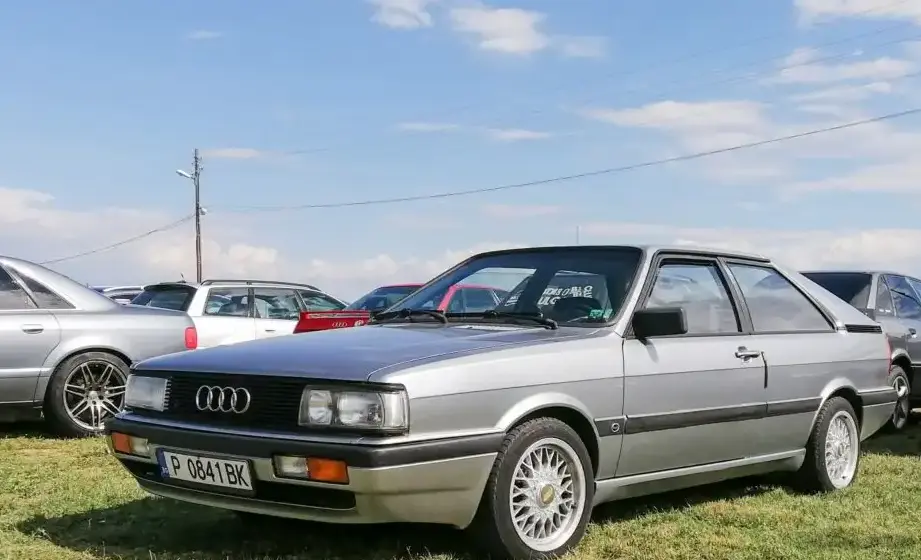
The Audi Coupe (B2), produced between 1980 and 1988, marked a significant evolution for Audi, blending sporty aesthetics with everyday practicality. The facelifted version, introduced in 1984 and continuing through 1988, refined the original design and expanded the engine options. Among these, the 2.2-liter quattro variant, delivering 136 horsepower, struck a balance between performance and the security of Audi’s renowned all-wheel-drive system. Internally designated as the 81/85 series, this model played a crucial role in establishing Audi’s reputation for technological advancement and driving pleasure in both North American and European markets.
Technical Specifications
| Brand | Audi |
| Model | Coupe |
| Generation | Coupe (B2 81, 85, facelift 1984) |
| Type (Engine) | 2.2 (136 Hp) quattro |
| Start of production | August, 1984 |
| End of production | July, 1988 |
| Powertrain Architecture | Internal Combustion engine |
| Body type | Coupe |
| Seats | 5 |
| Doors | 2 |
| Fuel Type | Petrol (Gasoline) |
| Acceleration 0 – 100 km/h | 8.9 sec |
| Acceleration 0 – 62 mph | 8.9 sec |
| Acceleration 0 – 60 mph | 8.5 sec |
| Maximum speed | 202 km/h (125.52 mph) |
| Weight-to-power ratio | 8.8 kg/Hp, 113.3 Hp/tonne |
| Weight-to-torque ratio | 6.5 kg/Nm, 155 Nm/tonne |
| Power | 136 Hp @ 5700 rpm |
| Power per litre | 61.1 Hp/l |
| Torque | 186 Nm @ 3500 rpm (137.19 lb.-ft. @ 3500 rpm) |
| Engine layout | Front, Longitudinal |
| Engine Model/Code | KV, HY |
| Engine displacement | 2226 cm3 (135.84 cu. in.) |
| Number of cylinders | 5 |
| Engine configuration | Inline |
| Cylinder Bore | 81 mm (3.19 in.) |
| Piston Stroke | 86.4 mm (3.4 in.) |
| Compression ratio | 10:1 |
| Number of valves per cylinder | 2 |
| Fuel injection system | Multi-port manifold injection |
| Engine aspiration | Naturally aspirated engine |
| Engine oil capacity | 4 l (4.23 US qt | 3.52 UK qt) |
| Coolant | 8 l (8.45 US qt | 7.04 UK qt) |
| Kerb Weight | 1200 kg (2645.55 lbs.) |
| Max. weight | 1660 kg (3659.67 lbs.) |
| Max load | 460 kg (1014.13 lbs.) |
| Trunk (boot) space – minimum | 391 l (13.81 cu. ft.) |
| Fuel tank capacity | 70 l (18.49 US gal | 15.4 UK gal) |
| Length | 4421 mm (174.06 in.) |
| Width | 1682 mm (66.22 in.) |
| Height | 1350 mm (53.15 in.) |
| Wheelbase | 2538 mm (99.92 in.) |
| Front track | 1403 mm (55.24 in.) |
| Rear (Back) track | 1407 mm (55.39 in.) |
| Ride height (ground clearance) | 120 mm (4.72 in.) |
| Drag coefficient (Cd) | 0.36 |
| Minimum turning circle (turning diameter) | 11 m (36.09 ft.) |
| Drive wheel | All wheel drive (4×4) |
| Number of gears and type of gearbox | 5 gears, manual transmission |
| Front brakes | Ventilated discs |
| Rear brakes | Disc |
| Tires size | 185/60 R14 |
| Wheel rims size | 14 |
Powertrain & Engine Architecture
The 2.2 quattro’s engine was Audi’s inline five-cylinder, identified as KV or HY depending on minor variations. This engine represented a departure from the more common inline-four designs, offering a smoother power delivery and a distinctive exhaust note. The 2226cc displacement was achieved through an 81mm bore and 86.4mm stroke, operating with a 10:1 compression ratio. A multi-port fuel injection system managed fuel delivery, enhancing efficiency and responsiveness. The engine generated 136 horsepower at 5700 rpm and 186 Nm (137.19 lb-ft) of torque at 3500 rpm. The engine’s longitudinal front-engine layout was essential for integrating the quattro all-wheel-drive system. A five-speed manual transmission was the sole gearbox option, providing precise control and a more engaging driving experience.
Driving Characteristics
The 2.2 quattro delivered a compelling combination of performance and all-weather capability. Acceleration from 0 to 60 mph took approximately 8.5 seconds, with a top speed of 125.52 mph. While not the quickest B2 Coupe variant – the 2.3 quattro offered significantly more power – the 2.2 provided ample power for spirited driving. The quattro system distributed power to all four wheels, providing exceptional traction and stability, especially on challenging surfaces. The five-speed manual transmission allowed drivers to effectively utilize the engine’s torque curve, offering precise gear changes and a connected feel. Compared to the base 1.8-liter models, the 2.2 quattro felt considerably more powerful, providing a more confident and enjoyable driving experience.
Equipment & Trim Levels
The 2.2 quattro was typically well-equipped, positioning it as a mid-range offering within the B2 Coupe lineup. Standard features included power windows, central locking, and a basic stereo system. Interior upholstery was generally cloth, with leather options available. The dashboard featured a straightforward layout with clear instrumentation. Optional extras included a sunroof, upgraded stereo systems, and alloy wheels. The 2.2 quattro often appealed to buyers seeking the benefits of the quattro system without the higher cost of the more potent 2.3-liter models.
Chassis & Braking
The Audi Coupe B2 utilized a MacPherson strut front suspension and a semi-trailing arm rear suspension. The 2.2 quattro benefited from a slightly stiffer suspension setup compared to lower-powered models, improving handling and stability. Braking was handled by ventilated discs at the front and solid discs at the rear. The quattro system’s weight distribution contributed to balanced braking performance. The car rode on 14-inch wheels with 185/60 R14 tires, striking a balance between ride comfort and grip.
Market Reception & Comparison
The Audi Coupe B2 2.2 quattro received generally positive reviews from automotive critics. It was praised for its stylish design, comfortable interior, and, crucially, its all-wheel-drive system. Critics noted that the 2.2-liter engine provided sufficient power for most driving scenarios, while the quattro system offered a significant advantage in handling and safety. Compared to the 1.8-liter models, the 2.2 quattro offered a noticeable performance boost, while remaining more affordable than the top-of-the-line 2.3-liter variant. Fuel economy was reasonable for the era, averaging around 22-26 mpg in mixed driving conditions.
Legacy
The Audi Coupe B2 2.2 quattro remains a sought-after vehicle among classic car enthusiasts. The inline five-cylinder engine is known for its durability and relatively simple maintenance requirements. The quattro system, while needing periodic maintenance, is generally reliable. Locating well-maintained examples can be difficult, as many have seen years of use. However, the 2.2 quattro’s combination of performance, practicality, and all-weather capability has ensured its lasting appeal. Today, it represents a significant chapter in Audi’s history, demonstrating the brand’s commitment to innovation and driving enjoyment. The car’s robust construction and relatively uncomplicated mechanics make it a rewarding project for enthusiasts willing to invest time and effort in restoration and upkeep.
