
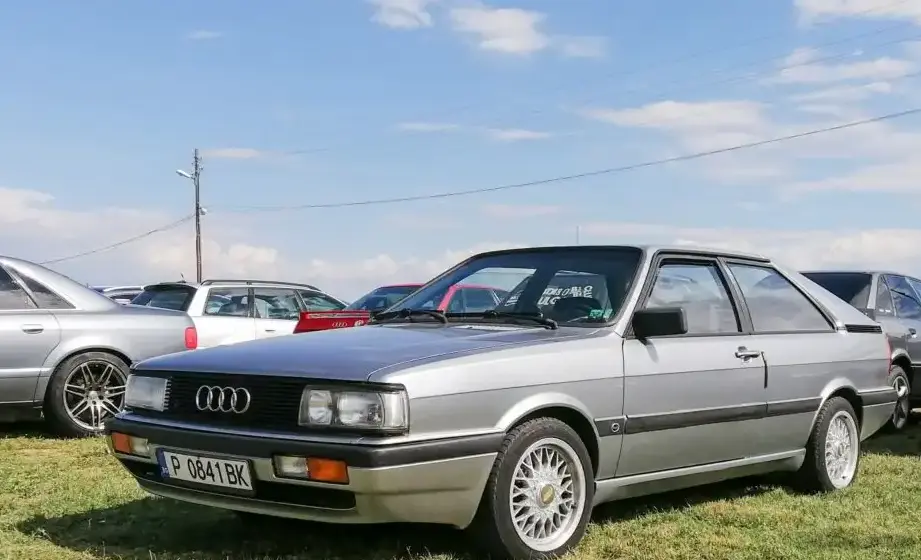
The Audi Coupe (B2), produced between 1980 and 1988, represented a significant step forward for Audi in the realm of sporty, yet practical coupes. The 2.3 E variant, equipped with a 136 horsepower engine and a catalytic converter coupled with an automatic transmission, was introduced in August 1986 and continued through 1988. This model occupied a mid-range position within the B2 Coupe lineup, offering a balance between performance and ease of use, appealing to buyers who desired a comfortable grand tourer rather than an outright sports car. It was built on the Audi 80 (B2) platform, sharing many components with the sedan but distinguished by its unique two-door coupe body style and more refined interior appointments.
Technical Specifications
| Brand | Audi |
| Model | Coupe |
| Generation | Coupe (B2 81, 85, facelift 1984) |
| Type (Engine) | 2.3 E (136 Hp) CAT Automatic |
| Start of production | August, 1986 |
| End of production | 1988 |
| Powertrain Architecture | Internal Combustion engine |
| Body type | Coupe |
| Seats | 5 |
| Doors | 2 |
| Fuel Type | Petrol (Gasoline) |
| Weight-to-power ratio | 7.9 kg/Hp, 125.9 Hp/tonne |
| Weight-to-torque ratio | 5.7 kg/Nm, 175.9 Nm/tonne |
| Power | 136 Hp @ 5700 rpm |
| Power per litre | 58.9 Hp/l |
| Torque | 190 Nm @ 4500 rpm (140.14 lb.-ft. @ 4500 rpm) |
| Engine layout | Front, Longitudinal |
| Engine Model/Code | NG |
| Engine displacement | 2309 cm3 (140.9 cu. in.) |
| Number of cylinders | 5 |
| Engine configuration | Inline |
| Cylinder Bore | 82.5 mm (3.25 in.) |
| Piston Stroke | 86.4 mm (3.4 in.) |
| Compression ratio | 10:1 |
| Number of valves per cylinder | 2 |
| Fuel injection system | Multi-port manifold injection |
| Engine aspiration | Naturally aspirated engine |
| Engine oil capacity | 4 l (4.23 US qt | 3.52 UK qt) |
| Coolant | 8 l (8.45 US qt | 7.04 UK qt) |
| Kerb Weight | 1080 kg (2380.99 lbs.) |
| Max. weight | 1520 kg (3351.03 lbs.) |
| Max load | 440 kg (970.03 lbs.) |
| Trunk (boot) space – minimum | 443 l (15.64 cu. ft.) |
| Fuel tank capacity | 75 l (19.81 US gal | 16.5 UK gal) |
| Length | 4421 mm (174.06 in.) |
| Width | 1682 mm (66.22 in.) |
| Height | 1350 mm (53.15 in.) |
| Wheelbase | 2538 mm (99.92 in.) |
| Front track | 1400 mm (55.12 in.) |
| Rear (Back) track | 1420 mm (55.91 in.) |
| Ride height (ground clearance) | 110 mm (4.33 in.) |
| Drag coefficient (Cd) | 0.36 |
| Minimum turning circle (turning diameter) | 11 m (36.09 ft.) |
| Drivetrain Architecture | The Internal combustion engine (ICE) drives the front wheels of the vehicle. |
| Drive wheel | Front wheel drive |
| Number of gears and type of gearbox | 3 gears, automatic transmission |
| Front brakes | Ventilated discs |
| Rear brakes | Disc |
| Tires size | 185/60 R14 |
| Wheel rims size | 14 |
Powertrain & Engine Architecture
The heart of the 2.3 E was the NG engine, a 2.3-liter inline five-cylinder powerplant. This engine was a development of Audi’s earlier five-cylinder designs, known for their smooth operation and relatively high output for their displacement. The NG featured multi-port fuel injection, a system that delivered fuel directly to each intake port, improving efficiency and responsiveness compared to earlier carbureted designs. The engine utilized a single overhead camshaft (SOHC) valvetrain with two valves per cylinder. The catalytic converter was a crucial component, mandated by increasingly stringent emissions regulations in many markets. The three-speed automatic transmission was a conventional hydraulic automatic, chosen for its ease of use and suitability for the grand touring nature of the car. While not particularly advanced, it provided smooth shifts and contributed to the comfortable driving experience.
Driving Characteristics
The 2.3 E Automatic offered a relaxed and refined driving experience. With 136 horsepower, acceleration was adequate but not particularly brisk. The automatic transmission, while smooth, did sap some performance compared to the available five-speed manual gearbox. The gear ratios were tuned for comfortable cruising, prioritizing fuel economy and minimizing engine noise at highway speeds. The front-wheel-drive layout provided good traction in most conditions, but could exhibit some understeer when pushed hard. Compared to the more powerful 2.3 quattro models, the 2.3 E Automatic felt less engaging, but it offered a more accessible and user-friendly experience for drivers less concerned with outright performance.
Equipment & Trim Levels
The 2.3 E Automatic typically came equipped with a reasonable level of standard features. This included power windows, central locking, and a basic stereo system. Interior upholstery was typically cloth, although leather was available as an option. The dashboard layout was typical of Audi in the 1980s, featuring a clean and functional design. Optional extras included a sunroof, upgraded stereo systems, and alloy wheels. The 2.3 E often sat between the base 1.8-liter models and the more performance-oriented 2.3 quattro variants in terms of equipment levels.
Chassis & Braking
The B2 Coupe utilized a MacPherson strut front suspension and a semi-trailing arm rear suspension. The suspension was tuned for comfort, providing a relatively smooth ride over uneven surfaces. The 2.3 E Automatic featured ventilated disc brakes at the front and solid disc brakes at the rear, providing adequate stopping power for its weight and performance. Stabilizer bars were fitted to both the front and rear axles to reduce body roll during cornering. The chassis was relatively lightweight, contributing to the car’s nimble handling characteristics.
Market Reception & Comparison
The 2.3 E Automatic was generally well-received by automotive critics as a comfortable and refined coupe. It was praised for its smooth engine, comfortable ride, and well-appointed interior. However, some critics noted that the automatic transmission dulled the driving experience compared to the manual gearbox. Fuel economy was considered reasonable for the time, but not exceptional. Compared to the 2.3 quattro, the 2.3 E Automatic offered a lower price point and a more accessible driving experience, making it appealing to a wider range of buyers. The 1.8-liter models were more affordable but offered significantly less performance.
Legacy
The Audi Coupe B2, including the 2.3 E Automatic variant, has developed a loyal following among classic car enthusiasts. The NG engine is generally considered to be a reliable unit, although regular maintenance is essential. Parts availability can be a challenge, but a dedicated network of suppliers and enthusiasts helps to keep these cars on the road. Today, the 2.3 E Automatic represents a well-preserved example of 1980s German engineering, offering a unique blend of style, comfort, and reliability. Its status in the used car market continues to appreciate as collectors recognize its significance as a classic Audi model.
