
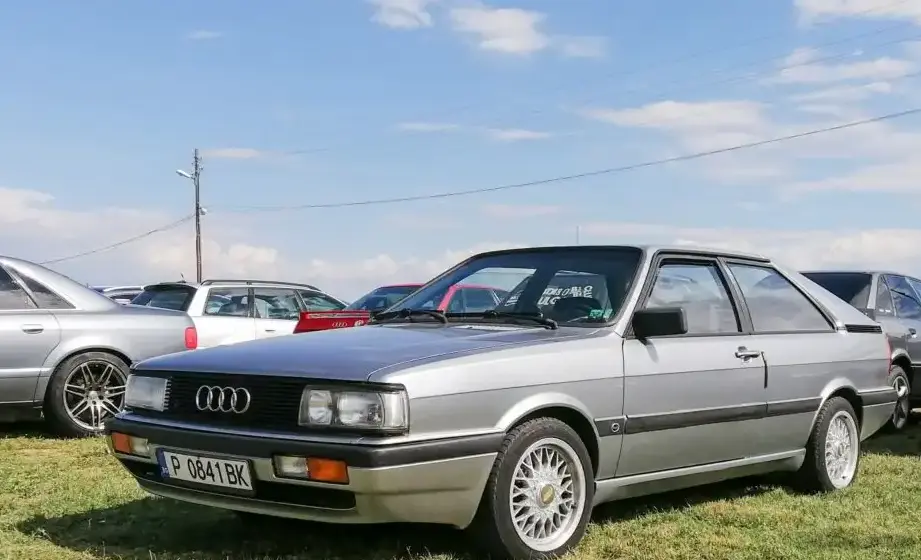
The Audi Coupe (B2), produced between 1980 and 1988, represented a significant step forward for Audi in the realm of sporty, yet practical coupes. The facelifted version, introduced in 1984, refined the original design and offered a range of engine options. Among these, the GT 1.8 variant, producing 90 horsepower, occupied an important position as an entry-level offering, particularly in European markets. Production of this specific configuration ran from 1984 until July 1988, falling within the broader B2 lifecycle (chassis codes 81 and 85). This model was designed to appeal to buyers seeking a stylish coupe with reasonable performance and fuel economy, serving as a more accessible alternative to the higher-performance versions like the Quattro.
Technical Specifications
| Brand | Audi |
| Model | Coupe |
| Generation | Coupe (B2 81, 85, facelift 1984) |
| Type (Engine) | GT 1.8 (90 Hp) |
| Start of production | 1984 |
| End of production | July, 1988 |
| Powertrain Architecture | Internal Combustion engine |
| Body type | Coupe |
| Seats | 5 |
| Doors | 2 |
| Fuel Type | Petrol (Gasoline) |
| Acceleration 0 – 100 km/h | 11 sec |
| Acceleration 0 – 62 mph | 11 sec |
| Acceleration 0 – 60 mph | 10.5 sec |
| Maximum speed | 172 km/h (106.88 mph) |
| Weight-to-power ratio | 10.6 kg/Hp, 94.7 Hp/tonne |
| Weight-to-torque ratio | 6.6 kg/Nm, 152.6 Nm/tonne |
| Power | 90 Hp @ 5200 rpm |
| Power per litre | 50.5 Hp/l |
| Torque | 145 Nm @ 3300 rpm (106.95 lb.-ft. @ 3300 rpm) |
| Engine layout | Front, Longitudinal |
| Engine Model/Code | DS, JN, JV |
| Engine displacement | 1781 cm3 (108.68 cu. in.) |
| Number of cylinders | 4 |
| Engine configuration | Inline |
| Cylinder Bore | 81 mm (3.19 in.) |
| Piston Stroke | 86.4 mm (3.4 in.) |
| Compression ratio | 10:1 |
| Number of valves per cylinder | 2 |
| Fuel injection system | Carburettor |
| Engine aspiration | Naturally aspirated engine |
| Engine oil capacity | 3 l (3.17 US qt | 2.64 UK qt) |
| Coolant | 6.5 l (6.87 US qt | 5.72 UK qt) |
| Kerb Weight | 950 kg (2094.39 lbs.) |
| Max. weight | 1410 kg (3108.52 lbs.) |
| Max load | 460 kg (1014.13 lbs.) |
| Trunk (boot) space – minimum | 443 l (15.64 cu. ft.) |
| Fuel tank capacity | 68 l (17.96 US gal | 14.96 UK gal) |
| Permitted trailer load with brakes (8%) | 1200 kg (2645.55 lbs.) |
| Permitted trailer load without brakes | 510 kg (1124.36 lbs.) |
| Length | 4421 mm (174.06 in.) |
| Width | 1682 mm (66.22 in.) |
| Height | 1350 mm (53.15 in.) |
| Wheelbase | 2538 mm (99.92 in.) |
| Front track | 1400 mm (55.12 in.) |
| Rear (Back) track | 1420 mm (55.91 in.) |
| Ride height (ground clearance) | 110 mm (4.33 in.) |
| Drag coefficient (Cd) | 0.36 |
| Minimum turning circle (turning diameter) | 10.6 m (34.78 ft.) |
| Drivetrain Architecture | The Internal combustion engine (ICE) drives the front wheels of the vehicle. |
| Drive wheel | Front wheel drive |
| Number of gears and type of gearbox | 5 gears, manual transmission |
| Front brakes | Disc |
| Rear brakes | Drum |
| Tires size | 175/70 R13 |
| Wheel rims size | 13 |
Powertrain & Engine Architecture
The GT 1.8 variant was powered by a 1.8-liter inline four-cylinder engine, designated with engine codes DS, JN, or JV depending on the specific year and market. This engine, while relatively simple in design, was known for its durability. It utilized a single overhead camshaft (SOHC) valvetrain with two valves per cylinder. Fuel delivery was managed by a carburetor, a common feature for vehicles of this era, rather than fuel injection. This carburetor setup, while less precise than injection, contributed to the engine’s simplicity and ease of maintenance. The engine produced 90 horsepower at 5200 rpm and 145 Nm (106.95 lb-ft) of torque at 3300 rpm. The engine was mounted longitudinally in the front of the vehicle, driving the front wheels. The standard transmission was a 5-speed manual, although a 3-speed automatic transmission was also available, albeit less common.
Driving Characteristics
The 1.8-liter engine, paired with the manual transmission, provided adequate, though not exhilarating, performance. Acceleration from 0 to 60 mph took around 10.5 seconds, and the top speed was approximately 107 mph. The automatic transmission option, while offering convenience, noticeably reduced performance due to its less efficient power transfer and wider gear ratios. The car felt relatively nimble due to its front-wheel-drive layout and relatively light weight (around 2094 lbs). Handling was predictable, but not particularly sporty, with a tendency towards understeer when pushed hard. Compared to the more powerful versions of the Audi Coupe, such as those equipped with the 1.9-liter or 2.1-liter engines, the GT 1.8 offered a more relaxed and fuel-efficient driving experience.
Equipment & Trim Levels
The GT 1.8 typically came with a fairly basic level of equipment, reflecting its position as an entry-level model. Standard features included cloth upholstery, a basic instrument cluster, and manual windows and door locks. Optional extras included a sunroof, upgraded audio systems, and alloy wheels. Interior trim was generally functional and durable, prioritizing practicality over luxury. The dashboard layout was typical of Audi designs of the period, with a clear and straightforward arrangement of controls.
Chassis & Braking
The Audi Coupe B2 utilized a MacPherson strut front suspension and a semi-trailing arm rear suspension. The GT 1.8 variant typically featured disc brakes on the front wheels and drum brakes on the rear. This configuration was common for vehicles in this price range during the 1980s. Stabilizer bars were fitted to both the front and rear axles to reduce body roll during cornering. The suspension was tuned for comfort rather than outright performance, providing a reasonably smooth ride on most road surfaces.
Market Reception & Comparison
The Audi Coupe GT 1.8 was generally well-received as an affordable and stylish coupe. Critics praised its attractive design and reasonable fuel economy. However, some reviewers noted that the engine lacked the power and refinement of its larger counterparts. Compared to other coupes in its class, such as the Volkswagen Scirocco or the Ford Escort, the Audi Coupe offered a more sophisticated driving experience and a higher level of build quality. The automatic transmission version, while convenient, was often criticized for its sluggish performance and reduced fuel efficiency.
Legacy
The Audi Coupe B2, including the GT 1.8 variant, has become a popular classic car among enthusiasts. The 1.8-liter engine, while not the most powerful option, is known for its reliability and relatively simple maintenance requirements. Parts availability is generally good, making it a relatively easy car to keep on the road. Today, well-maintained examples of the GT 1.8 can fetch reasonable prices in the used car market, appealing to buyers seeking a stylish and affordable classic coupe. The B2 Coupe laid the groundwork for future Audi coupe models, establishing a reputation for quality, design, and driving enjoyment.
