
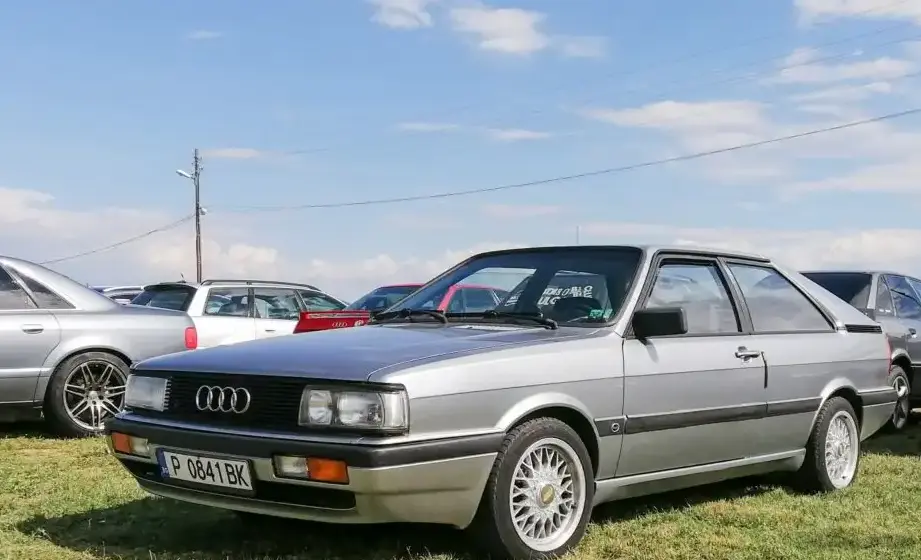
The Audi Coupe (B2), produced between 1980 and 1988, represented a significant step forward for Audi in the realm of sporty, yet accessible, grand touring coupes. The facelifted version introduced in 1984 brought subtle but important styling updates and mechanical refinements. Within the B2 range, the GT 1.8 with 90 horsepower and an automatic transmission, manufactured from 1984 to 1988, occupied the entry-level position, offering a balance of affordability and the Audi brand experience. This variant was primarily aimed at buyers seeking a comfortable and stylish coupe without the higher price tag or performance focus of the more powerful models.
Technical Specifications
| Brand | Audi |
| Model | Coupe |
| Generation | Coupe (B2 81, 85, facelift 1984) |
| Type (Engine) | GT 1.8 (90 Hp) Automatic |
| Start of production | 1984 |
| End of production | July, 1988 |
| Powertrain Architecture | Internal Combustion engine |
| Body type | Coupe |
| Seats | 5 |
| Doors | 2 |
| Fuel Type | Petrol (Gasoline) |
| Acceleration 0 – 100 km/h | 11 sec |
| Acceleration 0 – 62 mph | 11 sec |
| Acceleration 0 – 60 mph | 10.5 sec |
| Maximum speed | 168 km/h (104.39 mph) |
| Weight-to-power ratio | 10.8 kg/Hp, 92.8 Hp/tonne |
| Weight-to-torque ratio | 6.7 kg/Nm, 149.5 Nm/tonne |
| Power | 90 Hp @ 5200 rpm |
| Power per litre | 50.5 Hp/l |
| Torque | 145 Nm @ 3300 rpm (106.95 lb.-ft. @ 3300 rpm) |
| Engine layout | Front, Longitudinal |
| Engine Model/Code | DS, JN, JV |
| Engine displacement | 1781 cm3 (108.68 cu. in.) |
| Number of cylinders | 4 |
| Engine configuration | Inline |
| Cylinder Bore | 81 mm (3.19 in.) |
| Piston Stroke | 86.4 mm (3.4 in.) |
| Compression ratio | 10:1 |
| Number of valves per cylinder | 2 |
| Fuel injection system | Carburettor |
| Engine aspiration | Naturally aspirated engine |
| Engine oil capacity | 3 l (3.17 US qt | 2.64 UK qt) |
| Coolant | 6.5 l (6.87 US qt | 5.72 UK qt) |
| Kerb Weight | 970 kg (2138.48 lbs.) |
| Max. weight | 1410 kg (3108.52 lbs.) |
| Max load | 440 kg (970.03 lbs.) |
| Trunk (boot) space – minimum | 443 l (15.64 cu. ft.) |
| Fuel tank capacity | 68 l (17.96 US gal | 14.96 UK gal) |
| Permitted trailer load with brakes (8%) | 1300 kg (2866.01 lbs.) |
| Permitted trailer load without brakes | 510 kg (1124.36 lbs.) |
| Length | 4421 mm (174.06 in.) |
| Width | 1682 mm (66.22 in.) |
| Height | 1350 mm (53.15 in.) |
| Wheelbase | 2538 mm (99.92 in.) |
| Front track | 1400 mm (55.12 in.) |
| Rear (Back) track | 1420 mm (55.91 in.) |
| Ride height (ground clearance) | 110 mm (4.33 in.) |
| Drag coefficient (Cd) | 0.36 |
| Minimum turning circle (turning diameter) | 10.6 m (34.78 ft.) |
| Drivetrain Architecture | The Internal combustion engine (ICE) drives the front wheels of the vehicle. |
| Drive wheel | Front wheel drive |
| Number of gears and type of gearbox | 3 gears, automatic transmission |
| Front brakes | Disc |
| Rear brakes | Drum |
| Tires size | 175/70 R13 |
| Wheel rims size | 13 |
INTRODUCTION
The Audi Coupe B2, particularly the 1984-1988 facelifted models, represented a pivotal moment for Audi. Building on the success of the original Coupe (B1), the B2 offered a more refined and modern package. The GT 1.8 Automatic variant, powered by the DS, JN, or JV engine code, served as the entry point to the Coupe range. It was designed to appeal to buyers who prioritized comfort, style, and the prestige of the Audi badge over outright performance. This model was primarily sold in Europe, where it competed with other compact coupes like the Opel Ascona and Ford Taunus.
Powertrain & Engine Architecture
The heart of the GT 1.8 Automatic was the 1.8-liter inline-four cylinder engine. This engine, designated with codes DS, JN, or JV depending on the specific year and market, featured a single overhead camshaft (SOHC) valvetrain with two valves per cylinder. Unlike later Audi engines, this 1.8L relied on a carburetor for fuel delivery, a cost-saving measure for the entry-level model. While not as efficient or responsive as fuel injection, the carburetor provided adequate performance for everyday driving. The engine produced 90 horsepower at 5200 rpm and 145 Nm (106.95 lb-ft) of torque at 3300 rpm. The engine was mounted longitudinally in the front of the vehicle, driving the front wheels. Paired with the engine was a three-speed automatic transmission. This transmission, while providing convenience, was not known for its sportiness or efficiency. It featured relatively wide gear ratios, prioritizing smooth cruising over quick acceleration.
Driving Characteristics
The 1.8L automatic Coupe offered a comfortable, if not exhilarating, driving experience. Acceleration from 0-60 mph took around 10.5 seconds, and top speed was limited to 104.39 mph. Compared to the more powerful 1.8L versions with manual transmissions, or the higher-spec 2.0L and 2.2L models, the GT 1.8 Automatic felt noticeably slower. The automatic transmission contributed to this, as it lacked the responsiveness and control of a manual gearbox. However, the wide gear ratios made it a pleasant cruiser on the highway. The front-wheel-drive layout provided predictable handling, but the relatively soft suspension setup prioritized ride comfort over sharp cornering. The car felt stable and easy to drive, making it a good choice for inexperienced drivers or those seeking a relaxed grand touring experience.
Equipment & Trim Levels
The GT 1.8 Automatic typically came with a fairly basic level of equipment, reflecting its position as the entry-level model. Standard features included cloth upholstery, a basic stereo system, and manual windows and door locks. Power steering was often included, but air conditioning was typically an optional extra. Interior trim was generally functional and durable, with a focus on practicality rather than luxury. Optional extras included upgraded stereo systems, sunroofs, and alloy wheels. The dashboard layout was typical of 1980s Audis, with a clear and functional design.
Chassis & Braking
The Audi Coupe B2 utilized a MacPherson strut front suspension and a semi-trailing arm rear suspension. The GT 1.8 Automatic featured a softer suspension setup compared to the higher-performance models, prioritizing ride comfort. Braking duties were handled by disc brakes on the front wheels and drum brakes on the rear. This configuration was common for cars in this price range during the 1980s. The braking system was adequate for everyday driving, but lacked the stopping power of the larger disc brakes found on the more powerful models. The car’s weight distribution was reasonably balanced, contributing to its predictable handling.
Market Reception & Comparison
The GT 1.8 Automatic received mixed reviews from automotive critics. While praised for its comfortable ride, stylish design, and the prestige of the Audi brand, it was often criticized for its lack of performance and the sluggishness of the automatic transmission. Compared to the manual transmission versions of the 1.8L engine, the automatic offered significantly reduced performance and fuel economy. The higher-spec models, such as the 2.2L quattro, offered a much more engaging driving experience, but at a significantly higher price point. The GT 1.8 Automatic appealed to buyers who prioritized comfort and convenience over performance, and it offered a relatively affordable way to enter the Audi ownership experience.
Legacy
The 1.8L engine with the three-speed automatic transmission, while not the most sought-after configuration, proved to be reasonably reliable. The carburetor, while less efficient than fuel injection, was relatively simple to maintain. The automatic transmission, however, could be prone to wear and tear, particularly if not serviced regularly. Today, the GT 1.8 Automatic is a relatively affordable classic car. It represents a good entry point for those interested in owning a classic Audi Coupe. While not a performance icon, it offers a comfortable and stylish driving experience, and its relative simplicity makes it a relatively easy car to maintain. Its value in the used car market remains modest, making it an accessible option for enthusiasts.
