
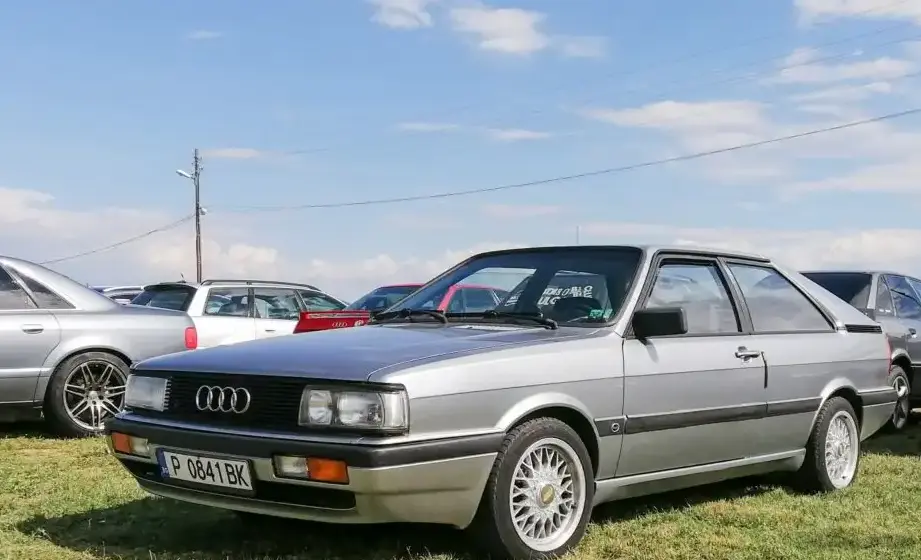
The Audi Coupe (B2), produced between 1980 and 1988, represented a significant step forward for Audi, blending sporty styling with practical usability. The facelifted version introduced in 1984 brought refinements to the exterior and interior. The GT 1.8i variant, appearing in August 1986 and continuing through 1988, occupied a middle ground in the B2 Coupe lineup, offering a balance between performance and affordability. It was positioned above the base 1.6-liter models and below the more potent 1.8S and 2.3-liter versions. This model was primarily aimed at the European market, where compact, sporty coupes were highly sought after, and represented Audi’s attempt to broaden the appeal of the Coupe beyond its initial enthusiast base.
Technical Specifications
| Brand | Audi |
| Model | Coupe |
| Generation | Coupe (B2 81, 85, facelift 1984) |
| Type (Engine) | GT 1.8i (112 Hp) |
| Start of production | August, 1986 |
| End of production | 1988 |
| Powertrain Architecture | Internal Combustion engine |
| Body type | Coupe |
| Seats | 5 |
| Doors | 2 |
| Fuel Type | Petrol (Gasoline) |
| Acceleration 0 – 100 km/h | 9.2 sec |
| Acceleration 0 – 62 mph | 9.2 sec |
| Acceleration 0 – 60 mph | 8.7 sec |
| Maximum speed | 187 km/h (116.2 mph) |
| Weight-to-power ratio | 8.8 kg/Hp, 114.3 Hp/tonne |
| Weight-to-torque ratio | 6.1 kg/Nm, 163.3 Nm/tonne |
| Power | 112 Hp @ 5800 rpm |
| Power per litre | 62.9 Hp/l |
| Torque | 160 Nm @ 3500 rpm (118.01 lb.-ft. @ 3500 rpm) |
| Engine layout | Front, Longitudinal |
| Engine Model/Code | DZ |
| Engine displacement | 1781 cm3 (108.68 cu. in.) |
| Number of cylinders | 4 |
| Engine configuration | Inline |
| Cylinder Bore | 81 mm (3.19 in.) |
| Piston Stroke | 86.4 mm (3.4 in.) |
| Compression ratio | 10:1 |
| Number of valves per cylinder | 2 |
| Fuel injection system | Multi-port manifold injection |
| Engine aspiration | Naturally aspirated engine |
| Engine oil capacity | 3.5 l (3.7 US qt | 3.08 UK qt) |
| Coolant | 6.5 l (6.87 US qt | 5.72 UK qt) |
| Kerb Weight | 980 kg (2160.53 lbs.) |
| Max. weight | 1440 kg (3174.66 lbs.) |
| Max load | 460 kg (1014.13 lbs.) |
| Trunk (boot) space – minimum | 443 l (15.64 cu. ft.) |
| Fuel tank capacity | 68 l (17.96 US gal | 14.96 UK gal) |
| Length | 4421 mm (174.06 in.) |
| Width | 1682 mm (66.22 in.) |
| Height | 1350 mm (53.15 in.) |
| Wheelbase | 2538 mm (99.92 in.) |
| Front track | 1400 mm (55.12 in.) |
| Rear (Back) track | 1420 mm (55.91 in.) |
| Ride height (ground clearance) | 110 mm (4.33 in.) |
| Drag coefficient (Cd) | 0.36 |
| Minimum turning circle (turning diameter) | 11 m (36.09 ft.) |
| Drivetrain Architecture | The Internal combustion engine (ICE) drives the front wheels of the vehicle. |
| Drive wheel | Front wheel drive |
| Number of gears and type of gearbox | 5 gears, manual transmission |
| Front brakes | Disc |
| Rear brakes | Drum |
| Tires size | 175/70 R13 |
| Wheel rims size | 13 |
Powertrain & Engine Architecture
The GT 1.8i variant was powered by Audi’s DZ engine, a 1781cc inline four-cylinder unit. This engine was a development of the earlier 1.6-liter engine, featuring a larger bore and stroke to increase displacement. The DZ engine utilized a Bosch K-Jetronic mechanical fuel injection system, a common feature on European cars of the era. This system, while reliable, was less sophisticated than later electronic fuel injection systems. The engine featured a single overhead camshaft (SOHC) operating two valves per cylinder. The engine’s longitudinal front-engine layout, coupled with front-wheel drive, was a defining characteristic of Audi’s engineering philosophy at the time. The five-speed manual transmission was the standard offering, providing a relatively direct connection between the engine and the front wheels. The transmission was known for its smooth operation, but its ratios were geared more towards fuel efficiency and comfortable cruising than outright performance.
Driving Characteristics
The 1.8i Coupe, with its 112 horsepower and 118 lb-ft of torque, offered a respectable, if not exhilarating, driving experience. Acceleration from 0-60 mph took around 8.7 seconds, making it competitive with other coupes in its class. However, it was noticeably slower than the 1.8S variant, which boasted a higher compression ratio and more aggressive camshaft timing. The five-speed manual transmission allowed drivers to make the most of the engine’s powerband, but the relatively long gear ratios meant that frequent downshifts were necessary for spirited driving. The front-wheel drive configuration provided good traction in most conditions, but could exhibit torque steer under hard acceleration. The suspension, while comfortable, was not particularly sporty, resulting in a degree of body roll during cornering. Overall, the GT 1.8i offered a balanced driving experience, prioritizing comfort and usability over outright performance.
Equipment & Trim Levels
The GT 1.8i typically came equipped with features considered standard for a coupe of its era. This included cloth upholstery, a basic stereo system, and power-assisted steering. Optional extras included a sunroof, alloy wheels, upgraded stereo systems, and central locking. Interior trim was relatively simple, reflecting the car’s positioning as a mid-range model. The dashboard layout was functional and driver-focused, with clearly marked gauges and controls. The GT 1.8i was often seen as a good value proposition, offering a reasonable level of equipment for its price.
Chassis & Braking
The B2 Coupe utilized a MacPherson strut front suspension and a torsion beam rear suspension. This setup provided a good balance between ride comfort and handling. The GT 1.8i variant typically featured disc brakes on the front wheels and drum brakes on the rear. While adequate for normal driving, the rear drum brakes were a limitation compared to the all-disc setups found on higher-spec models. The car’s relatively light weight (around 2160 lbs) helped to offset the limitations of the braking system. A stabilizer bar was fitted to the front suspension to reduce body roll, but the rear suspension lacked a stabilizer bar, contributing to the car’s tendency to understeer.
Market Reception & Comparison
The Audi Coupe GT 1.8i was generally well-received by automotive critics. It was praised for its stylish design, comfortable interior, and reasonable performance. However, some critics noted that the engine lacked the punch of the more powerful variants. Compared to the 1.6-liter models, the 1.8i offered a noticeable improvement in performance, making it a more appealing option for drivers who wanted a bit more excitement. Compared to the 1.8S, the GT 1.8i was less expensive but also less powerful and less well-equipped. Fuel economy was respectable for the time, averaging around 28-32 mpg. Reliability was generally good, although the K-Jetronic fuel injection system could require occasional maintenance.
Legacy
The Audi Coupe B2, and specifically the GT 1.8i variant, holds a nostalgic place in the hearts of many car enthusiasts. The DZ engine, while not particularly high-tech, proved to be durable and relatively easy to maintain. Today, well-maintained examples of the GT 1.8i are becoming increasingly collectible. The car’s simple design and robust construction make it a relatively easy classic to own and enjoy. While not a high-performance machine by modern standards, the GT 1.8i represents a significant chapter in Audi’s history, showcasing the brand’s commitment to stylish, well-engineered automobiles.
