
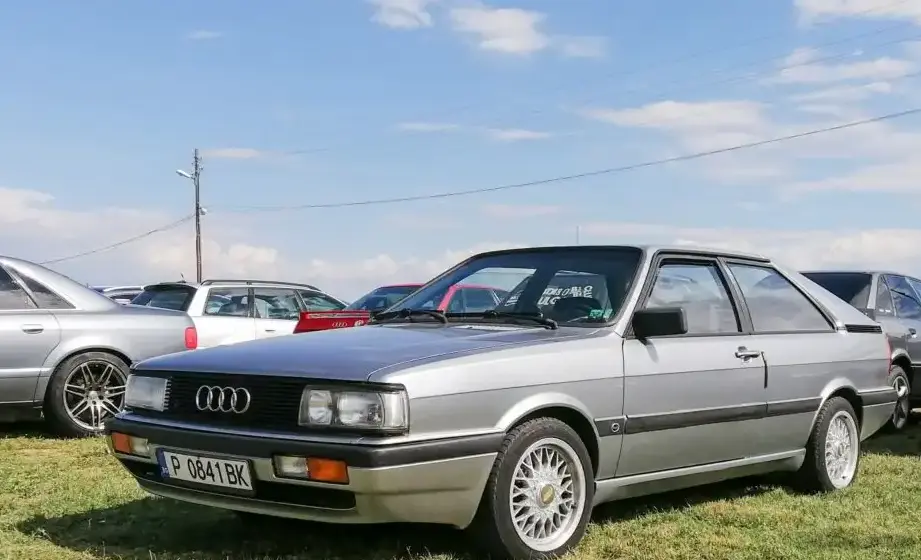
The Audi Coupe (B2), produced between 1980 and 1988, represented a significant step forward for Audi in the realm of sporty, yet practical coupes. The facelifted version introduced in 1984, encompassing models from 1985-1987, saw refinements to the exterior styling and mechanical components. The GT 2.2i variant, equipped with a 2.2-liter inline five-cylinder engine producing 115 horsepower, was a key model within the B2 lineup. It occupied a middle ground, offering a balance between performance and affordability, appealing to buyers seeking a more engaging driving experience than the base models but without the higher price tag of the more powerful versions.
Technical Specifications
| Brand | Audi |
| Model | Coupe |
| Generation | Coupe (B2 81, 85, facelift 1984) |
| Type (Engine) | GT 2.2i (115 Hp) CAT |
| Start of production | 1985 |
| End of production | 1987 |
| Powertrain Architecture | Internal Combustion engine |
| Body type | Coupe |
| Seats | 5 |
| Doors | 2 |
| Fuel consumption (combined) | 9.4 l/100 km (25 US mpg, 30.1 UK mpg, 10.6 km/l) |
| Fuel Type | Petrol (Gasoline) |
| Acceleration 0 – 100 km/h | 9.5 sec |
| Acceleration 0 – 62 mph | 9.5 sec |
| Acceleration 0 – 60 mph | 9 sec |
| Maximum speed | 189 km/h (117.44 mph) |
| Weight-to-power ratio | 9.2 kg/Hp, 108.5 Hp/tonne |
| Weight-to-torque ratio | 6.4 kg/Nm, 155.7 Nm/tonne |
| Power | 115 Hp @ 5500 rpm |
| Power per litre | 51.7 Hp/l |
| Torque | 165 Nm @ 2500 rpm (121.7 lb.-ft. @ 2500 rpm) |
| Engine layout | Front, Longitudinal |
| Engine Model/Code | KX |
| Engine displacement | 2226 cm3 (135.84 cu. in.) |
| Number of cylinders | 5 |
| Engine configuration | Inline |
| Cylinder Bore | 81 mm (3.19 in.) |
| Piston Stroke | 86.4 mm (3.4 in.) |
| Compression ratio | 8.5:1 |
| Number of valves per cylinder | 2 |
| Fuel injection system | Multi-port manifold injection |
| Engine aspiration | Naturally aspirated engine |
| Engine oil capacity | 4.5 l (4.76 US qt | 3.96 UK qt) |
| Coolant | 8 l (8.45 US qt | 7.04 UK qt) |
| Kerb Weight | 1060 kg (2336.9 lbs.) |
| Max. weight | 1520 kg (3351.03 lbs.) |
| Max load | 460 kg (1014.13 lbs.) |
| Trunk (boot) space – minimum | 443 l (15.64 cu. ft.) |
| Fuel tank capacity | 68 l (17.96 US gal | 14.96 UK gal) |
| Permitted trailer load with brakes (8%) | 1400 kg (3086.47 lbs.) |
| Permitted trailer load without brakes | 560 kg (1234.59 lbs.) |
| Length | 4421 mm (174.06 in.) |
| Width | 1682 mm (66.22 in.) |
| Height | 1350 mm (53.15 in.) |
| Wheelbase | 2538 mm (99.92 in.) |
| Front track | 1403 mm (55.24 in.) |
| Rear (Back) track | 1407 mm (55.39 in.) |
| Ride height (ground clearance) | 110 mm (4.33 in.) |
| Drag coefficient (Cd) | 0.36 |
| Minimum turning circle (turning diameter) | 11 m (36.09 ft.) |
| Drivetrain Architecture | The Internal combustion engine (ICE) drives the front wheels of the vehicle. |
| Drive wheel | Front wheel drive |
| Number of gears and type of gearbox | 5 gears, manual transmission |
| Front brakes | Ventilated discs |
| Rear brakes | Disc |
| Tires size | 185/60 R14 |
| Wheel rims size | 14 |
Powertrain & Engine Architecture
The heart of the GT 2.2i was the Audi KX engine, a 2.2-liter inline five-cylinder powerplant. This engine was a hallmark of Audi’s engineering prowess during the 1980s, offering a unique blend of smoothness and performance. The KX featured a cast iron block and an aluminum cylinder head, incorporating a single overhead camshaft operating two valves per cylinder. Fuel delivery was managed by Bosch K-Jetronic multi-port fuel injection, a sophisticated system for its time that contributed to relatively good fuel efficiency and smooth power delivery. The engine’s longitudinal mounting and front-wheel drive configuration were typical of Audi’s engineering philosophy, prioritizing balanced handling. The five-speed manual transmission was the standard offering, providing precise gear changes and allowing drivers to fully exploit the engine’s power band.
Driving Characteristics
The 115 horsepower and 122 lb-ft of torque produced by the 2.2i engine provided adequate, though not exhilarating, performance. Acceleration from 0 to 60 mph took around 9 seconds, and the car could reach a top speed of approximately 117 mph. The five-speed manual transmission offered a good spread of gears, allowing the engine to remain in its optimal power range during most driving situations. Compared to the more powerful Quattro models, the GT 2.2i felt less urgent, but it offered a more forgiving and accessible driving experience. The front-wheel drive layout provided good traction in most conditions, but could exhibit torque steer under hard acceleration. The suspension, while comfortable, was tuned for a balance between ride quality and handling, resulting in a slightly less sporty feel than the Quattro variants.
Equipment & Trim Levels
The GT 2.2i typically came equipped with a reasonable level of standard features. Interior appointments included cloth upholstery, a basic stereo system, and power windows. Optional extras included a sunroof, upgraded stereo systems, and alloy wheels. The dashboard layout was functional and straightforward, typical of German automotive design of the era. The GT 2.2i was positioned as a mid-range offering, bridging the gap between the base models and the more luxurious and performance-oriented Quattros. It appealed to buyers who wanted a stylish and well-built coupe without the higher price tag of the flagship models.
Chassis & Braking
The Audi Coupe B2 utilized a MacPherson strut front suspension and a semi-trailing arm rear suspension. The GT 2.2i variant featured ventilated disc brakes at the front and solid disc brakes at the rear, providing adequate stopping power for its weight and performance. The steering was a rack-and-pinion system, offering precise and responsive handling. The car’s relatively lightweight construction (around 2337 lbs) contributed to its nimble handling characteristics. Stabilizer bars were fitted to both the front and rear axles to reduce body roll during cornering.
Market Reception & Comparison
The Audi Coupe B2, and specifically the GT 2.2i variant, was generally well-received by automotive critics. It was praised for its stylish design, comfortable interior, and refined engine. However, some critics noted that the performance was not as exciting as that of the Quattro models. Compared to other coupes in its class, such as the BMW 3-Series Coupe and the Mercedes-Benz 190E Coupe, the Audi offered a unique combination of practicality, style, and German engineering. Fuel economy was respectable for the time, averaging around 25 mpg in combined driving. Reliability was generally good, although the K-Jetronic fuel injection system could require occasional maintenance.
Legacy
The Audi Coupe B2, including the GT 2.2i, remains a popular classic car among enthusiasts. The inline five-cylinder engine is particularly well-regarded for its smooth operation and distinctive sound. While not as sought-after as the Quattro models, the GT 2.2i offers a more affordable entry point into Audi ownership. The KX engine is known for its durability, but regular maintenance is essential to keep it running smoothly. Today, well-maintained examples of the GT 2.2i can be found in the used car market, offering a stylish and engaging driving experience for those seeking a classic German coupe.
