
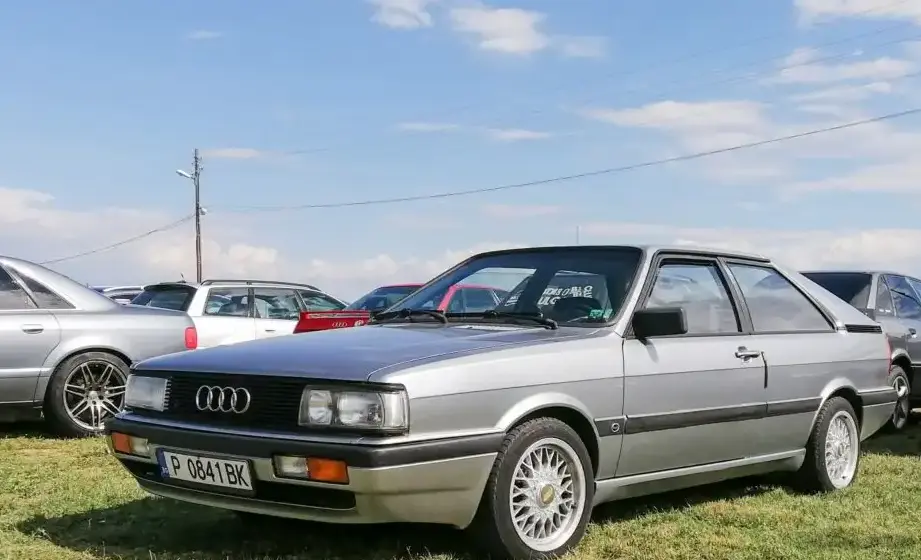
The Audi Coupe (B2), produced between 1980 and 1988, represented a significant step forward for Audi in the realm of sporty, yet practical coupes. The facelifted version introduced in 1984, encompassing models built through 1988, refined the original design and offered a range of engine options. The GT 2.2i variant, powered by a 2.2-liter inline-five engine producing 136 horsepower, occupied a sweet spot in the lineup, offering a balance of performance and affordability. This model was primarily aimed at the European market, where compact, sporty coupes were highly sought after, and represented Audi’s commitment to delivering a premium driving experience in a relatively accessible package.
Technical Specifications
| Brand | Audi |
| Model | Coupe |
| Generation | Coupe (B2 81, 85, facelift 1984) |
| Type (Engine) | GT 2.2i (136 Hp) |
| Start of production | August, 1984 |
| End of production | July, 1988 |
| Powertrain Architecture | Internal Combustion engine |
| Body type | Coupe |
| Seats | 5 |
| Doors | 2 |
| Fuel consumption (combined) | 9.4 l/100 km (25 US mpg, 30.1 UK mpg, 10.6 km/l) |
| Fuel Type | Petrol (Gasoline) |
| Acceleration 0 – 100 km/h | 8.6 sec |
| Acceleration 0 – 62 mph | 8.6 sec |
| Acceleration 0 – 60 mph | 8.2 sec |
| Maximum speed | 202 km/h (125.52 mph) |
| Weight-to-power ratio | 7.8 kg/Hp, 128.3 Hp/tonne |
| Weight-to-torque ratio | 5.7 kg/Nm, 175.5 Nm/tonne |
| Power | 136 Hp @ 5700 rpm |
| Power per litre | 61.1 Hp/l |
| Torque | 186 Nm @ 3500 rpm (137.19 lb.-ft. @ 3500 rpm) |
| Engine layout | Front, Longitudinal |
| Engine Model/Code | KV, HY |
| Engine displacement | 2226 cm3 (135.84 cu. in.) |
| Number of cylinders | 5 |
| Engine configuration | Inline |
| Cylinder Bore | 81 mm (3.19 in.) |
| Piston Stroke | 86.4 mm (3.4 in.) |
| Compression ratio | 10:1 |
| Number of valves per cylinder | 2 |
| Fuel injection system | Multi-port manifold injection |
| Engine aspiration | Naturally aspirated engine |
| Engine oil capacity | 4 l (4.23 US qt | 3.52 UK qt) |
| Coolant | 8 l (8.45 US qt | 7.04 UK qt) |
| Kerb Weight | 1060 kg (2336.9 lbs.) |
| Max. weight | 1520 kg (3351.03 lbs.) |
| Max load | 460 kg (1014.13 lbs.) |
| Trunk (boot) space – minimum | 443 l (15.64 cu. ft.) |
| Fuel tank capacity | 68 l (17.96 US gal | 14.96 UK gal) |
| Permitted trailer load with brakes (8%) | 1400 kg (3086.47 lbs.) |
| Permitted trailer load without brakes | 560 kg (1234.59 lbs.) |
| Length | 4421 mm (174.06 in.) |
| Width | 1682 mm (66.22 in.) |
| Height | 1350 mm (53.15 in.) |
| Wheelbase | 2538 mm (99.92 in.) |
| Front track | 1403 mm (55.24 in.) |
| Rear (Back) track | 1407 mm (55.39 in.) |
| Ride height (ground clearance) | 120 mm (4.72 in.) |
| Drag coefficient (Cd) | 0.36 |
| Minimum turning circle (turning diameter) | 11 m (36.09 ft.) |
| Drivetrain Architecture | The Internal combustion engine (ICE) drives the front wheels of the vehicle. |
| Drive wheel | Front wheel drive |
| Number of gears and type of gearbox | 5 gears, manual transmission |
| Front brakes | Ventilated discs |
| Rear brakes | Disc |
| Tires size | 185/60 R14 |
| Wheel rims size | 14 |
Powertrain & Engine Architecture
The heart of the GT 2.2i was Audi’s inline-five cylinder engine, designated KV or HY depending on minor variations. This engine was a hallmark of Audi’s engineering prowess during the 1980s, offering a unique blend of smoothness and performance. The 2226cc displacement was achieved with a bore of 81mm and a stroke of 86.4mm, operating with a compression ratio of 10:1. Fuel delivery was handled by a multi-port manifold injection system, a significant advancement over earlier carbureted designs, contributing to improved fuel efficiency and throttle response. The engine featured a single overhead camshaft (SOHC) operating two valves per cylinder. The five-cylinder configuration inherently provided a smoother power delivery compared to a four-cylinder, and the GT 2.2i’s 136 horsepower at 5700 rpm and 186 Nm (137.19 lb-ft) of torque at 3500 rpm provided adequate performance for spirited driving. The engine was mounted longitudinally in the front of the vehicle, driving the front wheels.
Driving Characteristics
The GT 2.2i, with its 136 horsepower and five-speed manual transmission, offered a respectable, though not blistering, driving experience. Acceleration from 0 to 60 mph took approximately 8.2 seconds, and the car could reach a top speed of 202 km/h (125.52 mph). Compared to the more powerful Quattro models or the later 2.3-liter variants, the GT 2.2i felt less urgent in its acceleration. However, the inline-five engine provided a broad torque curve, making it relatively easy to drive in everyday situations. The front-wheel drive configuration offered good traction in most conditions, but could exhibit torque steer under hard acceleration. The five-speed gearbox was well-matched to the engine’s characteristics, providing comfortable cruising at highway speeds.
Equipment & Trim Levels
The GT 2.2i typically came equipped with a reasonable level of standard features for its time. Interior appointments included cloth upholstery, a basic stereo system, and manual windows and door locks. Power steering was often included, but air conditioning was frequently an optional extra. The dashboard layout was functional and straightforward, typical of German automotive design of the era. Optional extras could include upgraded stereo systems, sunroofs, and alloy wheels. The GT 2.2i represented a mid-range trim level within the Coupe B2 lineup, positioned above the base models but below the more luxurious and performance-oriented Quattros.
Chassis & Braking
The Audi Coupe B2 utilized a MacPherson strut front suspension and a semi-trailing arm rear suspension. The GT 2.2i’s suspension was tuned for a balance of comfort and handling. Front brakes were ventilated discs, providing adequate stopping power, while rear brakes were solid discs. The car rode on 185/60 R14 tires mounted on 14-inch wheels. A stabilizer bar was fitted to both the front and rear axles to reduce body roll during cornering. The chassis was relatively lightweight, contributing to the car’s nimble handling characteristics.
Market Reception & Comparison
The Audi Coupe B2, and specifically the GT 2.2i variant, was generally well-received by automotive critics. It was praised for its stylish design, comfortable interior, and refined engine. However, some critics noted that the front-wheel drive configuration limited its handling potential compared to the Quattro models. Fuel economy was considered reasonable for the time, averaging around 25 US mpg. Compared to other coupes in its class, such as the BMW 3-Series Coupe or the Ford Capri, the Audi Coupe offered a unique combination of German engineering and practicality. The GT 2.2i provided a more affordable entry point into the Audi Coupe range, making it accessible to a wider range of buyers.
Legacy
The Audi Coupe B2, including the GT 2.2i, has developed a loyal following among classic car enthusiasts. The inline-five engine is particularly prized for its distinctive sound and robust construction. While not without its quirks, the GT 2.2i powertrain is generally considered reliable, provided it is properly maintained. Today, well-preserved examples of the GT 2.2i are becoming increasingly collectible, representing a piece of Audi’s rich automotive history. Parts availability can be a challenge, but a dedicated network of enthusiasts and suppliers helps to keep these cars on the road.
