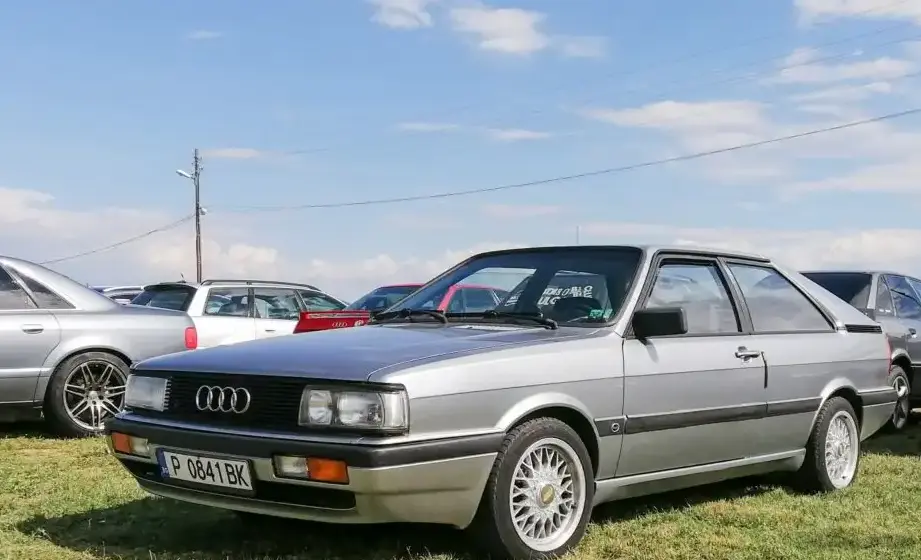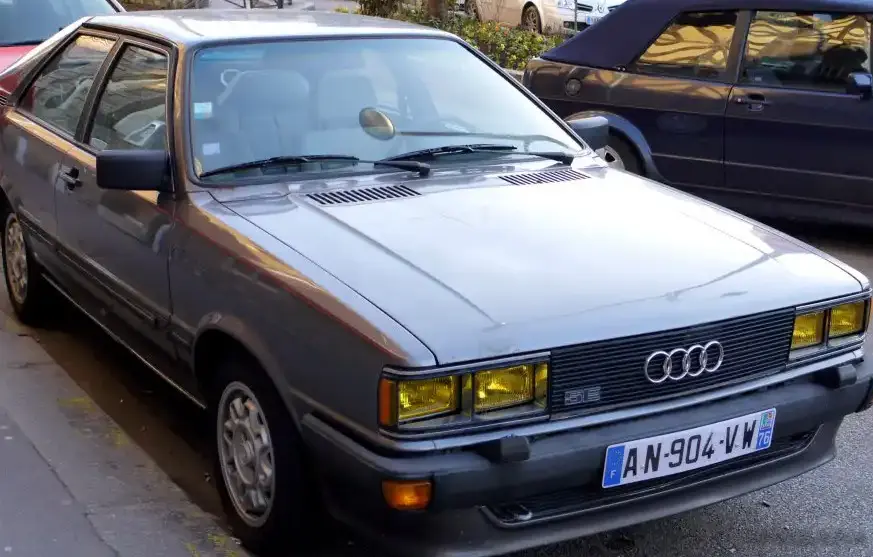
The Audi Coupe (B2), produced between 1980 and 1988, represented a significant step forward for Audi, blending sporty styling with practical usability. The GL 1.8 variant, specifically those built between January 1981 and July 1982, occupied an entry-level position within the B2 Coupe range. Positioned below the more powerful 1.6 and 2.1 liter models, and significantly predating the later turbocharged and five-cylinder versions, the GL 1.8 offered a more affordable and fuel-conscious option for buyers seeking Audi’s distinctive design and front-wheel-drive handling. It was built on the Audi B2 platform (internal codes 81 and 85), sharing its underpinnings with the Audi 80 sedan.
Technical Specifications
| Brand | Audi |
| Model | Coupe |
| Generation | Coupe (B2 81, 85) |
| Type (Engine) | GL 1.8 (75 Hp) |
| Start of production | January, 1981 |
| End of production | July, 1982 |
| Powertrain Architecture | Internal Combustion engine |
| Body type | Coupe |
| Seats | 5 |
| Doors | 2 |
| Fuel Type | Petrol (Gasoline) |
| Acceleration 0 – 100 km/h | 15.9 sec |
| Acceleration 0 – 62 mph | 15.9 sec |
| Acceleration 0 – 60 mph | 15.1 sec |
| Maximum speed | 156 km/h (96.93 mph) |
| Weight-to-power ratio | 12.7 kg/Hp, 78.9 Hp/tonne |
| Weight-to-torque ratio | 6.9 kg/Nm, 145.3 Nm/tonne |
| Power | 75 Hp @ 4500 rpm |
| Power per litre | 42.1 Hp/l |
| Torque | 138 Nm @ 2600 rpm (101.78 lb.-ft. @ 2600 rpm) |
| Engine layout | Front, Longitudinal |
| Engine Model/Code | DD |
| Engine displacement | 1781 cm3 (108.68 cu. in.) |
| Number of cylinders | 4 |
| Engine configuration | Inline |
| Cylinder Bore | 81 mm (3.19 in.) |
| Piston Stroke | 86.4 mm (3.4 in.) |
| Compression ratio | 8.8:1 |
| Number of valves per cylinder | 2 |
| Fuel injection system | Carburettor |
| Engine aspiration | Naturally aspirated engine |
| Engine oil capacity | 3.5 l (3.7 US qt | 3.08 UK qt) |
| Coolant | 6.5 l (6.87 US qt | 5.72 UK qt) |
| Kerb Weight | 950 kg (2094.39 lbs.) |
| Max. weight | 1410 kg (3108.52 lbs.) |
| Max load | 460 kg (1014.13 lbs.) |
| Trunk (boot) space – minimum | 494 l (17.45 cu. ft.) |
| Fuel tank capacity | 60 l (15.85 US gal | 13.2 UK gal) |
| Length | 4349 mm (171.22 in.) |
| Width | 1682 mm (66.22 in.) |
| Height | 1350 mm (53.15 in.) |
| Wheelbase | 2542 mm (100.08 in.) |
| Front track | 1400 mm (55.12 in.) |
| Rear (Back) track | 1420 mm (55.91 in.) |
| Drag coefficient (Cd) | 0.39 |
| Minimum turning circle | 10.4 m (34.12 ft.) |
| Drivetrain Architecture | The Internal combustion engine (ICE) drives the front wheels of the vehicle. |
| Drive wheel | Front wheel drive |
| Number of gears and type of gearbox | 5 gears, manual transmission |
| Front brakes | Ventilated discs |
| Rear brakes | Drum |
| Tires size | 175/70 R13 |
| Wheel rims size | 13 |
Powertrain & Engine Architecture
The GL 1.8 was powered by Audi’s DD engine code, a 1781cc inline four-cylinder engine. This engine utilized a single, two-barrel Solex carburetor for fuel delivery, a relatively simple system for the time. The engine featured a single overhead camshaft (SOHC) operating two valves per cylinder. The longitudinal engine placement, a hallmark of Audi’s front-wheel-drive layout, contributed to a balanced weight distribution. The five-speed manual transmission was standard, providing a reasonable spread of gears for maximizing the engine’s limited power. While not a particularly sophisticated engine by modern standards, the DD engine was known for its durability and relative ease of maintenance.
Driving Characteristics
The 75 horsepower output of the GL 1.8 translated to modest performance. Acceleration was leisurely, with 0-60 mph times hovering around 15 seconds. The car was geared for economy rather than outright speed. The five-speed manual transmission helped to keep the engine in its optimal power band, but overtaking required careful planning. Compared to the later 1.6 liter models, the 1.8 offered a slight improvement in torque, making it feel a bit more responsive in everyday driving. However, it lacked the punch of the 2.1 liter versions, and was worlds away from the performance offered by the later turbocharged and five-cylinder Coupes. The front-wheel-drive configuration provided predictable handling, but could exhibit understeer when pushed hard.
Equipment & Trim Levels
The GL 1.8 was positioned as a relatively basic trim level. Standard equipment typically included cloth upholstery, basic instrumentation, and steel wheels with hubcaps. Power steering and central locking were often optional extras. The interior design was functional and understated, reflecting the car’s entry-level status. Optional extras could include a sunroof, upgraded audio systems, and more comfortable seating. The dashboard layout was typical of early 1980s Audis, with a clear and logical arrangement of controls.
Chassis & Braking
The B2 Coupe utilized a MacPherson strut front suspension and a torsion beam rear suspension. The front suspension provided a comfortable ride and decent handling, while the rear torsion beam was a cost-effective solution that offered adequate stability. Braking was accomplished via ventilated discs at the front and drum brakes at the rear. The braking system was adequate for the car’s performance, but lacked the stopping power of more modern systems. Stabilizer bars were fitted to both the front and rear axles to reduce body roll during cornering.
Market Reception & Comparison
The GL 1.8 Coupe was generally well-received as an affordable and stylish entry point into the Audi range. Critics praised its design and build quality, but noted its modest performance. Compared to the more powerful variants, the GL 1.8 offered better fuel economy, making it an attractive option for buyers prioritizing efficiency. However, it lacked the prestige and performance of the higher-spec models. The 1.6 liter version offered similar fuel economy with slightly less power, while the 2.1 liter provided a significant performance boost at a higher price point.
Legacy
The GL 1.8 Coupe, while not the most sought-after variant of the B2 generation, holds a place in Audi’s history as a crucial stepping stone. The DD engine proved to be a reliable unit, and many examples are still on the road today. However, due to its age and relatively low performance, it is not a particularly popular choice among classic car enthusiasts. Parts availability can be a challenge, but many components are still available through specialist suppliers. The GL 1.8 represents a simpler, more analog era of automotive engineering, and offers a unique driving experience for those seeking a classic Audi Coupe.