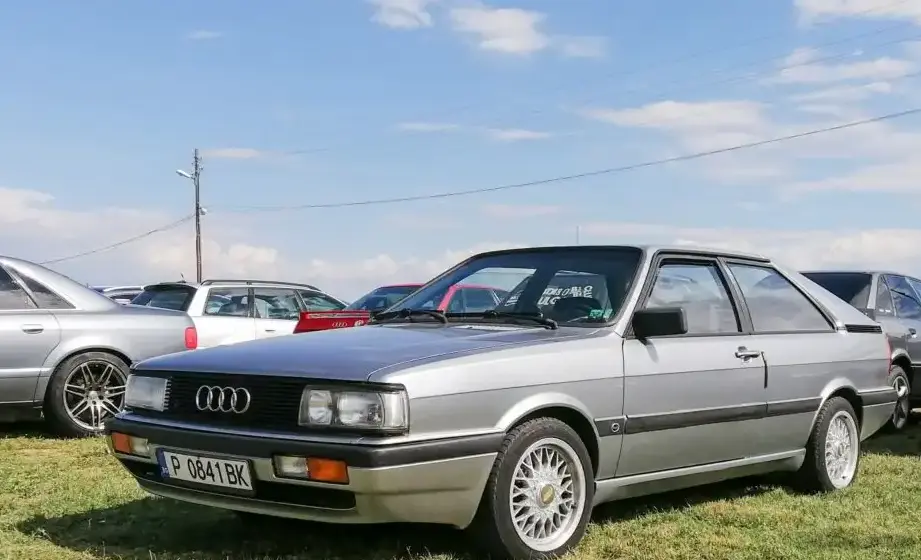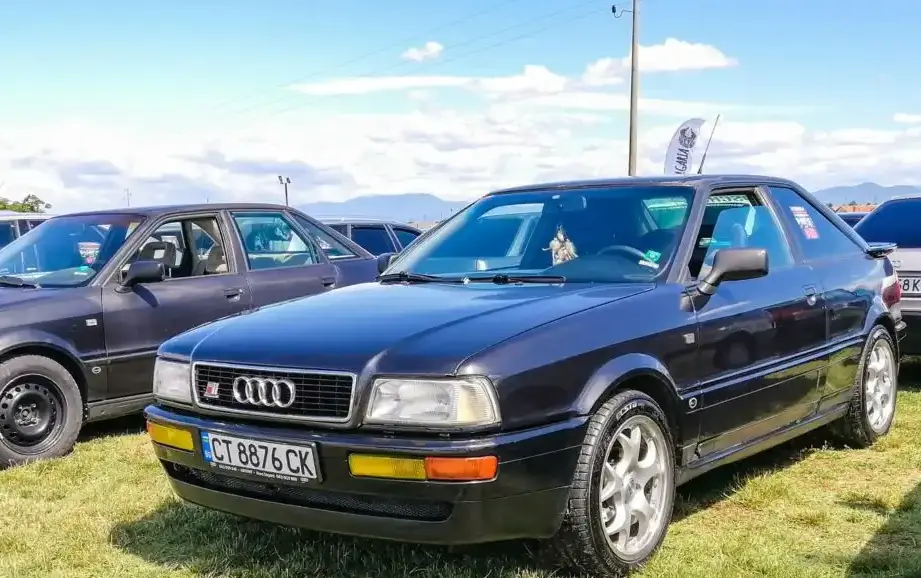
The Audi Coupe (B4), produced between 1992 and 1996, represented a significant evolution in Audi’s coupe lineage. Specifically, the 2.0 16V variant, powered by the ACE engine, occupied a middle ground within the B4 Coupe range, offering a balance between performance and affordability. This model, built on the Audi 8C platform (shared with the VW Passat and Golf), aimed to provide a more accessible entry point into the Audi coupe experience compared to the more potent 2.6L and S2 models. It was primarily marketed in Europe, where the demand for compact, sporty coupes remained strong.
Technical Specifications
| Brand | Audi |
| Model | Coupe |
| Generation | Coupe (B4 8C) |
| Type (Engine) | 2.0 16V (140 Hp) |
| Start of production | 1992 |
| End of production | 1996 |
| Powertrain Architecture | Internal Combustion engine |
| Body type | Coupe |
| Seats | 5 |
| Doors | 3 |
| Fuel consumption (urban) | 11.8 l/100 km (19.9 US mpg, 23.9 UK mpg, 8.5 km/l) |
| Fuel consumption (extra urban) | 5.9 l/100 km (39.9 US mpg, 47.9 UK mpg, 16.9 km/l) |
| Fuel consumption (combined) | 8 l/100 km (29.4 US mpg, 35.3 UK mpg, 12.5 km/l) |
| Fuel Type | Petrol (Gasoline) |
| Acceleration 0 – 100 km/h | 9.4 sec |
| Acceleration 0 – 62 mph | 9.4 sec |
| Acceleration 0 – 60 mph | 8.9 sec |
| Maximum speed | 207 km/h (128.62 mph) |
| Weight-to-power ratio | 9.1 kg/Hp, 110.2 Hp/tonne |
| Weight-to-torque ratio | 6.9 kg/Nm, 145.7 Nm/tonne |
| Power | 140 Hp @ 5900 rpm |
| Power per litre | 70.6 Hp/l |
| Torque | 185 Nm @ 4500 rpm (136.45 lb.-ft. @ 4500 rpm) |
| Engine layout | Front, Longitudinal |
| Engine Model/Code | ACE |
| Engine displacement | 1984 cm3 (121.07 cu. in.) |
| Number of cylinders | 4 |
| Engine configuration | Inline |
| Cylinder Bore | 82.5 mm (3.25 in.) |
| Piston Stroke | 92.8 mm (3.65 in.) |
| Compression ratio | 10.8:1 |
| Number of valves per cylinder | 4 |
| Fuel injection system | Multi-port manifold injection |
| Engine aspiration | Naturally aspirated engine |
| Valvetrain | DOHC |
| Engine oil capacity | 3 l (3.17 US qt | 2.64 UK qt) |
| Coolant | 6.5 l (6.87 US qt | 5.72 UK qt) |
| Kerb Weight | 1270 kg (2799.87 lbs.) |
| Max. weight | 1690 kg (3725.81 lbs.) |
| Max load | 420 kg (925.94 lbs.) |
| Trunk (boot) space – minimum | 295 l (10.42 cu. ft.) |
| Trunk (boot) space – maximum | 977 l (34.5 cu. ft.) |
| Fuel tank capacity | 68 l (17.96 US gal | 14.96 UK gal) |
| Length | 4366 mm (171.89 in.) |
| Width | 1716 mm (67.56 in.) |
| Width including mirrors | 1930 mm (75.98 in.) |
| Height | 1375 mm (54.13 in.) |
| Wheelbase | 2556 mm (100.63 in.) |
| Front track | 1446 mm (56.93 in.) |
| Rear (Back) track | 1447 mm (56.97 in.) |
| Front overhang | 911 mm (35.87 in.) |
| Rear overhang | 899 mm (35.39 in.) |
| Drag coefficient (Cd) | 0.32 |
| Minimum turning circle | 11.3 m (37.07 ft.) |
| Drivetrain Architecture | The Internal combustion engine (ICE) drives the front wheels of the vehicle. |
| Drive wheel | Front wheel drive |
| Number of gears and type of gearbox | 5 gears, manual transmission |
| Front suspension | Independent, type McPherson with coil spring and anti-roll bar |
| Rear suspension | Double wishbone |
| Front brakes | Ventilated discs |
| Rear brakes | Disc |
| Assisting systems | ABS (Anti-lock braking system) |
| Steering type | Steering rack and pinion |
| Power steering | Hydraulic Steering |
| Tires size | 205/60 R15 |
| Wheel rims size | 15 |
Powertrain & Engine Architecture
The heart of the Audi Coupe 2.0 16V is the ACE engine, a 1984cc inline-four cylinder powerplant. This engine, a member of Audi’s long-running EA827 family, featured a dual overhead camshaft (DOHC) valvetrain with four valves per cylinder – hence the “16V” designation. The ACE engine utilized Bosch Motronic fuel injection, a multi-port system that delivered precise fuel metering for improved efficiency and performance. The 10.8:1 compression ratio contributed to the engine’s respectable output. The engine’s longitudinal mounting and front-wheel drive configuration were typical for Audi models of this era. The standard transmission was a five-speed manual, though a four-speed automatic was also available, impacting performance and fuel economy.
Driving Characteristics
The 2.0 16V Coupe offered a reasonably engaging driving experience, though it wasn’t in the same league as the more powerful variants. With 140 horsepower, acceleration to 60 mph took around 8.9 seconds, and top speed was approximately 128 mph. The engine delivered a usable amount of torque, making it suitable for everyday driving. The five-speed manual transmission allowed drivers to keep the engine in its optimal power band, while the optional automatic, while providing convenience, resulted in noticeable performance loss. The front-wheel drive setup provided good traction in most conditions, but could exhibit torque steer under hard acceleration. The suspension, tuned for a balance of comfort and handling, offered a reasonably composed ride.
Equipment & Trim Levels
The 2.0 16V Coupe typically came equipped with features such as power windows, central locking, and a basic stereo system. Interior upholstery was generally cloth, though leather options were available. Dashboard design was functional and typically featured analog gauges. Optional extras included sunroofs, upgraded audio systems, and alloy wheels. The trim level sat in the middle of the range, offering more features than the base 1.8L model but lacking the luxury appointments of the 2.6L and S2 versions.
Chassis & Braking
The B4 Coupe utilized an independent McPherson strut suspension at the front and a double wishbone setup at the rear, providing a good balance of ride comfort and handling. Front brakes were ventilated discs, offering good stopping power, while rear brakes were solid discs. ABS (Anti-lock Braking System) was standard, enhancing safety. The chassis was relatively lightweight, contributing to the car’s agility. Stabilizer bars were fitted front and rear to reduce body roll during cornering.
Market Reception & Comparison
The Audi Coupe 2.0 16V was generally well-received by automotive critics as a stylish and capable coupe. It was praised for its handling, comfortable ride, and relatively fuel-efficient engine. However, some critics noted that it lacked the outright performance of the higher-spec models. Compared to the 1.8L version, the 2.0 16V offered a significant power boost and improved driving experience. Compared to the 2.6L and S2, it was more affordable but lacked their performance and luxury features. Fuel economy was respectable for its class, averaging around 29.4 US mpg in combined driving.
Legacy
The Audi Coupe B4 2.0 16V has developed a following among enthusiasts. The ACE engine is known for its reliability, provided it is properly maintained. Parts availability is generally good, though some specific trim pieces can be difficult to find. Today, these coupes are sought after as affordable classic cars, offering a blend of style, performance, and German engineering. The automatic transmission versions, while less desirable to purists, offer a more relaxed driving experience and can be found at lower prices. The B4 Coupe, and particularly the 2.0 16V variant, represents a significant chapter in Audi’s history, showcasing the brand’s commitment to building sporty and refined coupes.