
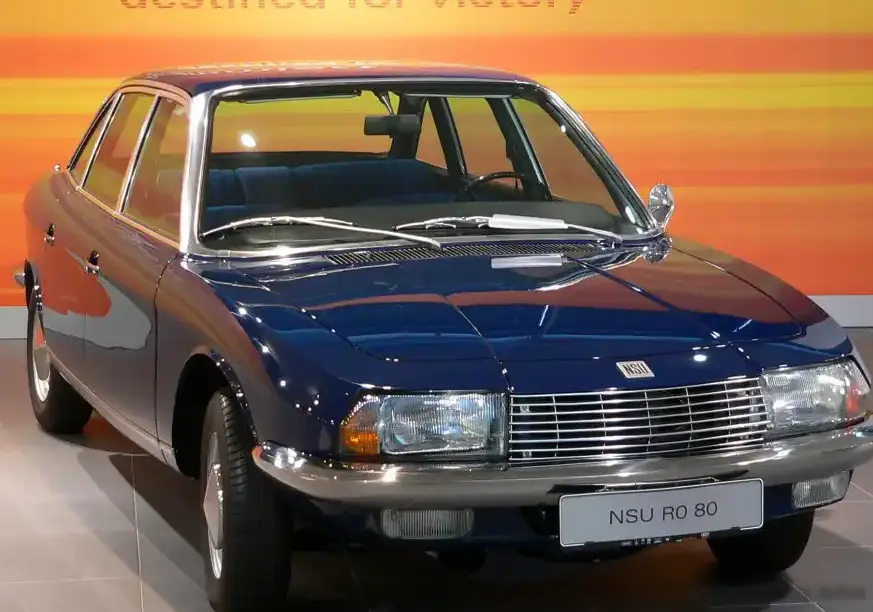
The Audi NSU Ro 80, produced between 1967 and 1977, represents a pivotal moment in automotive engineering. While marketed under the Audi brand following the merger of Auto Union and NSU, the Ro 80 was originally developed by NSU, and it remains a uniquely significant vehicle due to its pioneering use of the Wankel rotary engine. This article focuses specifically on the 1.0-liter (999cc) variant producing 115 horsepower, which was the primary configuration offered throughout the Ro 80’s production run. The Ro 80 was intended to be NSU’s flagship, a technologically advanced sedan competing with models like the Mercedes-Benz “Strich Acht” (W110) and the BMW “Neue Klasse” in the upper-middle class segment of the European market.
Technical Specifications
| Brand | Audi |
| Model | NSU Ro 80 |
| Generation | NSU Ro 80 |
| Type (Engine) | 1.0 (115 Hp) |
| Start of production | 1967 |
| End of production | 1977 |
| Powertrain Architecture | Internal Combustion engine |
| Body type | Sedan |
| Seats | 5 |
| Doors | 4 |
| Fuel Type | Petrol (Gasoline) |
| Acceleration 0 – 100 km/h | 12.8 sec |
| Acceleration 0 – 62 mph | 12.8 sec |
| Acceleration 0 – 60 mph | 12.2 sec |
| Maximum speed | 180 km/h (111.85 mph) |
| Weight-to-power ratio | 10.5 kg/Hp, 95 Hp/tonne |
| Weight-to-torque ratio | 6.4 kg/Nm, 155.4 Nm/tonne |
| Power | 115 Hp @ 5500 rpm |
| Power per litre | 115.1 Hp/l |
| Torque | 188 Nm @ 4500 rpm (138.66 lb.-ft. @ 4500 rpm) |
| Engine layout | Front, Longitudinal |
| Engine displacement | 999 cm3 (60.96 cu. in.) |
| Number of cylinders | 2 |
| Engine configuration | Rotary (Wankel) |
| Fuel injection system | Carburettor |
| Engine aspiration | Naturally aspirated engine |
| Kerb Weight | 1210 kg (2667.59 lbs) |
| Length | 4780 mm (188.19 in) |
| Width | 1760 mm (69.29 in) |
| Height | 1410 mm (55.51 in) |
| Wheelbase | 2860 mm (112.6 in) |
| Drivetrain Architecture | The Internal combustion engine (ICE) drives the front wheels of the vehicle. |
| Drive wheel | Front wheel drive |
| Number of gears and type of gearbox | 3 gears, manual transmission |
Powertrain & Engine Architecture
The heart of the Ro 80 is its single-rotor Wankel engine. Unlike traditional piston engines, the Wankel utilizes a triangular rotor spinning within a specially shaped housing to generate power. The 999cc engine, designated as the K80, produced 115 horsepower at 5500 rpm and 188 Nm (138.66 lb-ft) of torque at 4500 rpm. This output was considered respectable for its displacement, but the Wankel’s real appeal lay in its smoothness and compact size. The engine featured a single carburetor for fuel delivery, a relatively simple system for the time. The engine was mounted longitudinally in the front of the vehicle, driving the front wheels. The three-speed manual transmission was a key component, though an optional three-speed automatic transmission was available, albeit less common. The automatic transmission was a conventional torque converter type, and its availability broadened the Ro 80’s appeal to drivers prioritizing comfort over outright performance.
Driving Characteristics
The Ro 80 1.0 offered a unique driving experience. The Wankel engine delivered power in a remarkably linear fashion, lacking the traditional power band of a piston engine. Acceleration to 60 mph took approximately 12.2 seconds, and top speed was around 112 mph. While not a sports car, the Ro 80 felt surprisingly quick and responsive due to its light weight and the engine’s inherent smoothness. The three-speed manual gearbox was well-matched to the engine’s characteristics, allowing for efficient cruising. The automatic transmission, while providing convenience, did slightly diminish performance and fuel economy. Compared to potential upgrades like a larger displacement engine (which never materialized in production form), the 1.0-liter offered a balance between usability and economy. The front-wheel-drive layout provided good traction in most conditions, but the Ro 80 wasn’t particularly adept at handling aggressive cornering.
Equipment & Trim Levels
The Ro 80 was relatively well-equipped for its time, reflecting its positioning as a premium sedan. Standard features included comfortable seating for five, a spacious interior, and a comprehensive instrument panel. Interior upholstery was typically cloth, with vinyl options available. Dashboard design was modern and functional, with a focus on ergonomics. Optional extras included a sunroof, power steering, and a more luxurious interior trim. The Ro 80 didn’t offer a wide range of trim levels; it was largely standardized, with options being added individually. The focus was on providing a technologically advanced and comfortable driving experience rather than offering extensive customization.
Chassis & Braking
The Ro 80 featured a monocoque body construction, providing a rigid and lightweight chassis. Suspension consisted of independent front suspension with MacPherson struts and a torsion beam rear axle. This setup provided a comfortable ride, although it wasn’t particularly sporty. Braking was initially accomplished with disc brakes on the front wheels and drum brakes on the rear. Later models received disc brakes all around, improving stopping performance. Steering was rack and pinion, providing precise control. The Ro 80’s relatively light weight (around 2668 lbs) contributed to its nimble handling characteristics.
Market Reception & Comparison
The Ro 80 received mixed reviews upon its launch. While praised for its innovative engine and comfortable ride, concerns were raised about the Wankel’s long-term reliability and fuel consumption. The Wankel engine, while smooth, was known to require more frequent maintenance and had a reputation for apex seal wear. Fuel economy was also lower than comparable piston-engine cars. Compared to the standard 1.0-liter version, there were no significant alternatives within the Ro 80 lineup. The car was positioned as a technologically advanced alternative to more conventional sedans, appealing to buyers who valued innovation and a unique driving experience. However, the reliability concerns and higher running costs limited its widespread adoption.
Legacy
Despite its relatively short production run and initial reliability issues, the Audi NSU Ro 80 remains a significant vehicle in automotive history. It was the first production car to utilize a Wankel rotary engine, paving the way for further development of this technology. While the Wankel engine ultimately didn’t achieve mainstream success in automobiles, the Ro 80 demonstrated its potential. Today, the Ro 80 is a sought-after classic car, appreciated by enthusiasts for its unique engineering and distinctive styling. The 1.0-liter engine, while requiring diligent maintenance, is generally considered the most reliable configuration. Finding well-maintained examples can be challenging, but the Ro 80 offers a unique and rewarding driving experience for those willing to embrace its quirks. The car’s legacy lies not just in its technical innovation, but also in its bold attempt to challenge the status quo of automotive engineering.
