
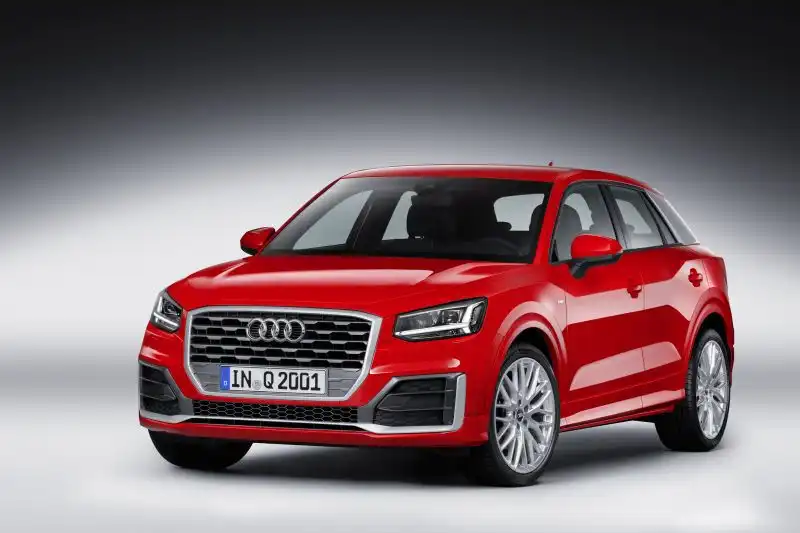
The Audi Q2 30 TDI S tronic was a front-wheel-drive subcompact luxury crossover SUV produced by the German manufacturer Audi between 2018 and 2020. Positioned as an entry-level offering within the Q2 range, it aimed to attract buyers seeking a premium vehicle with good fuel economy and practicality. This variant utilized a 1.6-liter turbocharged diesel engine paired with Audi’s seven-speed S tronic dual-clutch transmission. It served as a key model in Audi’s expansion into the burgeoning subcompact SUV segment, particularly in European markets.
Technical Specifications
| Brand | Audi |
| Model | Q2 |
| Generation | Q2 |
| Type (Engine) | 30 TDI (116 Hp) S tronic |
| Start of production | 2018 |
| End of production | 2020 |
| Powertrain Architecture | Internal Combustion engine |
| Body type | SUV |
| Seats | 5 |
| Doors | 5 |
| Combined fuel consumption (WLTP) | 5.8-6.4 l/100 km (40.6 – 36.8 US mpg, 48.7 – 44.1 UK mpg, 17.2 – 15.6 km/l) |
| CO2 emissions (WLTP) | 153-167 g/km |
| Fuel consumption (urban) | 4.9-5.3 l/100 km (48 – 44.4 US mpg, 57.6 – 53.3 UK mpg, 20.4 – 18.9 km/l) |
| Fuel consumption (extra urban) | 4.2-4.5 l/100 km (56 – 52.3 US mpg, 67.3 – 62.8 UK mpg, 23.8 – 22.2 km/l) |
| Fuel consumption (combined) | 4.5-4.8 l/100 km (52.3 – 49 US mpg, 62.8 – 58.9 UK mpg, 22.2 – 20.8 km/l) |
| CO2 emissions | 117-126 g/km |
| Fuel Type | Diesel |
| Acceleration 0 – 100 km/h | 10.5 sec |
| Acceleration 0 – 62 mph | 10.5 sec |
| Acceleration 0 – 60 mph | 10 sec (Calculated) |
| Maximum speed | 197 km/h (122.41 mph) |
| Emission standard | Euro 6d – TEMP |
| Weight-to-power ratio | 11.7 kg/Hp, 85.3 Hp/tonne |
| Weight-to-torque ratio | 5.4 kg/Nm, 183.8 Nm/tonne |
| Power | 116 Hp @ 3250-4000 rpm |
| Power per litre | 72.6 Hp/l |
| Torque | 250 Nm @ 1750-3200 rpm (184.39 lb.-ft. @ 1750-3200 rpm) |
| Engine layout | Front, Transverse |
| Engine Model/Code | DGTE |
| Engine displacement | 1598 cm3 (97.52 cu. in.) |
| Number of cylinders | 4 |
| Engine configuration | Inline |
| Number of valves per cylinder | 4 |
| Fuel injection system | Diesel Commonrail |
| Engine aspiration | Turbocharger, Intercooler |
| Engine oil capacity | 4.7 l (4.97 US qt | 4.14 UK qt) |
| Coolant capacity | 8 l (8.45 US qt | 7.04 UK qt) |
| Kerb Weight | 1360 kg (2998.29 lbs.) |
| Max. weight | 1945 kg (4287.99 lbs.) |
| Max load | 585 kg (1289.7 lbs.) |
| Trunk (boot) space – minimum | 405 l (14.3 cu. ft.) |
| Trunk (boot) space – maximum | 1050 l (37.08 cu. ft.) |
| Fuel tank capacity | 50 l (13.21 US gal | 11 UK gal) |
| Max. roof load | 60 kg (132.28 lbs.) |
| Permitted trailer load with brakes (8%) | 1700 kg (3747.86 lbs.) |
| Permitted trailer load with brakes (12%) | 1500 kg (3306.93 lbs.) |
| Permitted trailer load without brakes | 710 kg (1565.28 lbs.) |
| Permitted towbar download | 75 kg (165.35 lbs.) |
| Length | 4191 mm (165 in.) |
| Width | 1794 mm (70.63 in.) |
| Width including mirrors | 2009 mm (79.09 in.) |
| Height | 1508 mm (59.37 in.) |
| Wheelbase | 2601 mm (102.4 in.) |
| Front track | 1547 mm (60.91 in.) |
| Rear track | 1541 mm (60.67 in.) |
| Minimum turning circle | 11.1 m (36.42 ft.) |
| Drivetrain Architecture | Front wheel drive |
| Number of gears | 7 |
| Gearbox type | Automatic transmission S tronic |
| Front suspension | Independent type McPherson |
| Rear suspension | Torsion |
| Front brakes | Ventilated discs |
| Rear brakes | Disc |
INTRODUCTION
The Audi Q2 30 TDI S tronic, launched in 2018, represented Audi’s entry into the highly competitive subcompact SUV market. Built on the Volkswagen Group’s MQB platform (specifically the A05 variant), it shared its underpinnings with models like the Volkswagen T-Cross and SEAT Arona. The “30 TDI” designation indicated the engine output and fuel type, while “S tronic” denoted the use of Audi’s dual-clutch transmission. This particular variant was primarily aimed at European consumers seeking a stylish, efficient, and technologically advanced small SUV. Production of this specific configuration concluded in 2020 as Audi refined its Q2 lineup.
Powertrain & Engine Architecture
At the heart of the Q2 30 TDI S tronic lies the Volkswagen Group’s 1.6-liter inline-four cylinder diesel engine, identified by the engine code DGTE. This engine features a turbocharger with an intercooler, enhancing power and efficiency. It utilizes a common rail direct injection system, delivering fuel directly into the combustion chamber at high pressure for optimized combustion. The engine boasts four valves per cylinder, contributing to improved breathing and power output. The S tronic seven-speed dual-clutch transmission (DCT) is a key component, offering rapid and smooth gear changes. This transmission operates with two separate clutches, pre-selecting the next gear for near-instantaneous shifts. The DCT contributes significantly to the vehicle’s fuel efficiency and driving experience.
Driving Characteristics
The 116 horsepower and 250 Nm (184 lb-ft) of torque produced by the 1.6 TDI engine, coupled with the seven-speed S tronic transmission, provided adequate performance for everyday driving. Acceleration from 0 to 62 mph (0-100 km/h) took approximately 10.5 seconds, and the top speed was 197 km/h (122 mph). While not a performance-oriented variant, the Q2 30 TDI S tronic offered a responsive and refined driving experience. The S tronic transmission ensured quick acceleration and smooth gear changes, making it well-suited for urban and highway driving. Compared to the more powerful gasoline variants, the 30 TDI prioritized fuel economy and torque delivery at lower engine speeds. Manual transmission versions, when available, offered a more engaging driving experience, but the S tronic provided greater convenience and efficiency.
Equipment & Trim Levels
The Q2 30 TDI S tronic typically came equipped with a generous array of standard features. These included Audi’s MMI infotainment system with a 7-inch display screen, Bluetooth connectivity, and a multi-function steering wheel. Safety features such as ABS, electronic stability control, and multiple airbags were standard. Interior upholstery was typically cloth, with options for leather upgrades. Available optional extras included a larger infotainment screen, navigation system, parking sensors, a rearview camera, and a panoramic sunroof. Trim levels varied by market, but generally offered progressive enhancements in terms of interior materials, exterior styling, and technology features.
Chassis & Braking
The Q2 30 TDI S tronic featured a McPherson strut front suspension and a torsion beam rear suspension. This setup provided a good balance between ride comfort and handling. The front brakes were ventilated discs, while the rear brakes were solid discs. The steering system was an electric power-assisted rack and pinion system, offering precise and responsive steering feel. The chassis was tuned to provide a comfortable and stable ride, with minimal body roll during cornering. The weight distribution was optimized to enhance handling characteristics.
Market Reception & Comparison
The Audi Q2 30 TDI S tronic was generally well-received by automotive critics. It was praised for its stylish design, refined interior, and efficient engine. The S tronic transmission was also lauded for its smooth and quick gear changes. Compared to other trims in the Q2 lineup, the 30 TDI offered a more affordable entry point while still delivering a premium experience. Fuel economy was a key selling point, with the 30 TDI achieving impressive figures in real-world driving conditions. However, some critics noted that the engine could feel slightly underpowered when fully loaded or driving uphill. Compared to competitors like the BMW X1 and Mercedes-Benz GLA, the Q2 offered a more youthful and modern aesthetic.
Legacy
The Audi Q2 30 TDI S tronic has proven to be a reliable and durable vehicle in the used car market. The 1.6 TDI engine, while not known for blistering performance, is generally considered to be robust and long-lasting, provided it receives regular maintenance. The S tronic transmission, if properly maintained with regular fluid changes, is also known for its reliability. As a result, well-maintained examples of the Q2 30 TDI S tronic continue to hold their value and remain a popular choice for buyers seeking a stylish and efficient subcompact SUV.
