
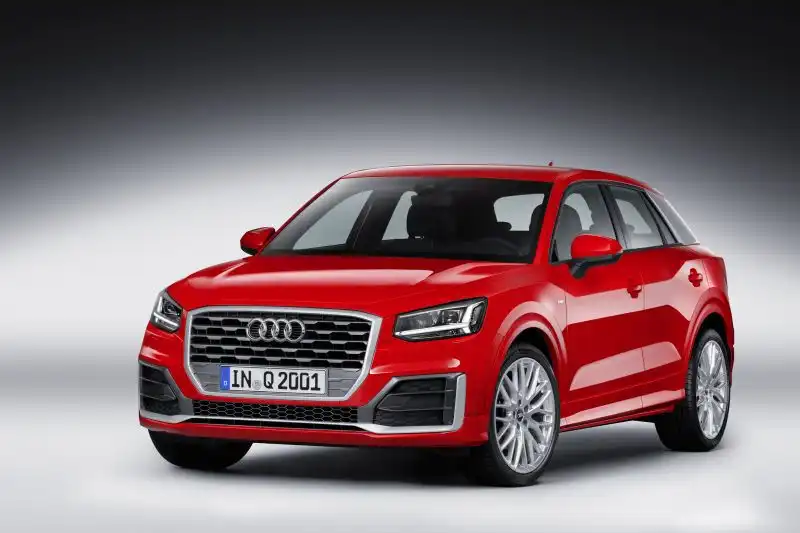
The Audi Q2 30 TFSI, produced from 2018 to 2020, represents the entry point into the Audi Q2 range. Positioned as a compact crossover SUV, it was primarily marketed in Europe as an accessible, stylish option for urban drivers. This variant utilized a 1.0-liter turbocharged three-cylinder engine producing 116 horsepower, paired with a six-speed manual transmission. It occupied the lower end of the Q2 lineup, offering a balance between fuel efficiency and everyday usability, appealing to buyers prioritizing economy and practicality over outright performance. The 30 TFSI trim served as a key volume seller, providing a more affordable alternative to the higher-powered 40 TFSI and diesel-powered variants.
Technical Specifications
| Brand | Audi |
| Model | Q2 |
| Generation | Q2 |
| Type (Engine) | 30 TFSI (116 Hp) |
| Start of production | 2018 |
| End of production | 2020 |
| Powertrain Architecture | Internal Combustion engine |
| Body type | SUV |
| Seats | 5 |
| Doors | 5 |
| Combined fuel consumption (WLTP) | 5.9-6.5 l/100 km (39.9 – 36.2 US mpg, 47.9 – 43.5 UK mpg, 16.9 – 15.4 km/l) |
| CO2 emissions (WLTP) | 133-147 g/km |
| Fuel consumption (urban) | 6.1-6.3 l/100 km (38.6 – 37.3 US mpg, 46.3 – 44.8 UK mpg, 16.4 – 15.9 km/l) |
| Fuel consumption (extra urban) | 4.8-4.9 l/100 km (49 – 48 US mpg, 58.9 – 57.6 UK mpg, 20.8 – 20.4 km/l) |
| Fuel consumption (combined) | 5.2-5.4 l/100 km (45.2 – 43.6 US mpg, 54.3 – 52.3 UK mpg, 19.2 – 18.5 km/l) |
| CO2 emissions | 119-122 g/km |
| Fuel Type | Petrol (Gasoline) |
| Acceleration 0 – 100 km/h | 10.1 sec |
| Acceleration 0 – 62 mph | 10.1 sec |
| Acceleration 0 – 60 mph | 9.6 sec |
| Maximum speed | 197 km/h (122.41 mph) |
| Emission standard | Euro 6d – TEMP |
| Weight-to-power ratio | 10.6 kg/Hp, 94.7 Hp/tonne |
| Weight-to-torque ratio | 6.1 kg/Nm, 163.3 Nm/tonne |
| Power | 116 Hp @ 5000-5500 rpm |
| Power per litre | 116.1 Hp/l |
| Torque | 200 Nm @ 2000-3500 rpm (147.51 lb.-ft. @ 2000-3500 rpm) |
| Engine layout | Front, Transverse |
| Engine Model/Code | DKRF |
| Engine displacement | 999 cm3 (60.96 cu. in.) |
| Number of cylinders | 3 |
| Engine configuration | Inline |
| Number of valves per cylinder | 4 |
| Fuel injection system | Direct injection |
| Engine aspiration | Turbocharger, Intercooler |
| Engine oil capacity | 4 l (4.23 US qt | 3.52 UK qt) |
| Coolant | 8 l (8.45 US qt | 7.04 UK qt) |
| Kerb Weight | 1225 kg (2700.66 lbs.) |
| Max. weight | 1800 kg (3968.32 lbs.) |
| Max load | 575 kg (1267.66 lbs.) |
| Trunk (boot) space – minimum | 405 l (14.3 cu. ft.) |
| Trunk (boot) space – maximum | 1050 l (37.08 cu. ft.) |
| Fuel tank capacity | 50 l (13.21 US gal | 11 UK gal) |
| Max. roof load | 60 kg (132.28 lbs.) |
| Permitted trailer load with brakes (8%) | 1500 kg (3306.93 lbs.) |
| Permitted trailer load with brakes (12%) | 1300 kg (2866.01 lbs.) |
| Permitted trailer load without brakes | 650 kg (1433 lbs.) |
| Permitted towbar download | 75 kg (165.35 lbs.) |
| Length | 4191 mm (165 in.) |
| Width | 1794 mm (70.63 in.) |
| Width including mirrors | 2009 mm (79.09 in.) |
| Height | 1508 mm (59.37 in.) |
| Wheelbase | 2601 mm (102.4 in.) |
| Front track | 1547 mm (60.91 in.) |
| Rear (Back) track | 1541 mm (60.67 in.) |
| Minimum turning circle | 11.1 m (36.42 ft.) |
| Drivetrain Architecture | The Internal combustion engine (ICE) drives the front wheels of the vehicle. |
| Drive wheel | Front wheel drive |
| Number of gears and type of gearbox | 6 gears, manual transmission |
| Front suspension | Independent type McPherson |
| Rear suspension | Torsion |
| Front brakes | Ventilated discs |
| Rear brakes | Disc |
| Assisting systems | ABS (Anti-lock braking system) |
| Steering type | Steering rack and pinion |
| Power steering | Electric Steering |
Powertrain & Engine Architecture
The heart of the Q2 30 TFSI is the DKRF engine, a 1.0-liter inline three-cylinder gasoline engine. This engine is part of Volkswagen Group’s EA211 family, known for its compact design and efficiency. It utilizes direct fuel injection and a single turbocharger with an intercooler to boost power output. The turbocharger helps mitigate the inherent power limitations of a small-displacement engine, providing a reasonable level of performance. The engine features four valves per cylinder and is constructed with an aluminum cylinder block. The six-speed manual transmission is a standard offering, providing precise gear changes and contributing to the vehicle’s overall fuel efficiency. The engine’s control unit (ECU) manages fuel delivery, ignition timing, and turbocharger boost pressure to optimize performance and emissions.
Driving Characteristics
The Q2 30 TFSI delivers a driving experience geared towards practicality and fuel economy rather than outright sportiness. With 116 horsepower and 200 Nm (147 lb-ft) of torque, acceleration is adequate for everyday driving, but not particularly brisk. The 0-60 mph time of around 9.6 seconds reflects this. The six-speed manual transmission allows drivers to maintain optimal engine speed for efficiency or to extract more power when needed. The turbocharger provides a noticeable boost in torque at lower engine speeds, making it relatively easy to navigate city traffic. Compared to the more powerful 40 TFSI variant, the 30 TFSI feels noticeably slower, especially during overtaking maneuvers. However, the lighter engine weight contributes to a more nimble feel in corners.
Equipment & Trim Levels
The 30 TFSI trim typically came standard with features such as air conditioning, a 5.8-inch infotainment screen with Bluetooth connectivity, alloy wheels, and a leather-wrapped steering wheel. Safety features included ABS, electronic stability control, and multiple airbags. Optional extras included a larger infotainment screen with navigation, automatic climate control, parking sensors, and a panoramic sunroof. Interior upholstery was typically cloth, with leather options available as an upgrade. The dashboard layout was clean and modern, reflecting Audi’s design language. Trim levels could vary slightly depending on the market, but the 30 TFSI generally represented a well-equipped entry-level option.
Chassis & Braking
The Q2 30 TFSI utilizes a front-wheel-drive layout with an independent McPherson strut suspension at the front and a torsion beam suspension at the rear. This suspension setup provides a comfortable ride quality, suitable for everyday driving conditions. The front brakes are ventilated discs, while the rear brakes are solid discs. The steering is electric power-assisted, offering light and precise control. The chassis is relatively lightweight, contributing to the vehicle’s agility. Stabilizer bars are fitted to both the front and rear axles to reduce body roll during cornering.
Market Reception & Comparison
The Audi Q2 30 TFSI was generally well-received by automotive critics as a stylish and practical entry-level crossover. Its fuel efficiency and low running costs were particularly praised. However, some reviewers noted that the engine could feel underpowered, especially when fully loaded or on uphill stretches. Compared to other trims in the Q2 lineup, the 30 TFSI offered the best fuel economy but the lowest performance. It competed with other compact crossovers such as the Volkswagen T-Roc, the Opel Crossland X, and the Nissan Juke. The Q2’s premium interior and brand image gave it an edge over some of its rivals.
Legacy
The 1.0-liter TFSI engine, as used in the Q2 30 TFSI, has proven to be a relatively reliable powertrain. While some early examples experienced minor issues with the turbocharger or fuel injectors, these were generally addressed through software updates and improved manufacturing processes. The engine’s simplicity and robust design contribute to its longevity. On the used car market, the Q2 30 TFSI remains a popular choice for buyers seeking a stylish and economical crossover. Its relatively low purchase price and running costs make it an attractive option for first-time car buyers or those looking for a practical city vehicle.
