
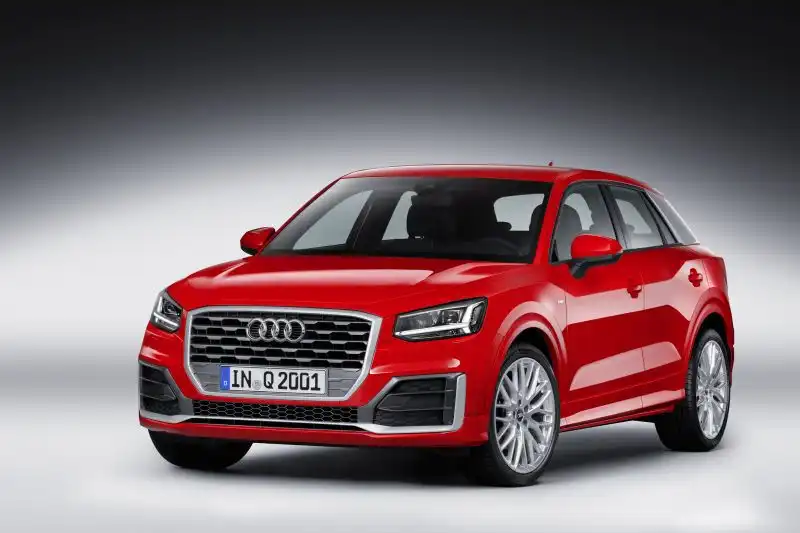
The Audi Q2 35 TDI quattro S tronic was a compact luxury crossover SUV produced by the German manufacturer Audi between 2018 and 2020. Positioned as a more youthful and accessible entry point into the Audi SUV lineup, the Q2 aimed to attract a broader customer base with its distinctive styling and available technology. The 35 TDI variant, equipped with a 2.0-liter turbocharged diesel engine producing 150 horsepower and paired with Audi’s seven-speed S tronic dual-clutch transmission and quattro all-wheel drive, represented a balance between fuel efficiency, performance, and all-weather capability. It occupied a mid-range position within the Q2 lineup, offering a step up from the lower-powered petrol engines while remaining more affordable than the higher-performance variants.
Technical Specifications
| Brand | Audi |
| Model | Q2 |
| Generation | Q2 |
| Type (Engine) | 35 TDI (150 Hp) quattro S tronic |
| Start of production | 2018 |
| End of production | 2020 |
| Powertrain Architecture | Internal Combustion engine |
| Body type | SUV |
| Seats | 5 |
| Doors | 5 |
| Combined fuel consumption (WLTP) | 5.8-6.3 l/100 km (40.6 – 37.3 US mpg, 48.7 – 44.8 UK mpg, 17.2 – 15.9 km/l) |
| CO2 emissions (WLTP) | 153-165 g/km |
| Fuel consumption (urban) | 6.0-6.2 l/100 km (39.2 – 37.9 US mpg, 47.1 – 45.6 UK mpg, 16.7 – 16.1 km/l) |
| Fuel consumption (extra urban) | 4.6-4.8 l/100 km (51.1 – 49 US mpg, 61.4 – 58.9 UK mpg, 21.7 – 20.8 km/l) |
| Fuel consumption (combined) | 5.1-5.3 l/100 km (46.1 – 44.4 US mpg, 55.4 – 53.3 UK mpg, 19.6 – 18.9 km/l) |
| CO2 emissions | 133-140 g/km |
| Fuel Type | Diesel |
| Acceleration 0 – 100 km/h | 8.1 sec |
| Acceleration 0 – 62 mph | 8.1 sec |
| Acceleration 0 – 60 mph | 7.7 sec |
| Maximum speed | 211 km/h (131.11 mph) |
| Emission standard | Euro 6d-Temp |
| Weight-to-power ratio | 9.8 kg/Hp, 101.7 Hp/tonne |
| Weight-to-torque ratio | 4.3 kg/Nm, 230.5 Nm/tonne |
| Power | 150 Hp @ 3500-4000 rpm |
| Power per litre | 76.2 Hp/l |
| Torque | 340 Nm @ 1750-3000 rpm (250.77 lb.-ft. @ 1750-3000 rpm) |
| Engine layout | Front, Transverse |
| Engine Model/Code | DFGA |
| Engine displacement | 1968 cm3 (120.09 cu. in.) |
| Number of cylinders | 4 |
| Engine configuration | Inline |
| Number of valves per cylinder | 4 |
| Fuel injection system | Diesel Commonrail |
| Engine aspiration | Turbocharger, Intercooler |
| Engine oil capacity | 4.7 l (4.97 US qt | 4.14 UK qt) |
| Coolant | 8 l (8.45 US qt | 7.04 UK qt) |
| Kerb Weight | 1475 kg (3251.82 lbs.) |
| Max. weight | 2070 kg (4563.57 lbs.) |
| Max load | 595 kg (1311.75 lbs.) |
| Trunk (boot) space – minimum | 355 l (12.54 cu. ft.) |
| Fuel tank capacity | 55 l (14.53 US gal | 12.1 UK gal) |
| Max. roof load | 60 kg (132.28 lbs.) |
| Permitted trailer load with brakes (8%) | 1800 kg (3968.32 lbs.) |
| Permitted trailer load with brakes (12%) | 1700 kg (3747.86 lbs.) |
| Permitted trailer load without brakes | 750 kg (1653.47 lbs.) |
| Permitted towbar download | 75 kg (165.35 lbs.) |
| Length | 4191 mm (165 in.) |
| Width | 1794 mm (70.63 in.) |
| Width including mirrors | 2009 mm (79.09 in.) |
| Height | 1508 mm (59.37 in.) |
| Wheelbase | 2601 mm (102.4 in.) |
| Front track | 1547 mm (60.91 in.) |
| Rear track | 1541 mm (60.67 in.) |
| Front overhang | 828 mm (32.6 in.) |
| Rear overhang | 762 mm (30 in.) |
| Drivetrain Architecture | All wheel drive (4×4). ICE drives front wheels, rear driven by clutch. |
| Number of gears | 7 |
| Gearbox type | Automatic transmission S tronic |
| Front suspension | Independent, McPherson with coil spring and anti-roll bar |
| Rear suspension | Independent multi-link spring suspension with stabilizer |
| Front brakes | Ventilated discs |
| Rear brakes | Disc |
| Tire size | 205/60 R16; 215/60 R16; 215/55 R17; 215/50 R18; 235/40 R19 |
| Wheel rims size | 6J x 16; 6.5J x 16; 7J x 17; 7J x 18; 8J x 19 |
INTRODUCTION
The Audi Q2 35 TDI quattro S tronic, launched in 2018, was a key component of Audi’s strategy to expand its presence in the burgeoning compact SUV market. Built on the Volkswagen Group’s MQB platform (specifically the A05 variant), also underpinning the Volkswagen Polo and Audi A3, the Q2 offered a distinctive design language characterized by its angular lines and prominent Singleframe grille. The 35 TDI model, powered by a 2.0-liter turbocharged diesel engine, was designed to appeal to European buyers seeking a blend of efficiency, performance, and all-weather capability. The “35 TDI” designation indicated a specific power output level within Audi’s diesel engine naming convention. Production of this specific variant concluded in 2020 as Audi refined its Q2 lineup.
Powertrain & Engine Architecture
At the heart of the Q2 35 TDI lay the DFGA engine, a 2.0-liter inline-four cylinder diesel engine. This engine, a member of the Volkswagen Group’s modular engine family, utilized a common rail direct injection system operating at pressures up to 2,500 bar. This high-pressure injection system ensured fine atomization of the fuel, contributing to efficient combustion and reduced emissions. The engine featured a variable geometry turbocharger (VGT) with an intercooler, optimizing boost pressure across the engine’s operating range. The valvetrain employed four valves per cylinder, enhancing breathing and contributing to the engine’s power output. The S tronic seven-speed dual-clutch transmission provided rapid and smooth gear changes, enhancing both performance and fuel economy. This transmission allowed for both fully automatic operation and manual gear selection via steering wheel-mounted paddles. The quattro all-wheel-drive system, a hallmark of Audi vehicles, distributed power between the front and rear axles as needed, providing enhanced traction and stability, particularly in adverse weather conditions.
Driving Characteristics
The Q2 35 TDI quattro S tronic offered a composed and refined driving experience. The 150 horsepower and 340 Nm (250.77 lb.-ft.) of torque provided adequate acceleration, with a 0-60 mph time of around 7.7 seconds. While not overtly sporty, the engine delivered a broad torque curve, making it responsive in everyday driving situations. The S tronic transmission contributed to seamless gear changes, and the quattro all-wheel-drive system instilled confidence in various road conditions. Compared to the lower-powered petrol versions of the Q2, the 35 TDI offered noticeably stronger acceleration and better mid-range punch. However, it lacked the outright performance of the higher-output petrol variants. The gear ratios were tuned for a balance between fuel efficiency and responsiveness, with taller gearing in higher gears for relaxed cruising.
Equipment & Trim Levels
The Q2 35 TDI quattro S tronic typically came well-equipped as standard. Features included Audi’s MMI infotainment system with a 7-inch display screen, Bluetooth connectivity, automatic climate control, and a leather-wrapped multifunction steering wheel. Standard safety equipment included ABS, electronic stability control, and multiple airbags. Higher trim levels offered options such as a larger MMI display screen, Audi Virtual Cockpit (a fully digital instrument cluster), LED headlights, and a panoramic sunroof. Interior upholstery options ranged from cloth to leather, and various trim accents were available to personalize the cabin. Optional extras also included parking sensors, a rearview camera, and a premium sound system.
Chassis & Braking
The Q2 35 TDI featured a McPherson strut front suspension and a multi-link rear suspension, providing a comfortable and controlled ride. The suspension was tuned to balance handling agility with ride comfort. Stabilizer bars were fitted to both the front and rear axles to reduce body roll during cornering. The braking system consisted of ventilated front discs and solid rear discs, providing adequate stopping power. ABS (Anti-lock Braking System) and electronic brake-force distribution were standard features. The steering system was an electric power-assisted rack and pinion system, offering precise and responsive steering feel.
Market Reception & Comparison
The Audi Q2 35 TDI quattro S tronic was generally well-received by automotive critics. It was praised for its stylish design, refined interior, and capable all-wheel-drive system. The diesel engine was noted for its fuel efficiency and strong torque output. Compared to other trims in the Q2 lineup, the 35 TDI offered a compelling balance between performance and economy. It was often seen as a more sensible choice than the higher-powered petrol variants for drivers who prioritized fuel efficiency and all-weather capability. However, some critics noted that the diesel engine could be slightly noisy compared to the petrol engines. In terms of fuel economy, the 35 TDI consistently outperformed the petrol versions, achieving around 5.8-6.3 l/100 km (40.6 – 37.3 US mpg) in combined driving.
Legacy
The Audi Q2 35 TDI quattro S tronic has proven to be a relatively reliable vehicle in the used car market. The 2.0-liter diesel engine is known for its durability, and the S tronic transmission, while requiring regular maintenance, is generally robust. Common issues reported by owners include occasional problems with the diesel particulate filter (DPF) and the dual-clutch transmission’s mechatronic unit. However, these issues are not widespread and can often be addressed with proper maintenance and servicing. Today, the Q2 35 TDI remains a popular choice for buyers seeking a stylish, efficient, and capable compact SUV. Its combination of practicality, performance, and all-wheel-drive capability continues to appeal to a wide range of drivers.
