
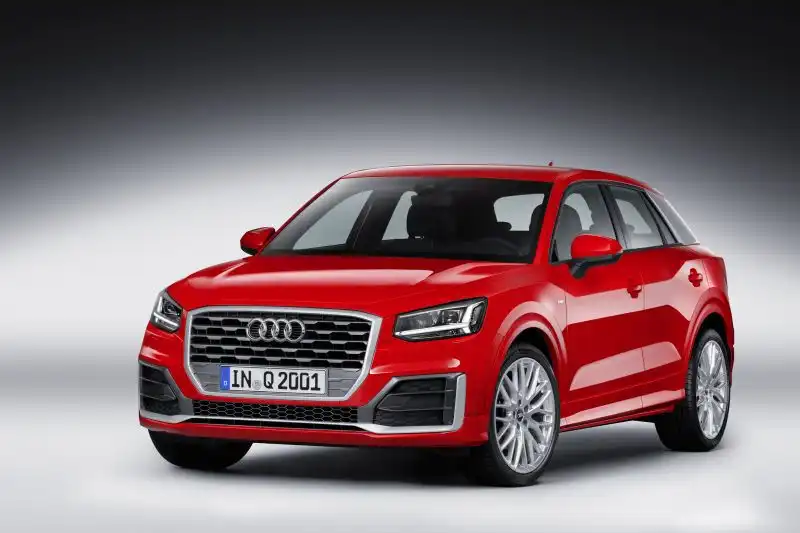
The Audi Q2 35 TDI S tronic was a front-wheel-drive subcompact luxury crossover SUV produced by the German manufacturer Audi from 2018 to 2020. Positioned as an entry-level offering within the Q2 range, it aimed to attract buyers seeking a premium, yet relatively affordable, vehicle with diesel efficiency. This variant combined a 2.0-liter turbocharged diesel engine producing 150 horsepower with Audi’s seven-speed S tronic dual-clutch transmission. It served as a key model in Audi’s expansion into the growing subcompact SUV segment, particularly in European markets where diesel engines remained popular.
Technical Specifications
| Brand | Audi |
| Model | Q2 |
| Generation | Q2 |
| Type (Engine) | 35 TDI (150 Hp) S tronic |
| Start of production | 2018 |
| End of production | 2020 |
| Powertrain Architecture | Internal Combustion engine |
| Body type | SUV |
| Seats | 5 |
| Doors | 5 |
| Combined fuel consumption (WLTP) | 5.5-6.0 l/100 km (42.8 – 39.2 US mpg, 51.4 – 47.1 UK mpg, 18.2 – 16.7 km/l) |
| CO2 emissions (WLTP) | 145-158 g/km |
| Fuel consumption (urban) | 5.1-5.5 l/100 km (46.1 – 42.8 US mpg, 55.4 – 51.4 UK mpg, 19.6 – 18.2 km/l) |
| Fuel consumption (extra urban) | 3.9-4.3 l/100 km (60.3 – 54.7 US mpg, 72.4 – 65.7 UK mpg, 25.6 – 23.3 km/l) |
| Fuel consumption (combined) | 4.4-4.7 l/100 km (53.5 – 50 US mpg, 64.2 – 60.1 UK mpg, 22.7 – 21.3 km/l) |
| CO2 emissions | 115-123 g/km |
| Fuel Type | Diesel |
| Acceleration 0 – 100 km/h | 8.5 sec |
| Acceleration 0 – 62 mph | 8.5 sec |
| Acceleration 0 – 60 mph | 8.1 sec |
| Maximum speed | 211 km/h (131.11 mph) |
| Emission standard | Euro 6d-Temp |
| Weight-to-power ratio | 9.3 kg/Hp, 107.9 Hp/tonne |
| Weight-to-torque ratio | 4.1 kg/Nm, 244.6 Nm/tonne |
| Power | 150 Hp @ 3500-4000 rpm |
| Torque | 340 Nm @ 1750-3000 rpm (250.77 lb.-ft. @ 1750-3000 rpm) |
| Engine layout | Front, Transverse |
| Engine Model/Code | DFGA |
| Engine displacement | 1968 cm3 (120.09 cu. in.) |
| Number of cylinders | 4 |
| Engine configuration | Inline |
| Number of valves per cylinder | 4 |
| Fuel injection system | Diesel Commonrail |
| Engine aspiration | Turbocharger, Intercooler |
| Engine oil capacity | 4.7 l (4.97 US qt | 4.14 UK qt) |
| Coolant capacity | 8 l (8.45 US qt | 7.04 UK qt) |
| Kerb Weight | 1390 kg (3064.43 lbs.) |
| Max. weight | 1980 kg (4365.15 lbs.) |
| Max load | 590 kg (1300.73 lbs.) |
| Trunk (boot) space – minimum | 405 l (14.3 cu. ft.) |
| Fuel tank capacity | 50 l (13.21 US gal | 11 UK gal) |
| Max. roof load | 60 kg (132.28 lbs.) |
| Permitted trailer load with brakes (8%) | 1800 kg (3968.32 lbs.) |
| Permitted trailer load with brakes (12%) | 1600 kg (3527.4 lbs.) |
| Permitted trailer load without brakes | 730 kg (1609.37 lbs.) |
| Permitted towbar download | 75 kg (165.35 lbs.) |
| Length | 4191 mm (165 in.) |
| Width | 1794 mm (70.63 in.) |
| Width including mirrors | 2009 mm (79.09 in.) |
| Height | 1508 mm (59.37 in.) |
| Wheelbase | 2601 mm (102.4 in.) |
| Front track | 1547 mm (60.91 in.) |
| Rear track | 1541 mm (60.67 in.) |
| Front overhang | 828 mm (32.6 in.) |
| Rear overhang | 762 mm (30 in.) |
| Drivetrain Architecture | Front wheel drive |
| Number of gears and type of gearbox | 7 gears, automatic transmission S tronic |
| Front suspension | Independent type McPherson |
| Rear suspension | Torsion |
| Front brakes | Ventilated discs |
| Rear brakes | Disc |
| Tires size | 205/60 R16; 215/60 R16; 215/55 R17; 215/50 R18; 235/40 R19 |
| Wheel rims size | 6J x 16; 6.5J x 16; 7J x 17; 7J x 18; 8J x 19 |
Powertrain & Engine Architecture
The Q2 35 TDI utilized Audi’s DFGA engine, a 2.0-liter inline-four cylinder diesel engine. This engine belonged to the Volkswagen Group’s modular engine family. It featured a turbocharger with an intercooler to boost power and efficiency. The engine employed a common rail direct injection system, delivering fuel directly into the combustion chambers at high pressure for optimized combustion. The engine’s valvetrain consisted of four valves per cylinder, enhancing breathing and contributing to its power output. The S tronic seven-speed dual-clutch transmission provided quick and smooth gear changes, enhancing both performance and fuel economy. This transmission allowed for both fully automatic operation and manual gear selection via steering wheel-mounted paddles or the gear selector.
Driving Characteristics
The 150 horsepower and 340 Nm (250 lb-ft) of torque delivered by the 35 TDI powertrain provided adequate performance for everyday driving. Acceleration from 0 to 60 mph took approximately 8.1 seconds, and the car had a top speed of 131 mph. While not particularly sporty, the engine offered a broad torque curve, providing good responsiveness in most driving situations. Compared to higher-output Q2 variants, such as the 2.0 TFSI petrol models, the 35 TDI prioritized fuel efficiency and relaxed cruising over outright speed. The S tronic transmission contributed to a refined driving experience, with seamless gear changes. The front-wheel-drive configuration offered predictable handling, but lacked the all-weather capability of the quattro all-wheel-drive system available on other Q2 models.
Equipment & Trim Levels
The Q2 35 TDI S tronic typically came equipped with a respectable level of standard features. These included Audi’s MMI infotainment system with a 7-inch display, Bluetooth connectivity, air conditioning, and a leather-wrapped multifunction steering wheel. Safety features such as ABS, electronic stability control, and multiple airbags were also standard. Optional extras included larger alloy wheels, a panoramic sunroof, upgraded upholstery, a more advanced MMI system with navigation, and various driver assistance systems like park assist and adaptive cruise control. Trim levels varied by market, but generally offered progressively more luxurious appointments and technology features.
Chassis & Braking
The Q2 35 TDI featured a McPherson strut front suspension and a torsion beam rear suspension. This setup provided a good balance between ride comfort and handling. The front brakes were ventilated discs, while the rear brakes were solid discs. The steering system was an electric power-assisted rack and pinion system, offering precise and responsive steering feel. The Q2’s chassis was designed to be relatively lightweight, contributing to its fuel efficiency and agility. Stabilizer bars were fitted to both the front and rear axles to reduce body roll during cornering.
Market Reception & Comparison
The Audi Q2 35 TDI S tronic was generally well-received by automotive critics. It was praised for its stylish design, comfortable interior, and fuel-efficient engine. However, some reviewers noted that the rear passenger space was somewhat limited. Compared to other trims in the Q2 lineup, the 35 TDI offered a more affordable entry point into the Q2 range, appealing to buyers who prioritized economy over performance. Its fuel economy figures were competitive with other diesel-powered subcompact SUVs. Reliability reports suggested that the DFGA engine and S tronic transmission were generally reliable, but regular maintenance was essential.
Legacy
The Audi Q2 35 TDI S tronic, while only produced for a relatively short period, remains a popular choice in the used car market, particularly in Europe. The DFGA engine is known for its durability and relatively low running costs. The S tronic transmission, when properly maintained, is also a reliable unit. As with any used vehicle, potential buyers should carefully inspect the car’s service history and consider a pre-purchase inspection by a qualified mechanic. The Q2 35 TDI represents a compelling option for those seeking a stylish, efficient, and well-equipped subcompact SUV.
