Technical Specifications
| Brand | Audi |
| Model | Q2 |
| Generation | Q2 (facelift 2020) |
| Type (Engine) | 30 TFSI (116 Hp) |
| Start of production | February, 2024 |
| Powertrain Architecture | Internal Combustion engine |
| Body type | SUV |
| Seats | 5 |
| Doors | 5 |
| Combined fuel consumption (WLTP) | 5.7-6.3 l/100 km (41.3 – 37.3 US mpg, 49.6 – 44.8 UK mpg, 17.5 – 15.9 km/l) |
| CO2 emissions (WLTP) | 129-144 g/km |
| Fuel Type | Petrol (Gasoline) |
| Acceleration 0 – 100 km/h | 10.5 sec |
| Acceleration 0 – 62 mph | 10.5 sec |
| Acceleration 0 – 60 mph | 10 sec |
| Maximum speed | 197 km/h (122.41 mph) |
| Emission standard | Euro 6e |
| Weight-to-power ratio | 10.8 kg/Hp, 92.4 Hp/tonne |
| Weight-to-torque ratio | 6.3 kg/Nm, 159.4 Nm/tonne |
| Power | 116 Hp @ 5500 rpm |
| Power per litre | 116.1 Hp/l |
| Torque | 200 Nm @ 2000-3500 rpm (147.51 lb.-ft. @ 2000-3500 rpm) |
| Engine layout | Front, Transverse |
| Engine Model/Code | EA211evo |
| Engine displacement | 999 cm3 (60.96 cu. in.) |
| Number of cylinders | 3 |
| Engine configuration | Inline |
| Cylinder Bore | 74.5 mm (2.93 in.) |
| Piston Stroke | 76.4 mm (3.01 in.) |
| Compression ratio | 11.5:1 |
| Number of valves per cylinder | 4 |
| Fuel injection system | Direct injection |
| Engine aspiration | Turbocharger, Intercooler |
| Valvetrain | DOHC |
| Engine oil capacity | 4 l (4.23 US qt | 3.52 UK qt) |
| Coolant | 8.9 l (9.4 US qt | 7.83 UK qt) |
| Engine systems | Start & Stop System, Particulate filter |
| Kerb Weight | 1255 kg (2766.8 lbs.) |
| Max. weight | 1825 kg (4023.44 lbs.) |
| Max load | 570 kg (1256.63 lbs.) |
| Trunk (boot) space – minimum | 405 l (14.3 cu. ft.) |
| Trunk (boot) space – maximum | 1050 l (37.08 cu. ft.) |
| Fuel tank capacity | 50 l (13.21 US gal | 11 UK gal) |
| Max. roof load | 60 kg (132.28 lbs.) |
| Permitted trailer load with brakes (8%) | 1500 kg (3306.93 lbs.) |
| Permitted trailer load with brakes (12%) | 1300 kg (2866.01 lbs.) |
| Permitted trailer load without brakes | 660 kg (1455.05 lbs.) |
| Permitted towbar download | 75 kg (165.35 lbs.) |
| Length | 4208 mm (165.67 in.) |
| Width | 1794 mm (70.63 in.) |
| Width including mirrors | 2009 mm (79.09 in.) |
| Height | 1508 mm (59.37 in.) |
| Wheelbase | 2601 mm (102.4 in.) |
| Front track | 1546 mm (60.87 in.) |
| Rear (Back) track | 1542 mm (60.71 in.) |
| Front overhang | 830 mm (32.68 in.) |
| Rear overhang | 777 mm (30.59 in.) |
| Drag coefficient (Cd) | 0.31 |
| Minimum turning circle (turning diameter) | 11.1 m (36.42 ft.) |
| Approach angle | 18.6° |
| Departure angle | 28° |
| Drivetrain Architecture | The Internal combustion engine (ICE) drives the front wheels of the vehicle. |
| Drive wheel | Front wheel drive |
| Number of gears and type of gearbox | 6 gears, manual transmission |
| Front suspension | Independent, type McPherson with coil spring and anti-roll bar |
| Rear suspension | Torsion |
| Front brakes | Ventilated discs |
| Rear brakes | Disc |
| Assisting systems | ABS (Anti-lock braking system) |
| Steering type | Steering rack and pinion |
| Power steering | Electric Steering |
| Tires size | 205/60 R16; 215/55 R17; 215/50 R18 |
| Wheel rims size | 6J x 16; 7J x 17; 7J x 18 |
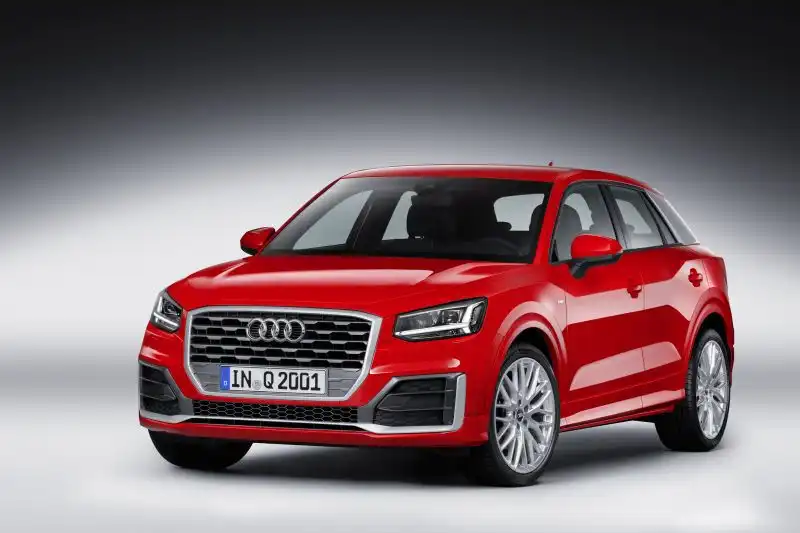
The Audi Q2 30 TFSI (116 hp) represents an entry point into the second-generation Q2 lineup, which received a significant facelift in 2020. Production of this specific variant began in February 2024. Positioned as a compact crossover SUV, the Q2 aims to attract a younger demographic with its distinctive styling and technology. This 30 TFSI model, powered by a 1.0-liter turbocharged three-cylinder engine, serves as the most fuel-efficient and accessible option within the Q2 range, slotting below the more powerful 40 TFSI and diesel variants. It primarily targets the European market, where smaller, efficient vehicles are highly valued, though limited imports can be found in other regions.
Powertrain & Engine Architecture
The heart of the Q2 30 TFSI is the EA211evo 1.0-liter turbocharged three-cylinder engine. This engine is part of the Volkswagen Group’s modular engine family, known for its compact size and efficiency. It utilizes direct fuel injection and a single-scroll turbocharger with intercooling to deliver a balance of power and fuel economy. The engine produces 116 horsepower at 5500 rpm and 200 Nm (147.51 lb-ft) of torque between 2000 and 3500 rpm. The EA211evo incorporates features like a cylinder head with an integrated exhaust manifold for improved thermal management and reduced emissions. The engine is paired with a 6-speed manual transmission, which is standard for this variant. The transmission is chosen for its efficiency and driver engagement, though no automatic transmission was offered for this specific configuration.
Driving Characteristics
The Q2 30 TFSI offers a comfortable and practical driving experience, prioritizing fuel efficiency over outright performance. Acceleration from 0 to 100 km/h (0-62 mph) takes 10.5 seconds, and the top speed is 197 km/h (122.41 mph). The three-cylinder engine delivers adequate power for everyday driving situations, but it can feel strained when fully loaded or during aggressive acceleration. The 6-speed manual transmission provides precise shifts, and the gear ratios are well-suited for maximizing fuel economy. Compared to the more powerful 40 TFSI variant, the 30 TFSI feels noticeably slower, but it offers a more relaxed and economical driving experience. The front-wheel-drive configuration provides good traction in most conditions, but it may struggle in slippery surfaces.
Equipment & Trim Levels
The Q2 30 TFSI typically comes with a respectable level of standard equipment. This includes Audi’s MMI radio plus infotainment system with a 7-inch touchscreen display, Bluetooth connectivity, and a USB interface. Safety features such as ABS, electronic stability control, and multiple airbags are also standard. Interior upholstery is typically cloth, with options for leather upgrades. Common features include air conditioning, power windows, and power mirrors. Optional extras include a larger touchscreen display, navigation system, automatic climate control, and a panoramic sunroof. Trim levels often build upon the base specification with cosmetic enhancements, such as different wheel designs and interior trim options.
Chassis & Braking
The Q2 30 TFSI utilizes a McPherson strut front suspension and a torsion beam rear suspension. This setup provides a good balance of ride comfort and handling. The front suspension incorporates a stabilizer bar to reduce body roll during cornering. The braking system consists of ventilated discs at the front and solid discs at the rear. ABS (Anti-lock Braking System) is standard, providing enhanced braking performance and stability. The steering is an electric power steering system, offering light and precise steering feel.
Market Reception & Comparison
The Audi Q2 30 TFSI was generally well-received by automotive critics for its stylish design, comfortable interior, and fuel efficiency. However, some reviewers noted that the engine could feel underpowered, especially when the vehicle is fully loaded. Compared to other compact crossovers in its class, the Q2 30 TFSI offers a more premium interior and a more refined driving experience. Its fuel economy of 5.7-6.3 l/100 km (41.3 – 37.3 US mpg) is competitive with other small gasoline engines. The 40 TFSI variant, with its more powerful engine, offers significantly better performance but at the cost of increased fuel consumption. The diesel variants provide even better fuel economy but may be subject to stricter emissions regulations.
Legacy
The EA211evo engine family has proven to be relatively reliable, and the Q2 30 TFSI is generally considered a dependable vehicle. Common maintenance items include regular oil changes, air filter replacements, and spark plug replacements. The turbocharger and direct injection system require careful maintenance to ensure long-term reliability. On the used car market, the Q2 30 TFSI represents a good value proposition for buyers seeking a stylish and efficient compact crossover. Its relatively low running costs and comfortable driving experience make it an attractive option for urban commuters and small families.