
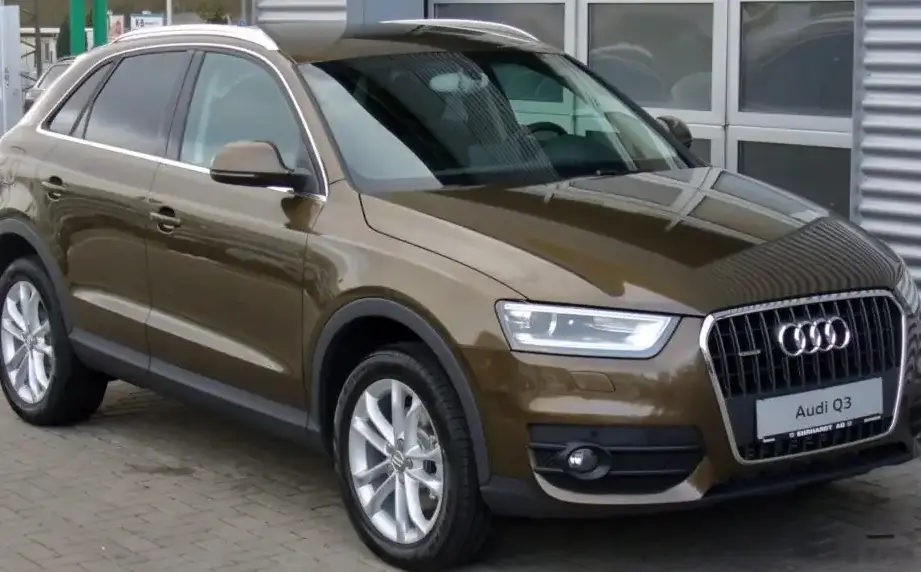
The Audi Q3 I (8U) 2.0 TDI 140 hp quattro S tronic was a compact luxury crossover SUV produced by the German manufacturer Audi between 2012 and 2014. Positioned as a mid-range offering within the first generation Q3 lineup (8U), it aimed to provide a balance between fuel efficiency, all-weather capability through Audi’s quattro all-wheel drive system, and the convenience of an automatic transmission. This variant played a significant role in establishing the Q3 as a competitor in the burgeoning premium compact SUV segment, particularly in European markets where diesel engines and all-wheel drive were highly valued.
Technical Specifications
| Brand | Audi |
| Model | Q3 |
| Generation | Q3 I (8U) |
| Type (Engine) | 2.0 TDI (140 Hp) quattro S tronic |
| Start of production | 2012 |
| End of production | 2014 |
| Powertrain Architecture | Internal Combustion engine |
| Body type | SUV |
| Seats | 5 |
| Doors | 5 |
| Fuel consumption (urban) | 6.8 l/100 km (34.6 US mpg, 41.5 UK mpg, 14.7 km/l) |
| Fuel consumption (extra urban) | 5.2 l/100 km (45.2 US mpg, 54.3 UK mpg, 19.2 km/l) |
| Fuel consumption (combined) | 5.8 l/100 km (40.6 US mpg, 48.7 UK mpg, 17.2 km/l) |
| CO2 emissions | 152 g/km |
| Fuel Type | Diesel |
| Acceleration 0 – 100 km/h | 9.9 sec |
| Acceleration 0 – 62 mph | 9.9 sec |
| Acceleration 0 – 60 mph | 9.4 sec |
| Maximum speed | 198 km/h (123.03 mph) |
| Emission standard | Euro 5 |
| Weight-to-power ratio | 11.8 kg/Hp, 85.1 Hp/tonne |
| Weight-to-torque ratio | 5.1 kg/Nm, 194.5 Nm/tonne |
| Power | 140 Hp @ 4200 rpm |
| Power per litre | 71.1 Hp/l |
| Torque | 320 Nm @ 1750-2500 rpm (236.02 lb.-ft. @ 1750-2500 rpm) |
| Engine layout | Front, Transverse |
| Engine Model/Code | CFFB, CLJA |
| Engine displacement | 1968 cm3 (120.09 cu. in.) |
| Number of cylinders | 4 |
| Engine configuration | Inline |
| Fuel injection system | Diesel Commonrail |
| Engine aspiration | Turbocharger, Intercooler |
| Engine oil capacity | 4.3 l (4.54 US qt | 3.78 UK qt) |
| Coolant capacity | 8 l (8.45 US qt | 7.04 UK qt) |
| Kerb Weight | 1645 kg (3626.6 lbs.) |
| Max. weight | 2170 kg (4784.03 lbs.) |
| Max load | 525 kg (1157.43 lbs.) |
| Trunk (boot) space – minimum | 460 l (16.24 cu. ft.) |
| Fuel tank capacity | 64 l (16.91 US gal | 14.08 UK gal) |
| Length | 4385 mm (172.64 in.) |
| Width | 1831 mm (72.09 in.) |
| Height | 1608 mm (63.31 in.) |
| Wheelbase | 2603 mm (102.48 in.) |
| Front track | 1571 mm (61.85 in.) |
| Rear (Back) track | 1575 mm (62.01 in.) |
| Minimum turning circle | 11.8 m (38.71 ft.) |
| Drive wheel | All wheel drive (4×4) |
| Number of gears and type of gearbox | 7 gears, automatic transmission S tronic |
| Front suspension | Independent type McPherson |
| Rear suspension | Independent multi-link suspension |
| Front brakes | Ventilated discs |
| Rear brakes | Disc |
| Assisting systems | ABS (Anti-lock braking system) |
| Steering type | Steering rack and pinion |
| Power steering | Electric Steering |
| Tires size | 215/65 R16 |
| Wheel rims size | 6.5J x 16 |
Powertrain & Engine Architecture
The heart of the Q3 2.0 TDI quattro S tronic is the Volkswagen Group’s 2.0-liter four-cylinder diesel engine, specifically the CFFB or CLJA engine codes depending on the production year and market. This engine utilizes a common rail direct injection system, delivering fuel at extremely high pressures for optimized combustion. A turbocharger with an intercooler is employed to boost power and torque, mitigating turbo lag and improving responsiveness. The engine features four valves per cylinder and a relatively high compression ratio typical of diesel engines. The S tronic transmission is a seven-speed dual-clutch transmission (DCT) known for its quick and smooth gear changes. It operates by pre-selecting the next gear, allowing for near-instantaneous shifts and contributing to both performance and fuel efficiency. The quattro all-wheel drive system is a Torsen-based system, proactively distributing torque between the front and rear axles based on traction conditions.
Driving Characteristics
The 140 hp output, coupled with the S tronic transmission and quattro all-wheel drive, provided the Q3 with respectable, though not particularly sporty, performance. Acceleration from 0-60 mph took approximately 9.4 seconds, and the top speed was around 123 mph. The S tronic transmission’s quick shifts helped to maximize the available power, and the quattro system provided excellent grip in various weather conditions. Compared to the more powerful 2.0 TDI variants (typically producing 177 hp or more), this version felt less eager to accelerate, but it offered a more relaxed and fuel-efficient driving experience. Manual transmission versions of the same engine offered a slightly more engaging driving experience, but the S tronic’s convenience was a major selling point for many buyers. The gear ratios were tuned for a balance between fuel economy and usability, with a relatively tall final drive to aid highway cruising.
Equipment & Trim Levels
The Q3 2.0 TDI 140 hp quattro S tronic typically came standard with features such as air conditioning, a multi-function steering wheel, power windows and mirrors, and an Audi Concert audio system. Safety features included ABS, electronic stability control, and multiple airbags. Higher trim levels offered options like leather upholstery, a panoramic sunroof, navigation system, parking sensors, and xenon headlights. Interior upholstery was typically cloth, with leather available as an upgrade. The dashboard layout was typical of Audi at the time, with a clean and functional design. Optional extras could significantly increase the price of the vehicle, allowing buyers to customize it to their preferences.
Chassis & Braking
The Q3’s chassis featured independent suspension all around, with McPherson struts at the front and a multi-link setup at the rear. This provided a comfortable ride quality while maintaining good handling characteristics. The front brakes were ventilated discs, while the rear brakes were solid discs. The steering was electrically assisted, providing a light and precise feel. Stabilizer bars were fitted to both the front and rear axles to reduce body roll during cornering. The suspension tuning was geared towards comfort rather than outright sportiness, making it well-suited for everyday driving.
Market Reception & Comparison
The Audi Q3 2.0 TDI 140 hp quattro S tronic was generally well-received by automotive critics. It was praised for its comfortable ride, spacious interior, and the security of the quattro all-wheel drive system. However, some critics noted that the 140 hp engine felt somewhat underpowered for a vehicle of its size and weight. Compared to other trims in the Q3 lineup, this variant offered the best fuel economy and a lower price point, making it an attractive option for buyers prioritizing practicality and efficiency. Against competitors like the BMW X1 and Mercedes-Benz GLA, the Q3 offered a compelling combination of features and value.
Legacy
The 2.0 TDI engine with the S tronic transmission proved to be a relatively reliable powertrain. While diesel engines are inherently more complex than gasoline engines, the Volkswagen Group’s 2.0 TDI has a generally good reputation for durability. Common issues, if any, often relate to the diesel particulate filter (DPF) requiring regeneration, particularly with frequent short trips. In the used car market, the Q3 2.0 TDI 140 hp quattro S tronic remains a popular choice, offering a good balance of practicality, comfort, and all-weather capability. Its fuel efficiency and relatively low running costs continue to appeal to buyers looking for a premium compact SUV.
