
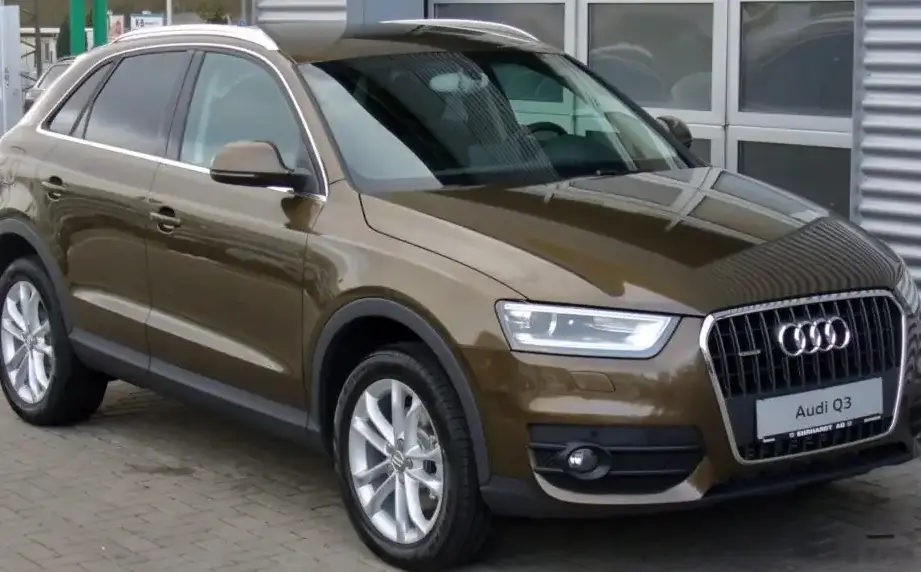
The Audi Q3 I (8U) 2.0 TDI quattro, produced from 2012 to 2014, represented Audi’s entry into the burgeoning compact luxury crossover segment. Positioned as a premium offering, the Q3 aimed to blend practicality, style, and Audi’s renowned build quality into a smaller package. This particular variant, equipped with the 2.0-liter TDI engine producing 177 horsepower and paired with a six-speed manual transmission, was a popular choice in European markets where diesel engines held significant market share. It served as a mid-range option within the Q3 lineup, offering a balance between performance and fuel efficiency, slotting below the more powerful petrol variants and above the lower-powered diesel options.
Technical Specifications
| Brand | Audi |
| Model | Q3 |
| Generation | Q3 I (8U) |
| Type (Engine) | 2.0 TDI (177 Hp) quattro |
| Start of production | 2012 |
| End of production | 2014 |
| Powertrain Architecture | Internal Combustion engine |
| Body type | SUV |
| Seats | 5 |
| Doors | 5 |
| Fuel consumption (urban) | 6.5 l/100 km (36.2 US mpg, 43.5 UK mpg, 15.4 km/l) |
| Fuel consumption (extra urban) | 5.2 l/100 km (45.2 US mpg, 54.3 UK mpg, 19.2 km/l) |
| Fuel consumption (combined) | 5.6 l/100 km (42 US mpg, 50.4 UK mpg, 17.9 km/l) |
| CO2 emissions | 148 g/km |
| Fuel Type | Diesel |
| Acceleration 0 – 100 km/h | 8.1 sec |
| Acceleration 0 – 62 mph | 8.1 sec |
| Acceleration 0 – 60 mph | 7.7 sec |
| Maximum speed | 215 km/h (133.59 mph) |
| Emission standard | Euro 5 |
| Weight-to-power ratio | 9.3 kg/Hp, 107.3 Hp/tonne |
| Weight-to-torque ratio | 4.3 kg/Nm, 230.3 Nm/tonne |
| Power | 177 Hp @ 4200 rpm |
| Power per litre | 89.9 Hp/l |
| Torque | 380 Nm @ 1750-2500 rpm (280.27 lb.-ft. @ 1750-2500 rpm) |
| Engine layout | Front, Transverse |
| Engine Model/Code | CFGC, CLLB |
| Engine displacement | 1968 cm3 (120.09 cu. in.) |
| Number of cylinders | 4 |
| Engine configuration | Inline |
| Fuel injection system | Diesel Commonrail |
| Engine aspiration | Turbocharger, Intercooler |
| Engine oil capacity | 4.3 l (4.54 US qt | 3.78 UK qt) |
| Coolant | 8 l (8.45 US qt | 7.04 UK qt) |
| Kerb Weight | 1650 kg (3637.63 lbs.) |
| Max. weight | 2175 kg (4795.05 lbs.) |
| Max load | 525 kg (1157.43 lbs.) |
| Trunk (boot) space – minimum | 460 l (16.24 cu. ft.) |
| Fuel tank capacity | 64 l (16.91 US gal | 14.08 UK gal) |
| Length | 4385 mm (172.64 in.) |
| Width | 1831 mm (72.09 in.) |
| Height | 1608 mm (63.31 in.) |
| Wheelbase | 2603 mm (102.48 in.) |
| Front track | 1571 mm (61.85 in.) |
| Rear (Back) track | 1575 mm (62.01 in.) |
| Minimum turning circle | 11.8 m (38.71 ft.) |
| Drive wheel | All wheel drive (4×4) |
| Number of gears | 6 |
| Gearbox type | Manual transmission |
| Front suspension | Independent type McPherson |
| Rear suspension | Independent multi-link suspension |
| Front brakes | Ventilated discs |
| Rear brakes | Disc |
| Assisting systems | ABS (Anti-lock braking system) |
| Steering type | Steering rack and pinion |
| Power steering | Electric Steering |
| Tires size | 235/55 R17 |
| Wheel rims size | 7J x 17 |
Powertrain & Engine Architecture
The heart of this Q3 variant is the 2.0-liter four-cylinder diesel engine, identified by engine codes CFGC or CLLB depending on specific market and production date. This engine belongs to the Volkswagen Group’s modular engine family, known for its robust construction and efficiency. It utilizes a common rail direct injection system, delivering fuel at extremely high pressures for optimized combustion. A turbocharger with an intercooler further enhances performance by forcing more air into the cylinders. The engine features four valves per cylinder (DOHC) and a variable geometry turbocharger (VGT) to improve responsiveness across the rev range. The six-speed manual transmission provides precise gear changes and allows the driver to fully utilize the engine’s torque output. The quattro all-wheel-drive system, a hallmark of Audi, distributes power between the front and rear axles as needed, providing enhanced traction and stability, particularly in adverse weather conditions.
Driving Characteristics
The 177 horsepower and 280 lb-ft of torque delivered by the 2.0 TDI engine provided the Q3 with respectable performance. Acceleration from 0-60 mph took approximately 7.7 seconds, making it competitive within its class. The manual transmission allowed for engaging driving experience, and the gear ratios were well-matched to the engine’s torque curve. While not as overtly sporty as some of its petrol-powered siblings, the 2.0 TDI quattro offered a smooth and refined driving experience, with ample power for everyday driving and highway cruising. Compared to the lower-powered diesel variants, this 177 hp version offered a noticeable improvement in acceleration and overall responsiveness. However, it didn’t quite match the outright performance of the 2.0 TFSI petrol engine.
Equipment & Trim Levels
The Q3 2.0 TDI quattro typically came equipped with a generous level of standard features. These included air conditioning, a multi-function steering wheel, power windows and mirrors, and an Audi Concert audio system. Upholstery was typically cloth, although leather options were available. Optional extras included a panoramic sunroof, navigation system, parking sensors, and upgraded alloy wheels. Trim levels varied by market, but generally offered progressive upgrades in terms of interior appointments and technology. The S line package, a popular option, added sporty styling cues and enhanced interior trim.
Chassis & Braking
The Q3’s chassis featured independent suspension all around, with McPherson struts at the front and a multi-link setup at the rear. This configuration provided a comfortable ride while maintaining good handling characteristics. The quattro all-wheel-drive system contributed to excellent stability and traction. Braking duties were handled by ventilated discs at the front and solid discs at the rear, equipped with ABS (Anti-lock Braking System). The steering was a rack-and-pinion system with electric power assistance, providing precise and responsive steering feel.
Market Reception & Comparison
The Audi Q3 2.0 TDI quattro was generally well-received by automotive critics. It was praised for its stylish design, high-quality interior, and refined driving experience. The diesel engine was lauded for its fuel efficiency and strong torque output. Compared to other compact luxury crossovers, the Q3 offered a compelling combination of practicality, performance, and prestige. The 2.0 TDI quattro variant offered a good balance between running costs and driving enjoyment, making it a popular choice for buyers who prioritized fuel economy without sacrificing performance. However, some critics noted that the rear seat space was somewhat limited compared to some competitors.
Legacy
The 2.0 TDI engine, in various iterations, has proven to be a remarkably durable and reliable powertrain. The Q3 I (8U) 2.0 TDI quattro, when properly maintained, continues to offer years of reliable service. On the used car market, these models are generally sought after for their build quality and fuel efficiency. Common maintenance items include regular oil changes, filter replacements, and inspection of the turbocharger and fuel injection system. The quattro all-wheel-drive system requires periodic servicing to ensure optimal performance. Overall, the Q3 2.0 TDI quattro remains a desirable and practical choice for buyers seeking a compact luxury crossover.
