
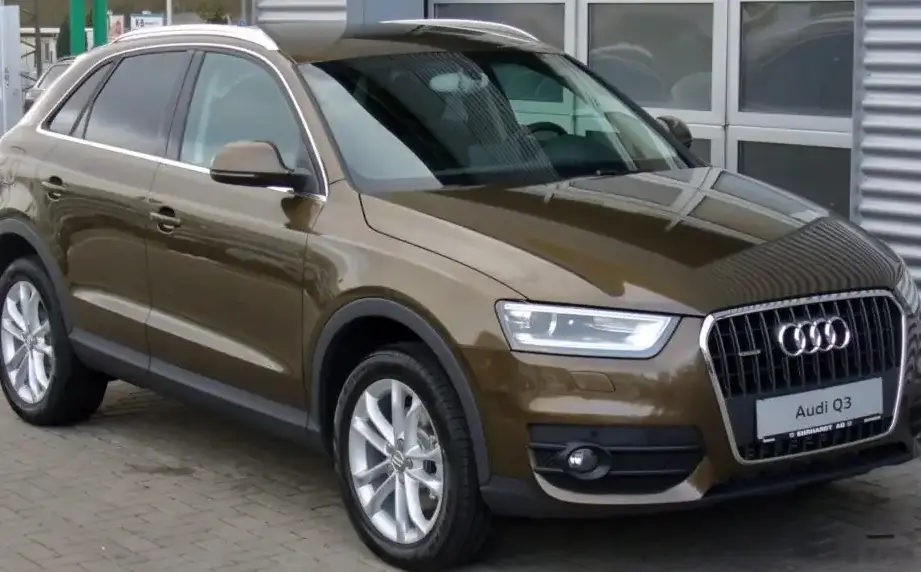
The Audi Q3 I (8U) 2.0 TDI 177 hp quattro S tronic represents a significant entry in Audi’s early foray into the compact luxury crossover segment. Produced from 2012 to 2014, this variant occupied a middle ground within the first-generation Q3 lineup, offering a blend of performance, efficiency, and all-weather capability. It was primarily marketed in Europe and other international markets, serving as a premium alternative to mainstream compact SUVs. The Q3 8U was built on the Volkswagen Group’s PQ35 platform, also underpinning models like the Volkswagen Tiguan and SEAT Ateca.
Technical Specifications
| Brand | Audi |
| Model | Q3 |
| Generation | Q3 I (8U) |
| Type (Engine) | 2.0 TDI (177 Hp) quattro S tronic |
| Start of production | 2012 |
| End of production | 2014 |
| Powertrain Architecture | Internal Combustion engine |
| Body type | SUV |
| Seats | 5 |
| Doors | 5 |
| Fuel consumption (urban) | 7 l/100 km (33.6 US mpg, 40.4 UK mpg, 14.3 km/l) |
| Fuel consumption (extra urban) | 5.3 l/100 km (44.4 US mpg, 53.3 UK mpg, 18.9 km/l) |
| Fuel consumption (combined) | 5.9 l/100 km (39.9 US mpg, 47.9 UK mpg, 16.9 km/l) |
| CO2 emissions | 156 g/km |
| Fuel Type | Diesel |
| Acceleration 0 – 100 km/h | 8.2 sec |
| Acceleration 0 – 62 mph | 8.2 sec |
| Acceleration 0 – 60 mph | 7.8 sec |
| Maximum speed | 212 km/h (131.73 mph) |
| Emission standard | Euro 5 |
| Weight-to-power ratio | 9.4 kg/Hp, 106.6 Hp/tonne |
| Weight-to-torque ratio | 4.4 kg/Nm, 228.9 Nm/tonne |
| Power | 177 Hp @ 4200 rpm |
| Power per litre | 89.9 Hp/l |
| Torque | 380 Nm @ 1750-2500 rpm (280.27 lb.-ft. @ 1750-2500 rpm) |
| Engine layout | Front, Transverse |
| Engine Model/Code | CFGC, CLLB |
| Engine displacement | 1968 cm3 (120.09 cu. in.) |
| Number of cylinders | 4 |
| Engine configuration | Inline |
| Fuel injection system | Diesel Commonrail |
| Engine aspiration | Turbocharger, Intercooler |
| Engine oil capacity | 4.3 l (4.54 US qt | 3.78 UK qt) |
| Coolant | 8 l (8.45 US qt | 7.04 UK qt) |
| Kerb Weight | 1660 kg (3659.67 lbs.) |
| Max. weight | 2185 kg (4817.1 lbs.) |
| Max load | 525 kg (1157.43 lbs.) |
| Trunk (boot) space – minimum | 460 l (16.24 cu. ft.) |
| Fuel tank capacity | 64 l (16.91 US gal | 14.08 UK gal) |
| Length | 4385 mm (172.64 in.) |
| Width | 1831 mm (72.09 in.) |
| Height | 1608 mm (63.31 in.) |
| Wheelbase | 2603 mm (102.48 in.) |
| Front track | 1571 mm (61.85 in.) |
| Rear (Back) track | 1575 mm (62.01 in.) |
| Minimum turning circle | 11.8 m (38.71 ft.) |
| Drive wheel | All wheel drive (4×4) |
| Number of gears | 7 |
| Gearbox type | automatic transmission S tronic |
| Front suspension | Independent type McPherson |
| Rear suspension | Independent multi-link suspension |
| Front brakes | Ventilated discs |
| Rear brakes | Disc |
| Assisting systems | ABS (Anti-lock braking system) |
| Steering type | Steering rack and pinion |
| Power steering | Electric Steering |
| Tires size | 235/55 R17 |
| Wheel rims size | 7J x 17 |
Powertrain & Engine Architecture
At the heart of the Q3 2.0 TDI quattro S tronic lies the Volkswagen Group’s 2.0-liter inline-four cylinder diesel engine, specifically the CFGC or CLLB engine codes depending on the market and specific production date. This engine is a turbocharged common rail direct injection diesel, known for its robust construction and relatively good fuel economy. The turbocharger, typically a variable geometry turbo (VGT), provides increased power and torque across a wider RPM range. The engine utilizes a sophisticated common rail system, injecting fuel at extremely high pressures for optimized combustion. The S tronic transmission is a 7-speed dual-clutch transmission (DCT) offering quick and smooth gear changes. This transmission contributes significantly to the vehicle’s performance and efficiency, providing both automatic convenience and the option for manual gear selection via paddle shifters or the gear lever.
Driving Characteristics
The 177 hp output, coupled with the 380 Nm (280 lb-ft) of torque, provided the Q3 2.0 TDI with respectable performance. Acceleration from 0-60 mph took around 7.8 to 8.2 seconds, making it competitive within its class. The S tronic transmission played a crucial role in maximizing this performance, delivering seamless shifts and keeping the engine within its optimal power band. Compared to the lower-powered 1.4 TFSI or 2.0 TFSI gasoline variants, the 2.0 TDI offered significantly more torque, resulting in stronger acceleration, particularly in everyday driving situations. While not as sporty as higher-output Q3 models, the 2.0 TDI provided a comfortable and capable driving experience, well-suited for both urban commutes and longer highway journeys. The quattro all-wheel-drive system enhanced traction and stability, especially in adverse weather conditions.
Equipment & Trim Levels
The Q3 2.0 TDI quattro S tronic typically came well-equipped, reflecting Audi’s premium positioning. Standard features often included automatic climate control, a multi-function steering wheel, power windows and mirrors, and an Audi Concert audio system. Higher trim levels offered options such as leather upholstery, panoramic sunroof, navigation system, and parking sensors. Interior materials were generally of high quality, with a focus on creating a refined and comfortable cabin environment. The dashboard layout was clean and functional, with a focus on ergonomics. Optional extras allowed buyers to personalize their Q3 to their specific preferences.
Chassis & Braking
The Q3 8U featured a McPherson strut front suspension and a multi-link rear suspension, providing a good balance between ride comfort and handling. The quattro all-wheel-drive system distributed power between the front and rear axles as needed, enhancing traction and stability. Braking systems typically consisted of ventilated front discs and solid rear discs, providing adequate stopping power for the vehicle’s weight and performance. Anti-lock braking system (ABS) and electronic stability control (ESC) were standard safety features.
Market Reception & Comparison
The Audi Q3 2.0 TDI quattro S tronic was generally well-received by automotive critics. It was praised for its refined interior, comfortable ride, and efficient diesel engine. The S tronic transmission was also a highlight, offering smooth and quick gear changes. Compared to other compact SUVs, the Q3 stood out for its premium feel and sophisticated technology. Fuel economy was a strong point, with combined figures around 39.9 US mpg. Reliability was generally good, although some owners reported issues with the diesel particulate filter (DPF) system, a common concern with modern diesel engines. Compared to the gasoline-powered Q3 variants, the 2.0 TDI offered better fuel economy and more torque, making it a popular choice for drivers who prioritized efficiency and practicality.
Legacy
The Audi Q3 I (8U) 2.0 TDI quattro S tronic has proven to be a relatively reliable vehicle in the used car market. The 2.0 TDI engine, while requiring regular maintenance, is known for its durability. The S tronic transmission, if properly maintained, can also provide years of trouble-free operation. However, potential buyers should be aware of the potential for DPF issues and the importance of using high-quality diesel fuel. Today, the Q3 8U remains a popular choice for those seeking a compact luxury crossover with a blend of performance, efficiency, and all-weather capability. It laid the foundation for the continued success of the Q3 model line, establishing Audi as a key player in the growing compact SUV segment.
