
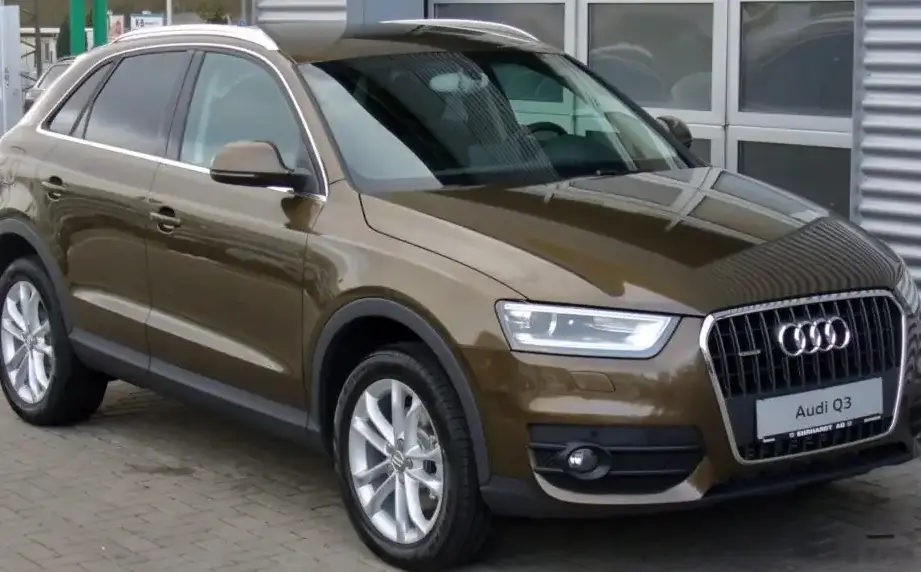
The Audi Q3 I (8U) 2.0 TFSI quattro, produced from 2012 to 2014, represents Audi’s entry into the burgeoning compact luxury crossover segment. Positioned as a premium offering, it aimed to provide a blend of practicality, style, and Audi’s renowned quattro all-wheel drive system. This particular variant, equipped with the 2.0-liter turbocharged four-cylinder engine producing 170 horsepower, served as a mid-range option within the Q3 lineup, slotting between the base 1.4 TFSI and the more potent 2.0 TFSI with higher output. It was primarily marketed in Europe and other international markets, offering a sophisticated alternative to mainstream compact SUVs.
Technical Specifications
| Brand | Audi |
| Model | Q3 |
| Generation | Q3 I (8U) |
| Type (Engine) | 2.0 TFSI (170 Hp) quattro |
| Start of production | 2012 |
| End of production | 2014 |
| Powertrain Architecture | Internal Combustion engine |
| Body type | SUV |
| Seats | 5 |
| Doors | 5 |
| Fuel consumption (urban) | 9.5 l/100 km (24.8 US mpg) |
| Fuel consumption (extra urban) | 6.1 l/100 km (38.6 US mpg) |
| Fuel consumption (combined) | 7.3 l/100 km (32.2 US mpg) |
| CO2 emissions | 174 g/km |
| Fuel Type | Petrol (Gasoline) |
| Acceleration 0 – 100 km/h | 8.2 sec |
| Acceleration 0 – 62 mph | 8.2 sec |
| Acceleration 0 – 60 mph | 7.8 sec |
| Maximum speed | 212 km/h (131.73 mph) |
| Emission standard | Euro 5 |
| Weight-to-power ratio | 9.3 kg/Hp |
| Weight-to-torque ratio | 5.7 kg/Nm |
| Power | 170 Hp @ 4300-6200 rpm |
| Torque | 280 Nm @ 1700-4200 rpm (206.52 lb.-ft.) |
| Engine layout | Front, Transverse |
| Engine Model/Code | CCZC |
| Engine displacement | 1984 cm3 (121.07 cu. in.) |
| Number of cylinders | 4 |
| Engine configuration | Inline |
| Fuel injection system | Direct injection |
| Engine aspiration | Turbocharger, Intercooler |
| Engine oil capacity | 4.6 l (4.86 US qt | 4.05 UK qt) |
| Coolant capacity | 10 l (10.57 US qt | 8.8 UK qt) |
| Kerb Weight | 1585 kg (3494.33 lbs.) |
| Max. weight | 2110 kg (4651.75 lbs.) |
| Max load | 525 kg (1157.43 lbs.) |
| Trunk (boot) space – minimum | 460 l (16.24 cu. ft.) |
| Fuel tank capacity | 64 l (16.91 US gal | 14.08 UK gal) |
| Length | 4385 mm (172.64 in.) |
| Width | 1831 mm (72.09 in.) |
| Height | 1608 mm (63.31 in.) |
| Wheelbase | 2603 mm (102.48 in.) |
| Front track | 1571 mm (61.85 in.) |
| Rear track | 1575 mm (62.01 in.) |
| Minimum turning circle | 11.8 m (38.71 ft.) |
| Drive wheel | All wheel drive (4×4) |
| Number of gears | 6 |
| Gearbox type | Manual transmission |
| Front suspension | Independent type McPherson |
| Rear suspension | Independent multi-link suspension |
| Front brakes | Ventilated discs |
| Rear brakes | Disc |
| Assisting systems | ABS (Anti-lock braking system) |
| Steering type | Steering rack and pinion |
| Power steering | Electric Steering |
| Tires size | 215/65 R16 |
| Wheel rims size | 6.5J x 16 |
Powertrain & Engine Architecture
At the heart of the Q3 2.0 TFSI quattro lies the CCZC engine code, a 1.984-liter (121.07 cubic inches) inline-four cylinder gasoline engine. This engine is part of Volkswagen Group’s EA888 family, known for its robust design and tuning potential. The CCZC utilizes direct fuel injection (FSI) and a single turbocharger with an intercooler to deliver a balance of power and efficiency. The direct injection system precisely meters fuel directly into the combustion chamber, improving combustion efficiency and reducing emissions. The turbocharger provides forced induction, boosting power output beyond what would be achievable with natural aspiration. The engine’s valvetrain features dual overhead camshafts (DOHC) and four valves per cylinder, optimizing airflow for enhanced performance. The six-speed manual transmission was standard, providing drivers with precise control over gear selection. While an S tronic dual-clutch transmission was available as an option, the manual was a popular choice for those prioritizing driver engagement and cost savings.
Driving Characteristics
The 170 horsepower and 280 Nm (206.52 lb-ft) of torque offered by the 2.0 TFSI engine provided adequate performance for everyday driving. Acceleration from 0 to 60 mph took approximately 7.8 seconds, making it competitive within its class. The quattro all-wheel drive system significantly enhanced traction, particularly in adverse weather conditions. Compared to the base 1.4 TFSI model, the 2.0 TFSI offered a noticeable improvement in responsiveness and overall driving enjoyment. However, it didn’t possess the outright performance of the higher-output 2.0 TFSI variants. The six-speed manual transmission provided a satisfying driving experience, with well-spaced gear ratios that allowed the engine to operate efficiently across a wide range of speeds. The power delivery was relatively linear, making it easy to modulate throttle inputs and maintain control.
Equipment & Trim Levels
The Q3 2.0 TFSI quattro typically came equipped with a respectable level of standard features. These included air conditioning, a multi-function steering wheel, power windows and mirrors, and an Audi Concert audio system. Upholstery was generally cloth, although leather options were available. Higher trim levels offered features such as panoramic sunroof, navigation system, parking sensors, and upgraded audio systems. Optional extras included heated front seats, xenon headlights, and a variety of customization options for interior and exterior styling. The dashboard layout was typical of Audi’s design language at the time, featuring a clean and modern aesthetic with intuitive controls.
Chassis & Braking
The Q3’s chassis was designed to provide a comfortable yet engaging driving experience. The front suspension utilized independent McPherson struts, while the rear suspension employed an independent multi-link setup. This configuration helped to minimize body roll and provide a stable platform for cornering. The braking system consisted of ventilated discs at the front and solid discs at the rear. Anti-lock braking system (ABS) was standard, enhancing safety and control during emergency braking situations. The steering was a rack-and-pinion system with electric power assistance, providing precise and responsive steering feel.
Market Reception & Comparison
The Audi Q3 2.0 TFSI quattro was generally well-received by automotive critics. It was praised for its stylish design, comfortable interior, and capable all-wheel drive system. However, some reviewers noted that the 170 horsepower engine could feel slightly underpowered when fully loaded or tackling steep inclines. Compared to other compact luxury crossovers, such as the BMW X1 and Mercedes-Benz GLA, the Q3 offered a compelling combination of value and refinement. Fuel economy was respectable, averaging around 32.2 US mpg in combined driving. Reliability was generally good, although some owners reported minor issues with the infotainment system and electrical components.
Legacy
The Audi Q3 I (8U) 2.0 TFSI quattro has proven to be a relatively reliable vehicle in the used car market. The EA888 engine is known for its durability, and the quattro all-wheel drive system continues to provide confident traction. Regular maintenance, including oil changes and timing belt replacements, is crucial for ensuring long-term reliability. Today, these Q3s represent a good value for buyers seeking a premium compact crossover with a proven track record. While newer generations of the Q3 offer more advanced technology and features, the first-generation model remains a stylish and capable vehicle that continues to appeal to a wide range of drivers.
