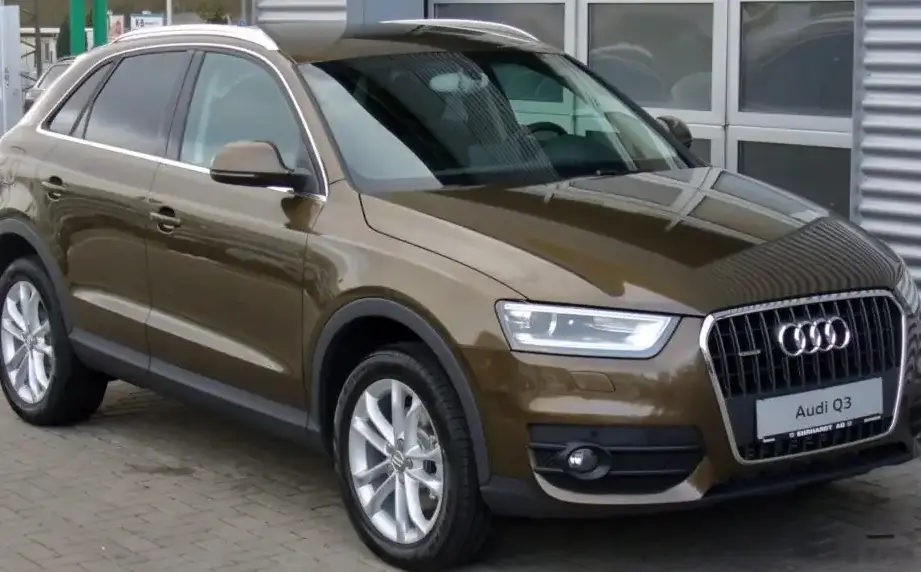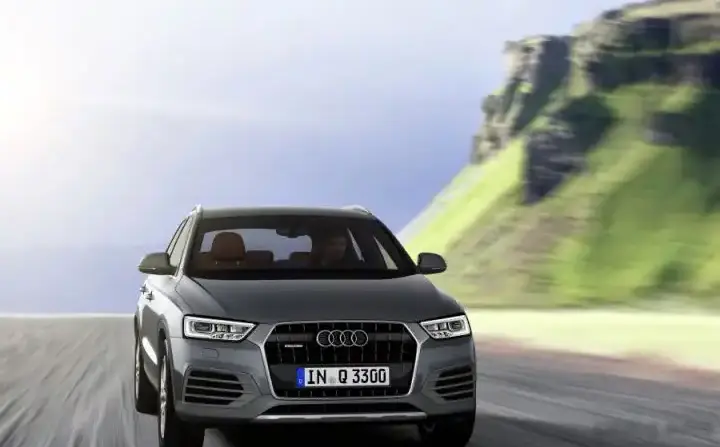
Technical Specifications
| Brand | Audi |
| Model | Q3 |
| Generation | Q3 I (8U, facelift 2014) |
| Type (Engine) | 1.4 TFSI (125 Hp) |
| Start of production | 2016 |
| End of production | 2018 |
| Powertrain Architecture | Internal Combustion engine |
| Body type | SUV |
| Seats | 5 |
| Doors | 5 |
| Fuel consumption (urban) | 7.1-7.4 l/100 km (33.1 – 31.8 US mpg, 39.8 – 38.2 UK mpg, 14.1 – 13.5 km/l) |
| Fuel consumption (extra urban) | 5.1-5.3 l/100 km (46.1 – 44.4 US mpg, 55.4 – 53.3 UK mpg, 19.6 – 18.9 km/l) |
| Fuel consumption (combined) | 5.8-6.1 l/100 km (40.6 – 38.6 US mpg, 48.7 – 46.3 UK mpg, 17.2 – 16.4 km/l) |
| CO2 emissions | 133-141 g/km |
| Fuel Type | Petrol (Gasoline) |
| Acceleration 0 – 100 km/h | 10.8 sec |
| Acceleration 0 – 62 mph | 10.8 sec |
| Acceleration 0 – 60 mph | 10.3 sec |
| Maximum speed | 194 km/h (120.55 mph) |
| Emission standard | Euro 6 |
| Weight-to-power ratio | 11.1 kg/Hp, 90.3 Hp/tonne |
| Weight-to-torque ratio | 6.3 kg/Nm, 158.8 Nm/tonne |
| Power | 125 Hp @ 5000 rpm |
| Power per litre | 89.6 Hp/l |
| Torque | 220 Nm @ 1500-4000 rpm (162.26 lb.-ft. @ 1500-4000 rpm) |
| Engine layout | Front, Transverse |
| Engine Model/Code | EA211 / CZDB |
| Engine displacement | 1395 cm3 (85.13 cu. in.) |
| Number of cylinders | 4 |
| Engine configuration | Inline |
| Cylinder Bore | 74.5 mm (2.93 in.) |
| Piston Stroke | 80 mm (3.15 in.) |
| Compression ratio | 10:1 |
| Number of valves per cylinder | 4 |
| Fuel injection system | Direct injection |
| Engine aspiration | Turbocharger, Intercooler |
| Engine oil capacity | 4 l (4.23 US qt | 3.52 UK qt) |
| Coolant | 8.3 l (8.77 US qt | 7.3 UK qt) |
| Kerb Weight | 1385 kg (3053.4 lbs.) |
| Max. weight | 1985 kg (4376.18 lbs.) |
| Max load | 600 kg (1322.77 lbs.) |
| Trunk (boot) space – minimum | 460 l (16.24 cu. ft.) |
| Trunk (boot) space – maximum | 1365 l (48.2 cu. ft.) |
| Fuel tank capacity | 64 l (16.91 US gal | 14.08 UK gal) |
| Max. roof load | 75 kg (165.35 lbs.) |
| Permitted trailer load with brakes (8%) | 1800 kg (3968.32 lbs.) |
| Permitted trailer load with brakes (12%) | 1800 kg (3968.32 lbs.) |
| Permitted trailer load without brakes | 730 kg (1609.37 lbs.) |
| Permitted towbar download | 80 kg (176.37 lbs.) |
| Length | 4388 mm (172.76 in.) |
| Width | 1831 mm (72.09 in.) |
| Width including mirrors | 2019 mm (79.49 in.) |
| Height | 1608 mm (63.31 in.) |
| Wheelbase | 2603 mm (102.48 in.) |
| Front track | 1571 mm (61.85 in.) |
| Rear (Back) track | 1575 mm (62.01 in.) |
| Front overhang | 905 mm (35.63 in.) |
| Rear overhang | 880 mm (34.65 in.) |
| Drag coefficient (Cd) | 0.32 |
| Minimum turning circle (turning diameter) | 11.8 m (38.71 ft.) |
| Drivetrain Architecture | The Internal combustion engine (ICE) drives the front wheels of the vehicle. |
| Drive wheel | Front wheel drive |
| Number of gears and type of gearbox | 6 gears, manual transmission |
| Front suspension | Independent, type McPherson with coil spring and anti-roll bar |
| Rear suspension | Independent coil spring |
| Front brakes | Ventilated discs |
| Rear brakes | Disc |
| Assisting systems | ABS (Anti-lock braking system) |
| Steering type | Steering rack and pinion |
| Power steering | Electric Steering |
| Tires size | 215/65 R16; 235/55 R17; 235/50 R18 |
| Wheel rims size | 6.5J x 16; 17; 18 |
The Audi Q3 I (8U) facelift, launched in 2014, brought updated styling, improved technology, and refined engine options to Audi’s compact SUV. The 1.4 TFSI 125 horsepower variant, introduced in 2016, served as an entry point into the Q3 range, appealing to buyers seeking a premium crossover with reasonable running costs. This version was particularly popular in Europe, where its fuel efficiency and manageable power output aligned with local driving conditions and regulations. It represented a balance between Audi’s luxury aspirations and the practicality of a smaller engine, offering a more affordable alternative to the higher-powered 2.0 TFSI models.
Powertrain & Engine Architecture
The heart of this Q3 variant is the EA211 series 1.4-liter turbocharged four-cylinder engine, designated CZDB. This engine utilizes direct fuel injection, delivering fuel directly into the combustion chamber for improved efficiency and power. The engine features a single scroll turbocharger with an intercooler, boosting output to 125 horsepower at 5000 rpm and 220 Nm (162 lb-ft) of torque between 1500 and 4000 rpm. The EA211 engine is known for its relatively lightweight construction, contributing to the Q3’s overall balanced handling. The engine is paired with a six-speed manual transmission, which was the standard offering for this trim level. This transmission provides precise shifts and contributes to the vehicle’s fuel economy. While a S tronic dual-clutch transmission was available on other Q3 models, it wasn’t offered with the 1.4 TFSI 125 hp engine.
Driving Characteristics
The 1.4 TFSI 125 hp Q3 offers a comfortable and refined driving experience, prioritizing ease of use over outright performance. Acceleration from 0-60 mph takes around 10.3 seconds, which is adequate for everyday driving but noticeably slower than the more powerful 2.0 TFSI variants. The turbocharger provides a noticeable boost in power during acceleration, but the engine doesn’t offer the same level of responsiveness as larger displacement engines. The six-speed manual transmission is well-matched to the engine’s characteristics, allowing drivers to keep the engine in its optimal torque band. The Q3’s suspension provides a comfortable ride, absorbing bumps and imperfections in the road effectively. However, the handling isn’t as sporty as some competitors, with a slight emphasis on comfort over agility.
Equipment & Trim Levels
The 1.4 TFSI 125 hp Q3 typically came equipped with a respectable level of standard features. These included Audi’s Multi Media Interface (MMI) infotainment system with a 6.5-inch display, air conditioning, alloy wheels, and a leather-wrapped steering wheel. Safety features such as ABS, electronic stability control, and multiple airbags were also standard. Optional extras included features like a panoramic sunroof, upgraded leather upholstery, parking sensors, and a more advanced MMI system with navigation. Trim levels varied slightly depending on the market, but generally, this variant represented the entry-level offering, with more luxurious features reserved for higher-spec models.
Chassis & Braking
The Q3 8U utilizes a McPherson strut front suspension and an independent multi-link rear suspension. This setup provides a good balance between ride comfort and handling. The front suspension incorporates a stabilizer bar to reduce body roll during cornering. Braking duties are handled by ventilated discs at the front and solid discs at the rear. ABS (Anti-lock Braking System) is standard, providing enhanced braking performance in emergency situations. The Q3’s steering is electrically assisted, offering a light and precise feel.
Market Reception & Comparison
The 1.4 TFSI 125 hp Q3 was generally well-received by critics as a practical and efficient entry-level luxury crossover. It was praised for its comfortable ride, refined interior, and reasonable fuel economy. However, some reviewers noted that the engine lacked the punch of its larger counterparts. Compared to the 2.0 TFSI models, the 1.4 TFSI offered significantly lower running costs but sacrificed performance. Against competitors like the BMW X1 and Mercedes-Benz GLA, the Q3 1.4 TFSI offered a compelling combination of value, comfort, and brand prestige.
Legacy
The 1.4 TFSI engine, while not known for being a powerhouse, has proven to be relatively reliable in the Q3. Common issues are generally related to the turbocharger and fuel injectors, but these are not widespread. The Q3 8U, including the 1.4 TFSI variant, has maintained a solid reputation in the used car market, attracting buyers seeking a well-built and comfortable compact SUV. Its fuel efficiency and relatively low maintenance costs make it an attractive option for those looking for a practical and affordable luxury vehicle.