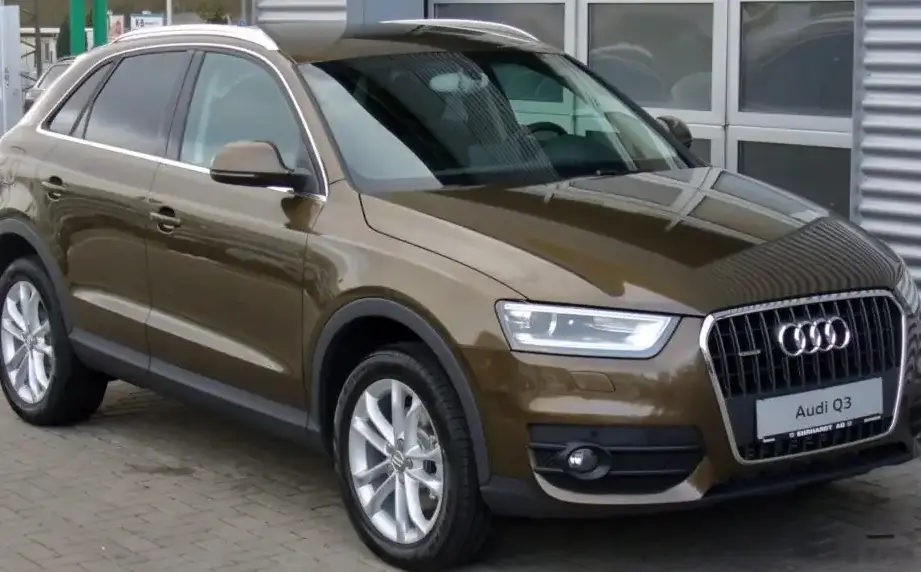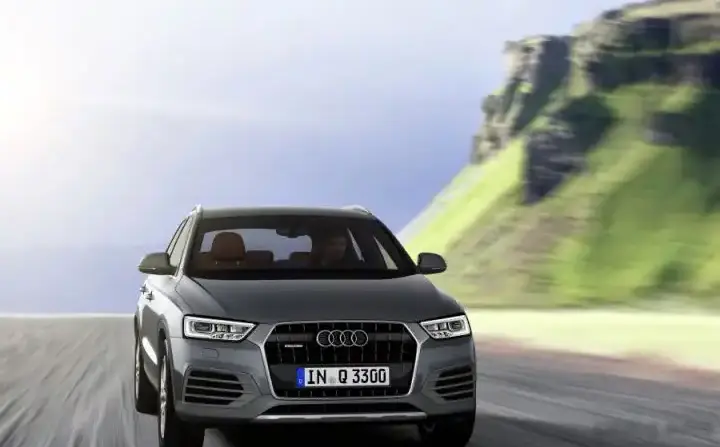
The Audi Q3 I (8U), specifically the facelifted version produced from 2014-2018, represented Audi’s entry into the burgeoning compact luxury crossover segment. Introduced as a more accessible alternative to the Q5, the Q3 aimed to attract a younger demographic with its stylish design and practical size. The 2.0 TDI 120 horsepower variant, produced from 2015-2018, was a key model in many European markets, offering a balance of fuel efficiency and reasonable performance. It occupied a mid-range position in the Q3 lineup, slotting below the more powerful TDI variants and the petrol-powered TFSI engines.
Technical Specifications
| Brand | Audi |
| Model | Q3 |
| Generation | Q3 I (8U, facelift 2014) |
| Type (Engine) | 2.0 TDI (120 Hp) |
| Start of production | 2015 |
| End of production | 2018 |
| Powertrain Architecture | Internal Combustion engine |
| Body type | SUV |
| Seats | 5 |
| Doors | 5 |
| Fuel consumption (urban) | 5.2 l/100 km (45.2 US mpg, 54.3 UK mpg, 19.2 km/l) |
| Fuel consumption (extra urban) | 4.1 l/100 km (57.4 US mpg, 68.9 UK mpg, 24.4 km/l) |
| Fuel consumption (combined) | 4.5 l/100 km (52.3 US mpg, 62.8 UK mpg, 22.2 km/l) |
| CO2 emissions | 117 g/km |
| Fuel Type | Diesel |
| Acceleration 0 – 100 km/h | 10.9 sec |
| Acceleration 0 – 62 mph | 10.9 sec |
| Acceleration 0 – 60 mph | 10.4 sec |
| Maximum speed | 190 km/h (118.06 mph) |
| Emission standard | Euro 6 |
| Weight-to-power ratio | 12.4 kg/Hp, 80.8 Hp/tonne |
| Weight-to-torque ratio | 5.1 kg/Nm, 195.3 Nm/tonne |
| Power | 120 Hp @ 3250-4500 rpm |
| Power per litre | 61 Hp/l |
| Torque | 290 Nm @ 1500-2750 rpm (213.89 lb.-ft. @ 1500-2750 rpm) |
| Engine layout | Front, Transverse |
| Engine Model/Code | EA288 / CUVD, DFTC |
| Engine displacement | 1968 cm3 (120.09 cu. in.) |
| Number of cylinders | 4 |
| Engine configuration | Inline |
| Number of valves per cylinder | 4 |
| Fuel injection system | Diesel Commonrail |
| Engine aspiration | Turbocharger, Intercooler |
| Engine oil capacity | 4.6 l (4.86 US qt | 4.05 UK qt) |
| Kerb Weight | 1485 kg (3273.86 lbs.) |
| Max. weight | 2085 kg (4596.64 lbs.) |
| Max load | 600 kg (1322.77 lbs.) |
| Trunk (boot) space – minimum | 460 l (16.24 cu. ft.) |
| Trunk (boot) space – maximum | 1365 l (48.2 cu. ft.) |
| Fuel tank capacity | 64 l (16.91 US gal | 14.08 UK gal) |
| Max. roof load | 75 kg (165.35 lbs.) |
| Permitted trailer load with brakes (8%) | 1800 kg (3968.32 lbs.) |
| Permitted trailer load with brakes (12%) | 1800 kg (3968.32 lbs.) |
| Permitted towbar download | 80 kg (176.37 lbs.) |
| Length | 4388 mm (172.76 in.) |
| Width | 1831 mm (72.09 in.) |
| Width including mirrors | 2019 mm (79.49 in.) |
| Height | 1608 mm (63.31 in.) |
| Wheelbase | 2603 mm (102.48 in.) |
| Front track | 1571 mm (61.85 in.) |
| Rear (Back) track | 1575 mm (62.01 in.) |
| Front overhang | 905 mm (35.63 in.) |
| Rear overhang | 880 mm (34.65 in.) |
| Minimum turning circle | 11.8 m (38.71 ft.) |
| Drivetrain Architecture | Front wheel drive |
| Number of gears and type of gearbox | 6 gears, manual transmission |
| Front suspension | Independent, type McPherson with coil spring and anti-roll bar |
| Rear suspension | Independent coil spring |
| Front brakes | Ventilated discs |
| Rear brakes | Disc |
| Assisting systems | ABS (Anti-lock braking system) |
| Steering type | Steering rack and pinion |
| Power steering | Electric Steering |
| Tires size | 215/65 R16 |
| Wheel rims size | 6.5J x 16 |
INTRODUCTION
The Audi Q3 I (8U) facelift, launched in 2014, brought updated styling, improved technology, and refined engine options to Audi’s compact SUV. The 2.0 TDI variant producing 120 horsepower was a significant offering, particularly in Europe where diesel engines were – and continue to be – popular due to their fuel efficiency and torque characteristics. This version of the Q3 aimed to provide a practical and economical option for buyers seeking a premium crossover. It was positioned as an entry point into the Q3 range, appealing to those prioritizing fuel economy and lower running costs over outright performance.
Powertrain & Engine Architecture
The heart of the Q3 2.0 TDI 120 is the Volkswagen Group’s EA288 engine family. Specifically, the CUVD and DFTC engine codes were commonly used for this output. This is a four-cylinder, inline diesel engine featuring common rail direct injection and a turbocharger with an intercooler. The common rail system, operating at very high pressures, ensures precise fuel delivery for optimized combustion. The engine utilizes four valves per cylinder, enhancing breathing and contributing to its torque output. The 120 hp version of the EA288 was tuned for efficiency, with a focus on maximizing torque at lower engine speeds. The engine is transversely mounted in the front of the vehicle. The Q3 2.0 TDI 120 was typically paired with a six-speed manual transmission, although a seven-speed S tronic dual-clutch transmission was also available as an option. The S tronic offered quicker shifts and improved fuel economy, but at an additional cost.
Driving Characteristics
The 2.0 TDI 120 hp Q3 offered a comfortable and refined driving experience, prioritizing fuel economy over sporty performance. With 290 Nm (213.89 lb-ft) of torque available from 1500-2750 rpm, the Q3 felt reasonably responsive in everyday driving situations. Acceleration from 0-60 mph took around 10.4 seconds, which was adequate but not particularly brisk. The six-speed manual transmission provided a good level of control, while the optional S tronic offered seamless gear changes. The gear ratios were optimized for fuel efficiency, with taller gearing in higher gears to reduce engine speed at cruising speeds. Compared to the more powerful TDI variants (150 hp and 184 hp), the 120 hp version felt noticeably slower, especially when fully loaded or tackling steep inclines. However, it offered a more relaxed and economical driving experience, making it well-suited for long-distance journeys.
Equipment & Trim Levels
The Q3 2.0 TDI 120 typically came with a respectable level of standard equipment. This included features such as air conditioning, a multi-function steering wheel, electric windows, and an audio system with a color display screen. Higher trim levels added features like alloy wheels, parking sensors, automatic climate control, and upgraded interior upholstery. Optional extras included a panoramic sunroof, navigation system, and leather seats. Interior materials were generally of good quality, reflecting Audi’s reputation for build quality. The dashboard layout was clean and functional, with intuitive controls. Upholstery options ranged from cloth to leather, depending on the trim level.
Chassis & Braking
The Q3 2.0 TDI 120 featured a McPherson strut front suspension and an independent coil spring rear suspension. This setup provided a good balance of ride comfort and handling. The suspension was tuned to prioritize comfort, resulting in a smooth and controlled ride. The steering was precise and well-weighted, providing good feedback to the driver. Braking duties were handled by ventilated discs at the front and solid discs at the rear. Anti-lock braking system (ABS) was standard, along with electronic brake-force distribution (EBD). The braking system provided adequate stopping power for everyday driving conditions.
Market Reception & Comparison
The Audi Q3 2.0 TDI 120 was generally well-received by critics, who praised its fuel efficiency, comfortable ride, and stylish design. However, some reviewers noted that the 120 hp engine felt underpowered, especially when compared to the more powerful TDI variants. Fuel economy was a key selling point, with the Q3 achieving around 52.3 US mpg on the combined cycle. In terms of reliability, the EA288 engine family has proven to be generally robust, although some issues have been reported with the diesel particulate filter (DPF) and turbocharger. Compared to competitors such as the BMW X1 and Mercedes-Benz GLA, the Q3 offered a compelling combination of value, practicality, and refinement.
Legacy
The Audi Q3 2.0 TDI 120 has proven to be a popular choice on the used car market, thanks to its fuel efficiency, reliability, and relatively low running costs. The EA288 engine, while not without its potential issues, has generally proven to be durable and long-lasting. Regular maintenance, including timely oil changes and DPF regeneration, is crucial for ensuring the longevity of the engine. Today, these Q3s represent a good value proposition for buyers seeking a premium compact SUV with reasonable running costs. The 2.0 TDI 120 remains a practical and economical choice for those prioritizing fuel efficiency and everyday usability.