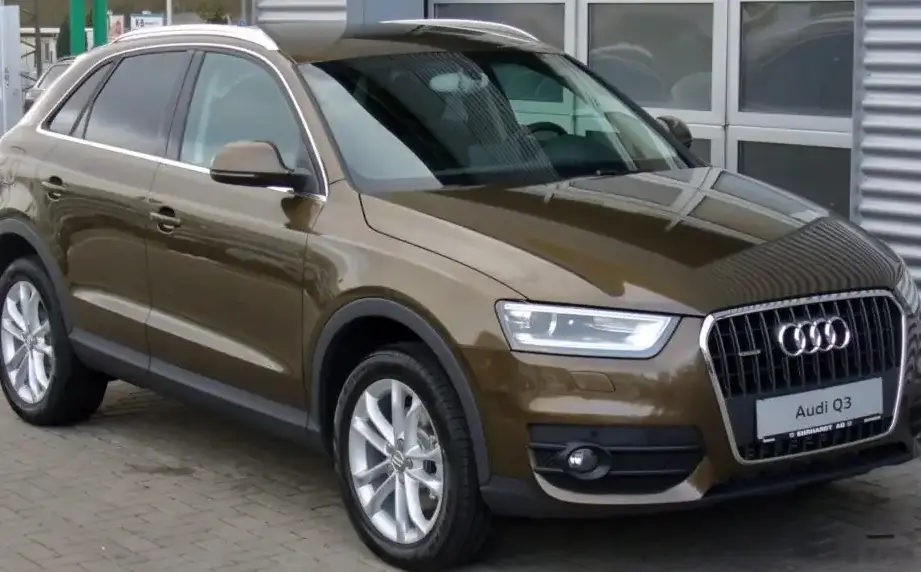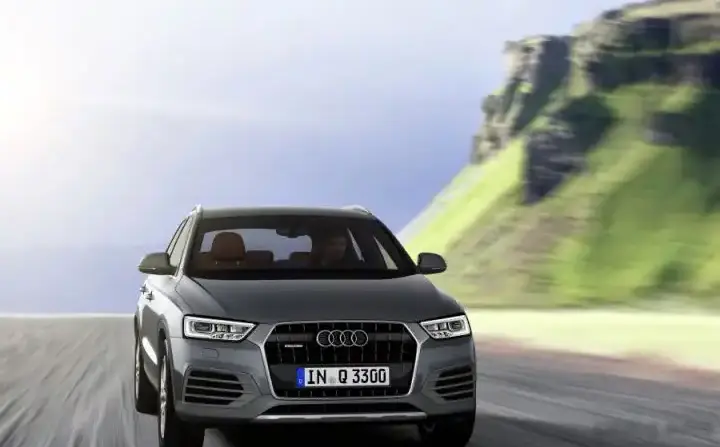
The Audi Q3 I (8U), specifically the facelifted model produced from 2014 to 2018, represented Audi’s entry into the burgeoning compact luxury crossover segment. This variant, powered by a 2.0-liter TDI engine producing 150 horsepower and paired with a seven-speed S tronic dual-clutch transmission and Audi’s quattro all-wheel drive system, was a significant offering in the European market. It aimed to balance fuel efficiency, practicality, and a premium driving experience. This configuration positioned itself as a mid-range option within the Q3 lineup, offering a step up in performance and capability from the lower-powered front-wheel-drive models, while remaining more accessible than the higher-output petrol variants.
Technical Specifications
| Brand | Audi |
| Model | Q3 |
| Generation | Q3 I (8U, facelift 2014) |
| Type (Engine) | 2.0 TDI (150 Hp) quattro S tronic |
| Start of production | 2014 |
| End of production | 2018 |
| Powertrain Architecture | Internal Combustion engine |
| Body type | SUV |
| Seats | 5 |
| Doors | 5 |
| Fuel consumption (urban) | 6.1 l/100 km (38.6 US mpg, 46.3 UK mpg, 16.4 km/l) |
| Fuel consumption (extra urban) | 4.5 l/100 km (52.3 US mpg, 62.8 UK mpg, 22.2 km/l) |
| Fuel consumption (combined) | 5.1 l/100 km (46.1 US mpg, 55.4 UK mpg, 19.6 km/l) |
| CO2 emissions | 132 g/km |
| Fuel Type | Diesel |
| Acceleration 0 – 100 km/h | 9.3 sec |
| Acceleration 0 – 62 mph | 9.3 sec |
| Acceleration 0 – 60 mph | 8.8 sec |
| Maximum speed | 204 km/h (126.76 mph) |
| Emission standard | Euro 6 |
| Weight-to-power ratio | 11.2 kg/Hp, 89.3 Hp/tonne |
| Weight-to-torque ratio | 4.9 kg/Nm, 202.4 Nm/tonne |
| Power | 150 Hp @ 3500-4000 rpm |
| Power per litre | 76.2 Hp/l |
| Torque | 340 Nm @ 1750-3000 rpm (250.77 lb.-ft. @ 1750-3000 rpm) |
| Engine layout | Front, Transverse |
| Engine Model/Code | EA288 / CUVC, DBBA, DFTA |
| Engine displacement | 1968 cm3 (120.09 cu. in.) |
| Number of cylinders | 4 |
| Engine configuration | Inline |
| Number of valves per cylinder | 4 |
| Fuel injection system | Diesel Commonrail |
| Engine aspiration | Turbocharger, Intercooler |
| Engine oil capacity | 4.6 l (4.86 US qt | 4.05 UK qt) |
| Kerb Weight | 1680 kg (3703.77 lbs.) |
| Max. weight | 2205 kg (4861.19 lbs.) |
| Max load | 525 kg (1157.43 lbs.) |
| Trunk (boot) space – minimum | 460 l (16.24 cu. ft.) |
| Trunk (boot) space – maximum | 1365 l (48.2 cu. ft.) |
| Fuel tank capacity | 64 l (16.91 US gal | 14.08 UK gal) |
| Max. roof load | 75 kg (165.35 lbs.) |
| Permitted towbar download | 80 kg (176.37 lbs.) |
| Length | 4388 mm (172.76 in.) |
| Width | 1831 mm (72.09 in.) |
| Width including mirrors | 2019 mm (79.49 in.) |
| Height | 1608 mm (63.31 in.) |
| Wheelbase | 2603 mm (102.48 in.) |
| Front track | 1571 mm (61.85 in.) |
| Rear (Back) track | 1575 mm (62.01 in.) |
| Front overhang | 905 mm (35.63 in.) |
| Rear overhang | 880 mm (34.65 in.) |
| Minimum turning circle | 11.8 m (38.71 ft.) |
| Drive wheel | All wheel drive (4×4) |
| Number of gears | 7 |
| Gearbox type | automatic transmission S tronic |
| Front suspension | Independent, type McPherson with coil spring and anti-roll bar |
| Rear suspension | Independent coil spring |
| Front brakes | Ventilated discs |
| Rear brakes | Disc |
| Assisting systems | ABS (Anti-lock braking system) |
| Steering type | Steering rack and pinion |
| Power steering | Electric Steering |
| Tires size | 215/65 R16 |
| Wheel rims size | 6.5J x 16 |
INTRODUCTION
The Audi Q3 I (8U) facelift, launched in 2014, brought refreshed styling and updated technology to Audi’s compact SUV. The 2.0 TDI 150 hp quattro S tronic variant was a key model in the range, particularly in Europe where diesel engines and all-wheel drive were highly valued. Built on the Volkswagen Group’s PQ25 platform (also known as the A3 platform – 1HX0/A3), the Q3 aimed to offer a more premium and refined experience than its mainstream competitors. This version bridged the gap between the more economical front-wheel-drive Q3 models and the more powerful, performance-oriented variants.
Powertrain & Engine Architecture
At the heart of this Q3 variant lies the Volkswagen Group’s EA288 series 2.0-liter four-cylinder diesel engine. Engine codes such as CUVC, DBBA, and DFTA were commonly used depending on the specific market and year of production. This engine featured a common rail direct injection system, delivering fuel at extremely high pressures for optimized combustion. The engine also employed a turbocharger with an intercooler to boost power and torque. The valvetrain utilized four valves per cylinder, contributing to efficient gas exchange. The seven-speed S tronic dual-clutch transmission (DCT) was a crucial component, offering rapid and smooth gear changes. This transmission, known for its efficiency and responsiveness, contributed significantly to the Q3’s driving dynamics. The quattro all-wheel-drive system, utilizing a multi-plate clutch, distributed power between the front and rear axles as needed, enhancing traction and stability.
Driving Characteristics
The 2.0 TDI 150 hp/S tronic combination provided a balanced driving experience. While not overtly sporty, the engine delivered ample torque – 340 Nm (250.77 lb-ft) – from 1750 to 3000 rpm, making it feel responsive in everyday driving situations. The S tronic transmission ensured quick acceleration, with a 0-60 mph time of around 8.8 seconds. The all-wheel-drive system provided excellent grip in various conditions, enhancing confidence on wet or slippery roads. Compared to the lower-powered 1.6 TDI models, this variant offered noticeably more performance. However, it lacked the outright punch of the 2.0 TFSI petrol engines. The gear ratios in the S tronic transmission were tuned for a blend of performance and fuel economy, with taller gears for cruising and shorter gears for quicker acceleration. The steering was precise, though not overly communicative, and the suspension provided a comfortable ride without feeling overly soft.
Equipment & Trim Levels
The 2.0 TDI quattro S tronic Q3 typically came well-equipped, reflecting its position as a mid-range offering. Standard features often included automatic climate control, a multi-function steering wheel, an infotainment system with a color display, and alloy wheels. Interior upholstery was typically cloth or a combination of cloth and leatherette. Optional extras included leather seats, a panoramic sunroof, a navigation system, and advanced driver-assistance systems such as parking sensors and adaptive cruise control. Trim levels varied by market, but generally offered progressively more luxurious features and styling enhancements.
Chassis & Braking
The Q3’s chassis featured an independent suspension setup at all four corners. The front suspension utilized a McPherson strut design with coil springs and an anti-roll bar, while the rear suspension employed a multi-link setup. This configuration provided a good balance of ride comfort and handling. Braking duties were handled by ventilated discs at the front and solid discs at the rear. Anti-lock braking system (ABS) was standard, along with electronic brake-force distribution (EBD). The Q3’s weight, around 1680 kg (3703.77 lbs), was relatively moderate for its class, contributing to its manageable handling characteristics.
Market Reception & Comparison
The Audi Q3 2.0 TDI quattro S tronic was generally well-received by automotive critics. It was praised for its refined interior, comfortable ride, and capable all-wheel-drive system. Fuel economy was a strong point, with combined figures around 5.1 l/100 km (46.1 US mpg). Compared to the front-wheel-drive Q3 models, the quattro version offered superior traction and handling, justifying the higher price. However, some critics noted that the engine could be somewhat noisy under hard acceleration. Compared to rivals like the BMW X1 and Mercedes-Benz GLA, the Q3 was often seen as offering a more understated and sophisticated driving experience.
Legacy
The 2.0 TDI engine in the Q3 proved to be generally reliable, although, like all diesel engines, it was susceptible to issues with the diesel particulate filter (DPF) if not driven on longer journeys regularly. The S tronic transmission, while efficient and responsive, required regular servicing to ensure smooth operation. Today, used examples of this Q3 variant are readily available and represent a good value proposition for buyers seeking a practical, comfortable, and fuel-efficient compact SUV. Its quattro all-wheel-drive system continues to be a desirable feature, particularly in regions with inclement weather. The EA288 engine, in its various iterations, remains a common sight in the Volkswagen Group’s product lineup, testament to its durability and versatility.