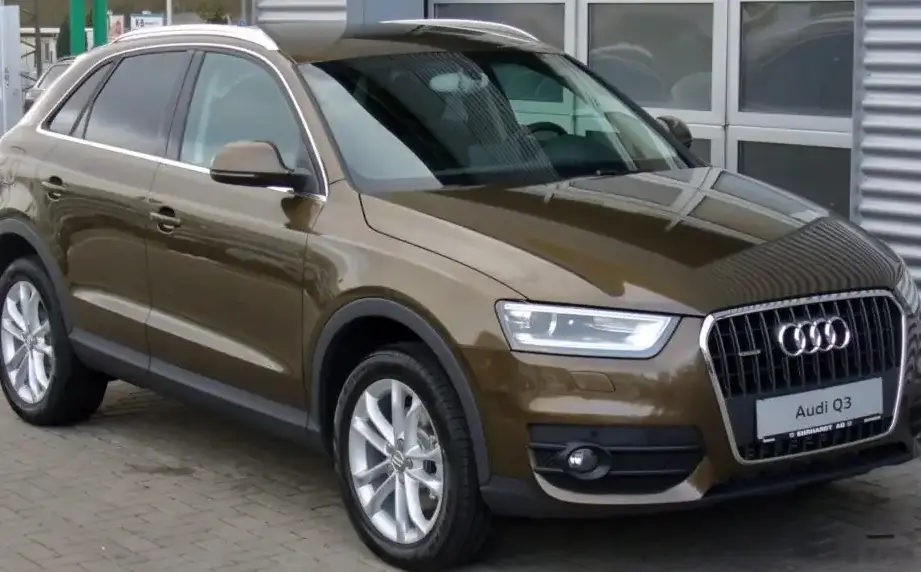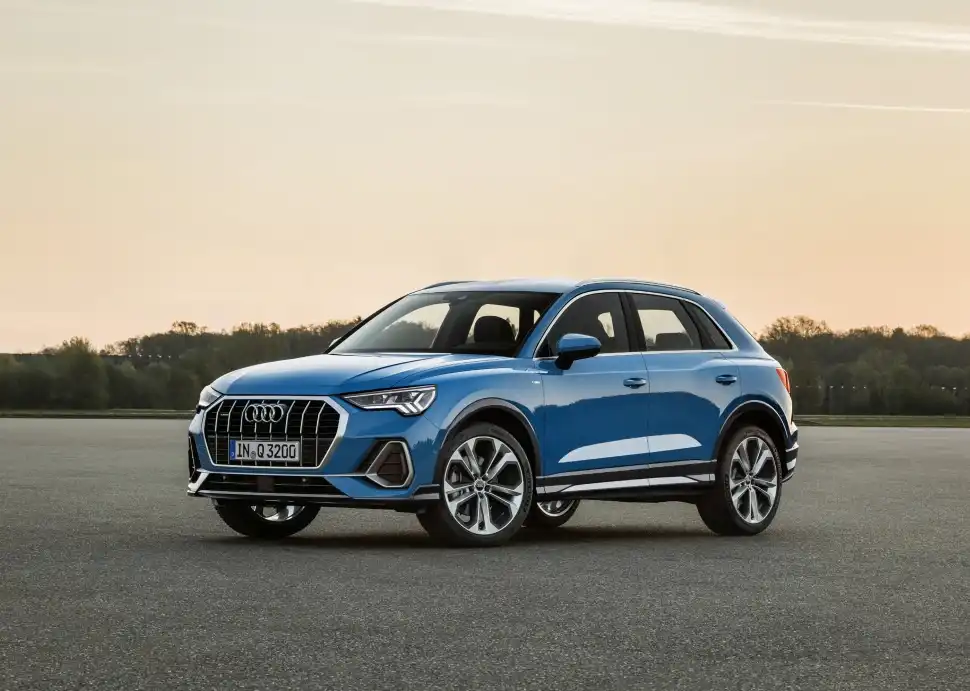
The Audi Q3 II (F3) 35 TDI, produced from December 2020 through 2024, represents a key variant within the second generation of Audi’s compact luxury SUV. Positioned as a diesel-powered option, it aimed to balance fuel efficiency with acceptable performance for the European market, where diesel engines remained popular. This model utilizes a 2.0-liter turbocharged diesel engine producing 150 horsepower, paired with a six-speed manual transmission. It served as a more economical alternative to the higher-output petrol and diesel variants within the Q3 F3 range, targeting buyers prioritizing running costs over outright speed.
Technical Specifications
| Brand | Audi |
| Model | Q3 |
| Generation | Q3 II (F3) |
| Type (Engine) | 35 TDI (150 Hp) |
| Start of production | December, 2020 |
| End of production | 2024 |
| Powertrain Architecture | Internal Combustion engine |
| Body type | SUV |
| Seats | 5 |
| Doors | 5 |
| Combined fuel consumption (WLTP) | 5-5.5 l/100 km (47 – 42.8 US mpg, 56.5 – 51.4 UK mpg, 20 – 18.2 km/l) |
| CO2 emissions (WLTP) | 132-145 g/km |
| Fuel consumption (urban) | 5.8-5.9 l/100 km (40.6 – 39.9 US mpg, 48.7 – 47.9 UK mpg, 17.2 – 16.9 km/l) |
| Fuel consumption (extra urban) | 3.8-4.1 l/100 km (61.9 – 57.4 US mpg, 74.3 – 68.9 UK mpg, 26.3 – 24.4 km/l) |
| Fuel consumption (combined) | 4.6-4.8 l/100 km (51.1 – 49 US mpg, 61.4 – 58.9 UK mpg, 21.7 – 20.8 km/l) |
| CO2 emissions (NEDC) | 120-125 g/km |
| Fuel Type | Diesel |
| Acceleration 0 – 100 km/h | 9.4 sec |
| Acceleration 0 – 62 mph | 9.4 sec |
| Acceleration 0 – 60 mph | 8.9 sec |
| Maximum speed | 202 km/h (125.52 mph) |
| Emission standard | Euro 6d-ISC-FCM |
| Weight-to-power ratio | 10.4 kg/Hp, 96.5 Hp/tonne |
| Weight-to-torque ratio | 4.6 kg/Nm, 218.6 Nm/tonne |
| Power | 150 Hp @ 3250-4200 rpm |
| Torque | 340 Nm @ 1600-3000 rpm (250.77 lb.-ft. @ 1600-3000 rpm) |
| Engine layout | Front, Transverse |
| Engine Model/Code | EA288 evo / DTSA |
| Engine displacement | 1968 cm3 (120.09 cu. in.) |
| Number of cylinders | 4 |
| Engine configuration | Inline |
| Cylinder Bore | 81 mm (3.19 in.) |
| Piston Stroke | 95.5 mm (3.76 in.) |
| Compression ratio | 16:1 |
| Number of valves per cylinder | 4 |
| Fuel injection system | Diesel Commonrail |
| Engine aspiration | Turbocharger, Intercooler |
| Valvetrain | DOHC |
| Engine oil capacity | 5.5 l (5.81 US qt | 4.84 UK qt) |
| Coolant capacity | 12.9 l (13.63 US qt | 11.35 UK qt) |
| Kerb Weight | 1555-1625 kg (3428.19 – 3582.51 lbs.) |
| Max. weight | 2130-2220 kg (4695.85 – 4894.26 lbs.) |
| Max load | 575-595 kg (1267.66 – 1311.75 lbs.) |
| Trunk (boot) space – minimum | 530 l (18.72 cu. ft.) |
| Trunk (boot) space – maximum | 1525 l (53.85 cu. ft.) |
| Fuel tank capacity | 60 l (15.85 US gal | 13.2 UK gal) |
| AdBlue tank | 18 l (4.76 US gal | 3.96 UK gal) |
| Max. roof load | 75 kg (165.35 lbs.) |
| Permitted trailer load with brakes (8%) | 2000 kg (4409.25 lbs.) |
| Permitted trailer load with brakes (12%) | 2000 kg (4409.25 lbs.) |
| Permitted trailer load without brakes | 750 kg (1653.47 lbs.) |
| Permitted towbar download | 90 kg (198.42 lbs.) |
| Length | 4484 mm (176.54 in.) |
| Width | 1849 mm (72.8 in.) |
| Width including mirrors | 2024 mm (79.69 in.) |
| Height | 1616 mm (63.62 in.) |
| Wheelbase | 2680 mm (105.51 in.) |
| Front track | 1584 mm (62.36 in.) |
| Rear track | 1576 mm (62.05 in.) |
| Front overhang | 896 mm (35.28 in.) |
| Rear overhang | 908 mm (35.75 in.) |
| Drag coefficient (Cd) | 0.32 |
| Minimum turning circle | 11.8 m (38.71 ft.) |
| Approach angle | 18.8° |
| Departure angle | 16.2° |
| Drivetrain Architecture | Front wheel drive |
| Number of gears | 6 |
| Type of gearbox | Manual transmission |
| Front suspension | Independent, type McPherson with coil spring and anti-roll bar |
| Rear suspension | Independent multi-link spring suspension with stabilizer |
| Front brakes | Ventilated discs |
| Rear brakes | Disc |
INTRODUCTION
The Audi Q3 II (F3) 35 TDI, launched in late 2020, is a compact SUV built on the Volkswagen Group’s MQB Evo platform (specifically the 1HX0/A3 variant). It represents the second generation of the Q3, offering a more refined interior, updated technology, and improved driving dynamics compared to its predecessor. The “35 TDI” designation indicates a specific engine and power output level within the Q3 range. This variant was primarily aimed at the European market, where diesel engines continued to hold a significant share due to their fuel efficiency and suitability for long-distance driving. The F3 generation Q3 marked a significant step up in terms of interior quality and technology integration for Audi’s entry-level SUV.
Powertrain & Engine Architecture
At the heart of the Q3 35 TDI lies the EA288 evo series 2.0-liter inline-four cylinder diesel engine, specifically the DTSA code variant. This engine is a turbocharged common-rail direct injection diesel, known for its robust construction and relatively good fuel economy. The turbocharger, coupled with an intercooler, provides increased air density for improved combustion. The engine utilizes a sophisticated common-rail fuel injection system, delivering fuel at extremely high pressures for optimized atomization and efficient combustion. The valvetrain employs a Dual Overhead Camshaft (DOHC) configuration with four valves per cylinder, enhancing volumetric efficiency. The six-speed manual transmission provides precise gear changes and contributes to the vehicle’s overall efficiency. The transmission’s gear ratios are tuned to balance acceleration with fuel economy, prioritizing mid-range torque delivery for everyday driving situations.
Driving Characteristics
The 150 horsepower and 340 Nm (250.77 lb-ft) of torque delivered by the 35 TDI powertrain provide adequate, though not exhilarating, performance. Acceleration from 0-100 km/h (0-62 mph) takes approximately 9.4 seconds. The engine’s peak torque is available from 1600-3000 rpm, providing strong pulling power for overtaking and climbing hills. Compared to the more powerful petrol variants (like the 45 TFSI), the 35 TDI feels less responsive, particularly at higher engine speeds. However, the manual transmission allows for greater driver control and engagement. The gear ratios are spaced to maximize fuel efficiency, meaning the engine doesn’t rev as freely as in higher-performance models. The front-wheel-drive configuration contributes to a slightly more economical driving experience, but it can exhibit some torque steer under hard acceleration.
Equipment & Trim Levels
The Q3 35 TDI typically came equipped with a respectable level of standard features. These generally included Audi’s MMI infotainment system with a 10.1-inch touchscreen display, automatic climate control, LED headlights, and a suite of driver-assistance systems such as lane departure warning and forward collision warning. Interior upholstery was typically cloth, with leather options available as an upgrade. Optional extras included a panoramic sunroof, a premium sound system, adaptive cruise control, and a virtual cockpit digital instrument cluster. Trim levels varied by market, but generally offered progressive upgrades in terms of interior materials, exterior styling, and technology features. The 35 TDI often served as a base for customers who then added specific option packages to tailor the vehicle to their preferences.
Chassis & Braking
The Q3 35 TDI utilizes an independent suspension setup at all four corners. The front suspension employs a McPherson strut design with coil springs and an anti-roll bar, while the rear features a multi-link suspension system, also with coil springs and a stabilizer bar. This configuration provides a comfortable ride quality and good handling characteristics. Braking duties are handled by ventilated discs at the front and solid discs at the rear. The vehicle is equipped with ABS (Anti-lock Braking System) and electronic stability control as standard safety features. The steering system is an electric power steering rack and pinion, providing precise and responsive steering feel.
Market Reception & Comparison
The Audi Q3 35 TDI was generally well-received by automotive critics as a practical and efficient compact SUV. Reviewers praised its comfortable ride, refined interior, and user-friendly technology. However, some criticized its relatively modest performance compared to its petrol-powered counterparts. In terms of fuel economy, the 35 TDI offered a significant advantage over the petrol models, achieving between 5.0 and 5.5 liters per 100 kilometers (47-42.8 US mpg) in combined driving. Compared to other diesel-powered SUVs in its class, such as the BMW X1 and Mercedes-Benz GLA, the Q3 35 TDI offered a competitive blend of performance, fuel economy, and interior quality. Reliability reports suggest the EA288 engine is generally robust, but regular maintenance is crucial to prevent issues with the diesel particulate filter (DPF) and fuel injection system.
Legacy
The Audi Q3 II (F3) 35 TDI powertrain has proven to be relatively reliable, provided it receives regular maintenance, including oil changes and DPF regeneration. On the used car market, these models represent a good value proposition for buyers seeking a fuel-efficient and well-equipped compact SUV. The EA288 engine is known for its longevity, but potential buyers should be aware of the potential for DPF issues, particularly if the vehicle has been primarily used for short trips. The Q3 F3 generation, including the 35 TDI variant, helped solidify Audi’s position as a leading premium SUV manufacturer, offering a compelling alternative to its German rivals.