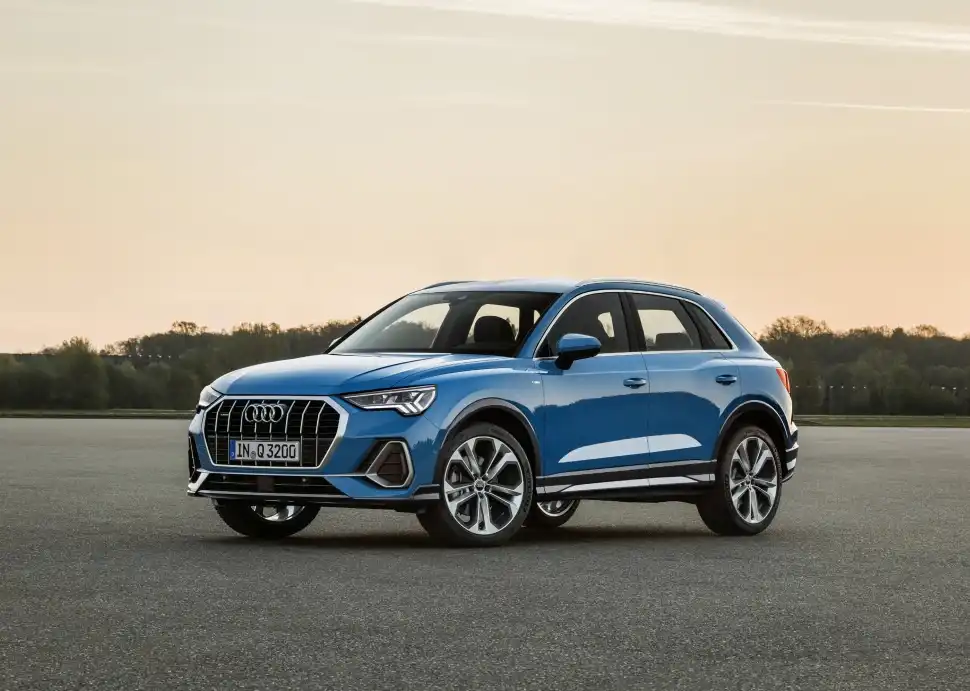
The Audi Q3 II (F3) 35 TFSI, produced from 2018 to 2020, represents a key entry point into the second-generation Q3 range. Positioned as a compact luxury crossover SUV, it aimed to deliver a balance of practicality, technology, and Audi’s signature refinement to a broader customer base. This variant, powered by a 1.5-liter turbocharged four-cylinder engine producing 150 horsepower, was primarily marketed in Europe and other regions where smaller displacement engines are favored due to tax incentives and fuel efficiency regulations. It served as a more accessible alternative to the higher-performance 40 TFSI and diesel-powered variants within the F3 Q3 lineup.
Technical Specifications
| Brand | Audi |
| Model | Q3 |
| Generation | Q3 II (F3) |
| Type (Engine) | 35 TFSI (150 Hp) |
| Start of production | 2018 |
| End of production | 2020 |
| Powertrain Architecture | Internal Combustion engine |
| Body type | SUV |
| Seats | 5 |
| Doors | 5 |
| Combined fuel consumption (WLTP) | 6.6-7.2 l/100 km (35.6 – 32.7 US mpg, 42.8 – 39.2 UK mpg, 15.2 – 13.9 km/l) |
| CO2 emissions (WLTP) | 149-164 g/km |
| Fuel consumption (urban) | 7.6-7.7 l/100 km (30.9 – 30.5 US mpg, 37.2 – 36.7 UK mpg, 13.2 – 13 km/l) |
| Fuel consumption (extra urban) | 5.1-5.4 l/100 km (46.1 – 43.6 US mpg, 55.4 – 52.3 UK mpg, 19.6 – 18.5 km/l) |
| Fuel consumption (combined) | 6.0-6.3 l/100 km (39.2 – 37.3 US mpg, 47.1 – 44.8 UK mpg, 16.7 – 15.9 km/l) |
| CO2 emissions | 139-145 g/km |
| Fuel Type | Petrol (Gasoline) |
| Acceleration 0 – 100 km/h | 9.6 sec |
| Acceleration 0 – 62 mph | 9.6 sec |
| Acceleration 0 – 60 mph | 9.1 sec |
| Maximum speed | 211 km/h (131.11 mph) |
| Emission standard | Euro 6d – TEMP |
| Weight-to-power ratio | 9.7 kg/Hp, 102.7 Hp/tonne |
| Weight-to-torque ratio | 5.8 kg/Nm, 171.2 Nm/tonne |
| Power | 150 Hp @ 5000-6000 rpm |
| Power per litre | 100.1 Hp/l |
| Torque | 250 Nm @ 1500-3500 rpm (184.39 lb.-ft. @ 1500-3500 rpm) |
| Engine layout | Front, Transverse |
| Engine Model/Code | DPCA |
| Engine displacement | 1498 cm3 (91.41 cu. in.) |
| Number of cylinders | 4 |
| Engine configuration | Inline |
| Cylinder Bore | 74.5 mm (2.93 in.) |
| Piston Stroke | 85.9 mm (3.38 in.) |
| Compression ratio | 10.5:1 |
| Number of valves per cylinder | 4 |
| Fuel injection system | Direct injection |
| Engine aspiration | Turbocharger, Intercooler |
| Engine oil capacity | 4.3 l (4.54 US qt | 3.78 UK qt) |
| Coolant | 11.2 l (11.83 US qt | 9.85 UK qt) |
| Kerb Weight | 1460 kg (3218.75 lbs.) |
| Max. weight | 2045 kg (4508.45 lbs.) |
| Max load | 585 kg (1289.7 lbs.) |
| Trunk (boot) space – minimum | 530 l (18.72 cu. ft.) |
| Trunk (boot) space – maximum | 1525 l (53.85 cu. ft.) |
| Fuel tank capacity | 60 l (15.85 US gal | 13.2 UK gal) |
| Max. roof load | 75 kg (165.35 lbs.) |
| Permitted trailer load with brakes (8%) | 2000 kg (4409.25 lbs.) |
| Permitted trailer load with brakes (12%) | 1800 kg (3968.32 lbs.) |
| Permitted trailer load without brakes | 750 kg (1653.47 lbs.) |
| Permitted towbar download | 90 kg (198.42 lbs.) |
| Length | 4484 mm (176.54 in.) |
| Width | 1856 mm (73.07 in.) |
| Width including mirrors | 2024 mm (79.69 in.) |
| Height | 1616 mm (63.62 in.) |
| Wheelbase | 2680 mm (105.51 in.) |
| Front track | 1584 mm (62.36 in.) |
| Rear track | 1576 mm (62.05 in.) |
| Front overhang | 896 mm (35.28 in.) |
| Rear overhang | 908 mm (35.75 in.) |
| Drag coefficient (Cd) | 0.32 |
| Minimum turning circle | 11.8 m (38.71 ft.) |
| Drivetrain Architecture | The Internal combustion engine (ICE) drives the front wheels of the vehicle. |
| Drive wheel | Front wheel drive |
| Number of gears and type of gearbox | 6 gears, manual transmission |
| Front suspension | Independent type McPherson |
| Rear suspension | Independent multi-link suspension |
| Front brakes | Ventilated discs |
| Rear brakes | Disc |
| Assisting systems | ABS (Anti-lock braking system) |
| Steering type | Steering rack and pinion |
| Power steering | Electric Steering |
| Tires size | 215/65 R17 |
| Wheel rims size | 6.5J x 17 |
INTRODUCTION
The Audi Q3 II (F3) 35 TFSI, launched in 2018, is a front-wheel-drive compact SUV built on the Volkswagen Group’s MQB platform (specifically the A3 variant, 1HX0/A3). It represents the second generation of the Q3, offering a more refined and technologically advanced package compared to its predecessor. This particular variant, the 35 TFSI, was designed to appeal to buyers seeking a premium SUV experience with a focus on fuel efficiency and affordability. It occupied the entry-level position in the Q3 range, offering a stepping stone into the Audi SUV lineup.
Powertrain & Engine Architecture
At the heart of the Q3 35 TFSI lies the DPCA engine, a 1.5-liter inline-four cylinder gasoline engine. This engine utilizes direct injection and a single turbocharger with an intercooler to deliver a balance of power and efficiency. A key feature of this engine is its cylinder deactivation technology (COD – Cylinder On Demand), which shuts down two cylinders under light load conditions to reduce fuel consumption. The engine is paired with a 6-speed manual transmission as standard, sending power to the front wheels. The fuel injection system is a Bosch-supplied direct injection system operating at high pressure for optimized combustion. The engine’s valvetrain employs dual overhead camshafts (DOHC) with four valves per cylinder, contributing to its responsive nature.
Driving Characteristics
The 150 horsepower and 250 Nm (184 lb-ft) of torque produced by the 1.5 TFSI engine provide adequate performance for everyday driving. Acceleration from 0-60 mph takes approximately 9.1 seconds, and the top speed is 131 mph. While not particularly sporty, the engine delivers a usable amount of power for merging onto highways and overtaking. The 6-speed manual transmission offers a reasonably precise shift feel, although the gear ratios are tuned for fuel economy rather than outright performance. Compared to the more powerful 40 TFSI variant, the 35 TFSI feels noticeably less eager to accelerate, but it offers a smoother and more relaxed driving experience. The front-wheel-drive configuration contributes to a slight tendency towards understeer in spirited cornering.
Equipment & Trim Levels
The Q3 35 TFSI typically came equipped with a generous amount of standard features, including Audi’s MMI infotainment system with a 7-inch touchscreen display, automatic climate control, and a suite of safety features such as lane departure warning and automatic emergency braking. Interior upholstery was typically cloth, with options for leather upgrades. Common optional extras included a larger touchscreen display, a digital instrument cluster (Audi Virtual Cockpit), a panoramic sunroof, and a premium sound system. Trim levels varied by market, but generally offered progressive upgrades in terms of interior materials, exterior styling, and technology features.
Chassis & Braking
The Q3 35 TFSI utilizes an independent McPherson strut suspension at the front and a multi-link suspension at the rear, providing a comfortable and controlled ride. Stabilizer bars are fitted to both axles to reduce body roll during cornering. The braking system consists of ventilated discs at the front and solid discs at the rear, providing adequate stopping power for the vehicle’s weight and performance. ABS (Anti-lock Braking System) is standard, along with electronic brake-force distribution and brake assist.
Market Reception & Comparison
The Q3 35 TFSI was generally well-received by automotive critics, who praised its comfortable ride, refined interior, and fuel efficiency. However, some reviewers noted that the engine could feel underpowered, particularly when fully loaded or driving uphill. Compared to the 40 TFSI variant, the 35 TFSI offered a more affordable entry point into the Q3 range, but at the expense of performance. In terms of fuel economy, the 35 TFSI typically achieved around 35-38 mpg on the combined cycle, making it a competitive option in its class. Reliability has been generally good, with few widespread issues reported.
Legacy
The Audi Q3 II (F3) 35 TFSI represents a significant step forward in the compact luxury SUV segment. Its combination of style, technology, and efficiency has made it a popular choice among buyers seeking a premium crossover. The 1.5 TFSI engine, while not the most powerful option, has proven to be a reliable and fuel-efficient powerplant. On the used car market, these models continue to hold their value well, particularly those with low mileage and a full service history. The Q3 35 TFSI remains a compelling option for buyers seeking a well-rounded and refined compact SUV.