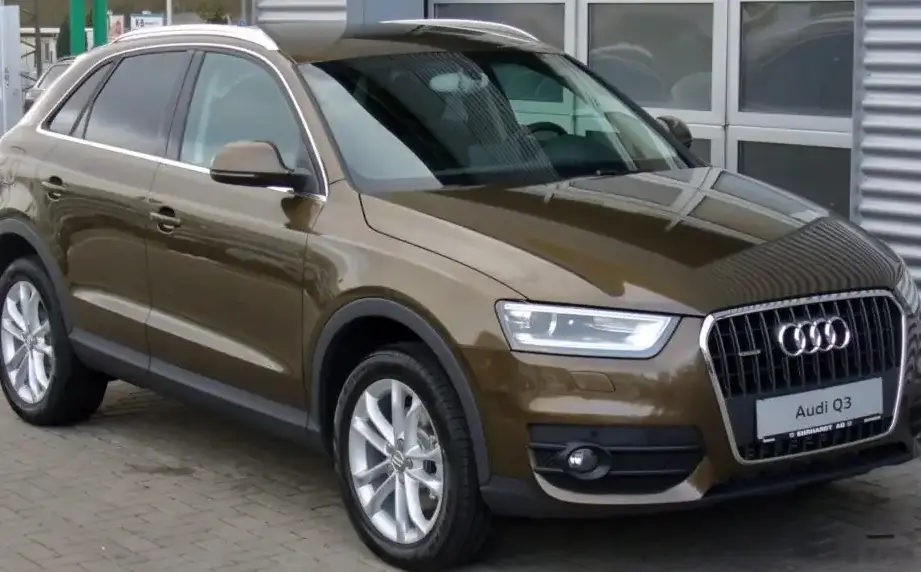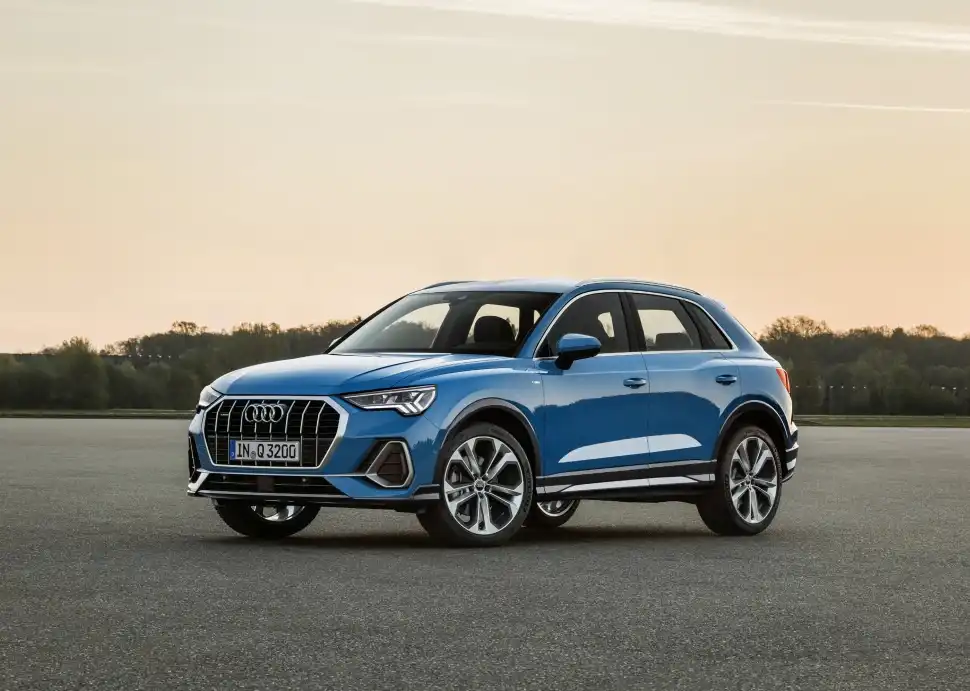
The Audi Q3 II (F3) 35 TFSI Mild Hybrid S tronic is a compact luxury crossover SUV produced by the German manufacturer Audi from 2020 to June 2025. Positioned as an entry-level offering within the second-generation Q3 (F3) lineup, it aimed to provide a balance of fuel efficiency, technology, and Audi’s signature refinement at a more accessible price point. This variant utilizes a 1.5-liter turbocharged four-cylinder engine coupled with a 48-volt mild hybrid system and a seven-speed S tronic dual-clutch transmission, driving the front wheels. It served as a key model in Audi’s strategy to offer a wider range of powertrain options within the popular compact SUV segment, particularly in European markets where fuel economy and emissions regulations are stringent.
Technical Specifications
| Brand | Audi |
| Model | Q3 |
| Generation | Q3 II (F3) |
| Type (Engine) | 35 TFSI (150 Hp) Mild Hybrid S tronic |
| Start of production | 2020 |
| End of production | June, 2025 |
| Powertrain Architecture | MHEV (Mild Hybrid Electric Vehicle) |
| Body type | SUV |
| Seats | 5 |
| Doors | 5 |
| Combined fuel consumption (WLTP) | 6.7-7.2 l/100 km (35.1 – 32.7 US mpg, 42.2 – 39.2 UK mpg, 14.9 – 13.9 km/l) |
| CO2 emissions (WLTP) | 153-163 g/km |
| Fuel consumption (urban) | 6.9-7.0 l/100 km (34.1 – 33.6 US mpg, 40.9 – 40.4 UK mpg, 14.5 – 14.3 km/l) |
| Fuel consumption (extra urban) | 5.2-5.5 l/100 km (45.2 – 42.8 US mpg, 54.3 – 51.4 UK mpg, 19.2 – 18.2 km/l) |
| Fuel consumption (combined) | 5.9-6.1 l/100 km (39.9 – 38.6 US mpg, 47.9 – 46.3 UK mpg, 16.9 – 16.4 km/l) |
| CO2 emissions (NEDC) | 134-138 g/km |
| Fuel Type | Petrol (Gasoline) |
| Acceleration 0 – 100 km/h | 9.4 sec |
| Acceleration 0 – 62 mph | 9.4 sec |
| Acceleration 0 – 60 mph | 8.9 sec |
| Maximum speed | 205 km/h (127.38 mph) |
| Emission standard | Euro 6d-TEMP-EVAP-ISC |
| Weight-to-power ratio | 10.2 kg/Hp |
| Weight-to-torque ratio | 6.1 kg/Nm |
| Power | 150 Hp @ 5000-6000 rpm |
| Torque | 250 Nm @ 1500-3500 rpm (184.39 lb.-ft. @ 1500-3500 rpm) |
| Engine layout | Front, Transverse |
| Engine Model/Code | DFYA |
| Engine displacement | 1498 cm3 (91.41 cu. in.) |
| Number of cylinders | 4 |
| Engine configuration | Inline |
| Number of valves per cylinder | 4 |
| Fuel injection system | Direct injection |
| Engine aspiration | Turbocharger, Intercooler |
| Engine oil capacity | 4.3 l (4.54 US qt | 3.78 UK qt) |
| Coolant capacity | 9 l (9.51 US qt | 7.92 UK qt) |
| Kerb Weight | 1530 kg (3373.07 lbs.) |
| Trunk (boot) space – minimum | 410 l (14.48 cu. ft.) |
| Trunk (boot) space – maximum | 1405 l (49.62 cu. ft.) |
| Fuel tank capacity | 58 l (15.32 US gal | 12.76 UK gal) |
| Max. roof load | 75 kg (165.35 lbs.) |
| Permitted trailer load (8%) | 2000 kg (4409.25 lbs.) |
| Permitted trailer load (12%) | 1800 kg (3968.32 lbs.) |
| Permitted trailer load (unbraked) | 750 kg (1653.47 lbs.) |
| Permitted towbar download | 90 kg (198.42 lbs.) |
| Length | 4484 mm (176.54 in.) |
| Width | 1849 mm (72.8 in.) |
| Width (including mirrors) | 2024 mm (79.69 in.) |
| Height | 1616 mm (63.62 in.) |
| Wheelbase | 2680 mm (105.51 in.) |
| Front track | 1584 mm (62.36 in.) |
| Rear track | 1576 mm (62.05 in.) |
| Minimum turning circle | 11.8 m (38.71 ft.) |
| Drivetrain | Front wheel drive, MHEV |
| Gearbox | 7 gears, automatic transmission S tronic |
| Front suspension | Independent McPherson |
| Rear suspension | Independent multi-link |
| Front brakes | Ventilated discs |
| Rear brakes | Disc |
| Tire size | 215/65 R17 |
| Wheel rims size | 7 J x 17 |
INTRODUCTION
The Audi Q3 II (F3) 35 TFSI Mild Hybrid S tronic, launched in 2020, represents a significant update to Audi’s popular compact SUV. Built on the Volkswagen Group’s MQB Evo platform (shared with models like the Volkswagen Tiguan and Skoda Karoq), the F3 generation Q3 aimed for a more sophisticated and technologically advanced experience. The 35 TFSI variant, with its 150 horsepower engine and mild hybrid assistance, was designed to appeal to buyers prioritizing fuel efficiency and lower running costs without sacrificing the Audi brand’s premium feel. It occupied the entry-level position in the Q3 range, offering a more affordable alternative to the higher-powered 40 TFSI and 45 TFSI models.
Powertrain & Engine Architecture
At the heart of the Q3 35 TFSI lies the DFYA engine, a 1.5-liter turbocharged inline-four cylinder gasoline engine. This engine is part of Audi’s EA211 family and features direct fuel injection and variable valve timing on both intake and exhaust sides. The turbocharger, coupled with an intercooler, provides a boost in power and torque. What sets this variant apart is its 48-volt mild hybrid system. This system incorporates a belt starter generator (BSG) that recovers energy during deceleration and stores it in a small battery. This stored energy can then be used to assist the engine during acceleration, allowing for smoother starts and improved fuel economy. The seven-speed S tronic dual-clutch transmission delivers quick and efficient gear changes. This transmission is known for its responsiveness and contributes to the overall driving experience. The engine’s control unit manages the interplay between the combustion engine and the electric motor, optimizing performance and efficiency.
Driving Characteristics
The Q3 35 TFSI S tronic delivers a comfortable and refined driving experience, prioritizing ease of use over outright performance. With 150 horsepower and 250 Nm (184 lb-ft) of torque, acceleration from 0 to 60 mph takes around 8.9 seconds, which is adequate for everyday driving but doesn’t offer the sporty feel of the more powerful Q3 variants. The S tronic transmission provides smooth and quick shifts, enhancing the overall driving experience. The mild hybrid system contributes to a seamless start-stop function and a slight boost during acceleration, making city driving more pleasant. The front-wheel-drive configuration provides good traction in most conditions, although all-wheel drive (quattro) was available as an option on higher trims. The steering is light and precise, making it easy to maneuver in urban environments. Compared to the 40 TFSI, the 35 TFSI feels less eager to accelerate, but the difference is noticeable primarily during more spirited driving.
Equipment & Trim Levels
The Q3 35 TFSI typically came standard with a generous amount of equipment, reflecting Audi’s premium positioning. Standard features included Audi’s MMI infotainment system with a 10.1-inch touchscreen display, Apple CarPlay and Android Auto integration, automatic climate control, and a suite of driver-assistance systems such as lane departure warning and forward collision warning. Interior upholstery was typically cloth, with leather options available as upgrades. Optional extras included a panoramic sunroof, a premium sound system, adaptive cruise control, and a digital instrument cluster (Audi Virtual Cockpit). Trim levels varied by market, but generally offered increasing levels of luxury and technology. The base trim focused on essential features, while higher trims added more comfort and convenience items.
Chassis & Braking
The Q3 35 TFSI utilizes a McPherson strut suspension setup at the front and a multi-link suspension at the rear, providing a comfortable and controlled ride. The suspension is tuned to prioritize comfort over sporty handling, making it well-suited for everyday driving. The braking system consists of ventilated discs at the front and solid discs at the rear. Anti-lock braking system (ABS) and electronic stability control (ESC) are standard features, enhancing safety and stability. The steering system is an electric power steering system, providing precise and responsive steering feel. The chassis is designed to minimize body roll and provide a stable platform for the vehicle.
Market Reception & Comparison
The Audi Q3 35 TFSI Mild Hybrid S tronic was generally well-received by automotive critics. It was praised for its fuel efficiency, comfortable ride, and refined interior. However, some reviewers noted that the engine could feel underpowered, especially when fully loaded or driving uphill. Compared to the 40 TFSI, the 35 TFSI offered a more affordable entry point into the Q3 range, but at the expense of performance. The 35 TFSI’s fuel economy was competitive with other compact SUVs in its class, and the mild hybrid system contributed to lower emissions. Reliability reports have been generally positive, with few major issues reported.
Legacy
The Audi Q3 II (F3) 35 TFSI Mild Hybrid S tronic represents a key step in Audi’s electrification strategy. The integration of the 48-volt mild hybrid system demonstrated Audi’s commitment to improving fuel efficiency and reducing emissions. In the used car market, these models are becoming increasingly popular due to their combination of affordability, fuel economy, and Audi’s reputation for quality. The DFYA engine, while not known for being exceptionally powerful, has proven to be relatively reliable. As with any used vehicle, potential buyers should have a thorough inspection performed to ensure the vehicle is in good condition. The Q3 35 TFSI continues to be a viable option for buyers seeking a premium compact SUV with a focus on efficiency and practicality.