Technical Specifications
| Brand | Audi |
| Model | Q3 |
| Generation | Q3 II (F3) |
| Type (Engine) | 40 TDI (193 Hp) quattro S tronic |
| Start of production | March, 2024 |
| End of production | June, 2025 |
| Powertrain Architecture | Internal Combustion engine |
| Body type | SUV |
| Seats | 5 |
| Doors | 5 |
| Combined fuel consumption (WLTP) | 6.3-7 l/100 km (37.3 – 33.6 US mpg, 44.8 – 40.4 UK mpg, 15.9 – 14.3 km/l) |
| CO2 emissions (WLTP) | 165-183 g/km |
| Fuel Type | Diesel |
| Acceleration 0 – 100 km/h | 7.6 sec |
| Acceleration 0 – 62 mph | 7.6 sec |
| Acceleration 0 – 60 mph | 7.2 sec |
| Maximum speed | 218 km/h (135.46 mph) |
| Emission standard | Euro 6e |
| Weight-to-power ratio | 8.6 kg/Hp, 116.3 Hp/tonne |
| Weight-to-torque ratio | 4.2 kg/Nm, 241 Nm/tonne |
| Power | 193 Hp @ 3500-4200 rpm |
| Power per litre | 98.1 Hp/l |
| Torque | 400 Nm @ 1750-3250 rpm (295.02 lb.-ft. @ 1750-3250 rpm) |
| Engine layout | Front, Transverse |
| Engine displacement | 1968 cm3 (120.09 cu. in.) |
| Number of cylinders | 4 |
| Engine configuration | Inline |
| Cylinder Bore | 81 mm (3.19 in.) |
| Piston Stroke | 95.5 mm (3.76 in.) |
| Compression ratio | 15.5:1 |
| Number of valves per cylinder | 4 |
| Fuel injection system | Diesel Commonrail |
| Engine aspiration | Turbocharger, Intercooler |
| Valvetrain | DOHC |
| Engine oil capacity | 5.5 l (5.81 US qt | 4.84 UK qt) |
| Coolant | 13.2 l (13.95 US qt | 11.61 UK qt) |
| Kerb Weight | 1660 kg (3659.67 lbs.) |
| Max. weight | 2205-2250 kg (4861.19 – 4960.4 lbs.) |
| Max load | 545-590 kg (1201.52 – 1300.73 lbs.) |
| Trunk (boot) space – minimum | 530 l (18.72 cu. ft.) |
| Trunk (boot) space – maximum | 1525 l (53.85 cu. ft.) |
| Fuel tank capacity | 58 l (15.32 US gal | 12.76 UK gal) |
| AdBlue tank | 18 l (4.76 US gal | 3.96 UK gal) |
| Max. roof load | 75 kg (165.35 lbs.) |
| Permitted trailer load with brakes (8%) | 2200 kg (4850.17 lbs.) |
| Permitted trailer load with brakes (12%) | 2200 kg (4850.17 lbs.) |
| Permitted trailer load without brakes | 750 kg (1653.47 lbs.) |
| Permitted towbar download | 90 kg (198.42 lbs.) |
| Length | 4484 mm (176.54 in.) |
| Width | 1856 mm (73.07 in.) |
| Width including mirrors | 2024 mm (79.69 in.) |
| Height | 1616 mm (63.62 in.) |
| Wheelbase | 2680 mm (105.51 in.) |
| Front track | 1584 mm (62.36 in.) |
| Rear (Back) track | 1576 mm (62.05 in.) |
| Front overhang | 896 mm (35.28 in.) |
| Rear overhang | 908 mm (35.75 in.) |
| Drag coefficient (Cd) | 0.34 |
| Minimum turning circle (turning diameter) | 11.8 m (38.71 ft.) |
| Approach angle | 17.3° |
| Departure angle | 26.4° |
| Drivetrain Architecture | The Internal combustion engine (ICE) drives the front wheels permanently, and the rear wheels are driven through an electrically or mechanically operated clutch if necessary. |
| Drive wheel | All wheel drive (4×4) |
| Number of gears and type of gearbox | 7 gears, automatic transmission S tronic |
| Front suspension | Independent, type McPherson with coil spring and anti-roll bar |
| Rear suspension | Independent multi-link spring suspension with stabilizer |
| Front brakes | Ventilated discs |
| Rear brakes | Disc |
| Assisting systems | ABS (Anti-lock braking system) |
| Steering type | Steering rack and pinion |
| Power steering | Electric Steering |
| Tires size | 215/65 R17; 235/55 R18; 235/50 R19; 255/45 R19; 255/40 R20 |
| Wheel rims size | 6.5J x 17; 7J x 17; 7J x 18; 7J x 19; 8.5J x 19; 8.5J x 20 |
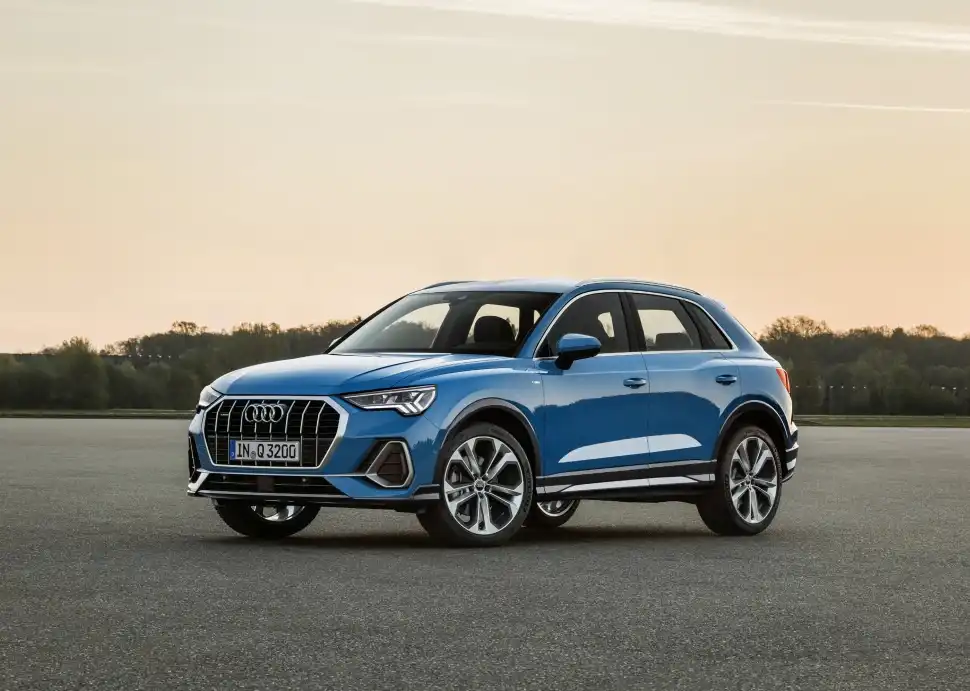
The Audi Q3 II (F3) 40 TDI quattro S tronic represents a significant iteration in Audi’s popular compact SUV lineup. Introduced in March 2024 and produced through June 2025, this variant occupies a key position within the F3 generation, offering a blend of performance, efficiency, and all-weather capability. It’s positioned as a mid-range offering, bridging the gap between the entry-level petrol models and the more potent, higher-trim diesel options. The Q3 F3 series is built on the Volkswagen Group’s MQB Evo platform, shared with models like the Volkswagen Tiguan and Skoda Karoq, allowing for economies of scale and a flexible architecture.
Powertrain & Engine Architecture
The heart of the Q3 40 TDI is the 2.0-liter inline-four cylinder diesel engine, typically identified by engine codes such as DWC. This engine is a member of the Volkswagen Group’s modular engine family, known for its robust construction and efficiency. It utilizes a common-rail direct injection system, delivering fuel at extremely high pressures for optimized combustion. The engine is turbocharged with an intercooler, enhancing power output and reducing turbo lag. The valvetrain employs a dual overhead camshaft (DOHC) configuration with four valves per cylinder, maximizing airflow and contributing to the engine’s broad torque curve. Paired with this engine is the seven-speed S tronic dual-clutch transmission. This transmission offers quick, seamless shifts and contributes to the vehicle’s overall efficiency. The quattro all-wheel-drive system is integral, utilizing a multi-plate clutch to distribute torque between the front and rear axles as needed, providing enhanced traction and stability.
Driving Characteristics
The 193 horsepower and 400 Nm (295 lb-ft) of torque delivered by the 40 TDI powertrain provide a confident and capable driving experience. Acceleration from 0-60 mph takes approximately 7.2 seconds, making it adequately quick for everyday driving and highway merging. The S tronic transmission’s quick shifts contribute to a responsive feel. Compared to the lower-powered petrol variants, the 40 TDI offers significantly more torque, resulting in stronger acceleration, particularly at lower engine speeds. While not as sporty as the higher-output TDI models, the 40 TDI provides a good balance between performance and fuel economy. The gear ratios are tuned for a blend of acceleration and cruising efficiency, with the seventh gear providing a comfortable and economical highway driving experience. The quattro all-wheel-drive system inspires confidence in various weather conditions, providing enhanced grip and stability.
Equipment & Trim Levels
The Q3 40 TDI quattro S tronic typically came well-equipped, even in base trim. Standard features often included Audi’s MMI infotainment system with a touchscreen display, Apple CarPlay and Android Auto integration, automatic climate control, and a suite of driver-assistance systems such as lane departure warning and forward collision warning. Interior upholstery was typically cloth, with leather options available as upgrades. Higher trim levels added features like a panoramic sunroof, premium sound system, heated front seats, and advanced driver-assistance features like adaptive cruise control and blind-spot monitoring. Optional extras included metallic paint finishes, upgraded wheel designs, and various interior customization options.
Chassis & Braking
The Q3 F3 utilizes a McPherson strut front suspension and a multi-link rear suspension, providing a comfortable and controlled ride. Stabilizer bars are fitted to both axles to reduce body roll during cornering. The braking system consists of ventilated discs at the front and solid discs at the rear. Anti-lock braking system (ABS) and electronic stability control (ESC) are standard features, enhancing safety and control. The steering is an electric power-assisted rack and pinion system, providing precise and responsive steering feel.
Market Reception & Comparison
The Audi Q3 40 TDI quattro S tronic was generally well-received by automotive critics. It was praised for its refined engine, comfortable ride, and spacious interior. Fuel economy was also a strong point, with the diesel engine offering significantly better mileage than the petrol alternatives. Compared to the 35 TDI variant, the 40 TDI offered a noticeable performance boost, justifying the slightly higher price. Against competitors like the BMW X3 and Mercedes-Benz GLC, the Q3 40 TDI offered a compelling combination of value, features, and driving dynamics. Some critics noted that the interior materials, while well-assembled, weren’t quite as luxurious as those found in its German rivals.
Legacy
The 2.0-liter TDI engine and S tronic transmission pairing have proven to be reliable and durable in numerous Volkswagen Group vehicles. While diesel engines have faced increased scrutiny in recent years, the Q3 40 TDI remains a popular choice in the used car market, particularly for those seeking a fuel-efficient and capable SUV. Regular maintenance, including timely oil changes and adherence to recommended service intervals, is crucial for ensuring the long-term reliability of this powertrain. The quattro all-wheel-drive system continues to be a valuable asset, providing enhanced traction and safety in challenging driving conditions. The Q3 40 TDI represents a well-rounded and practical choice for buyers seeking a premium compact SUV.