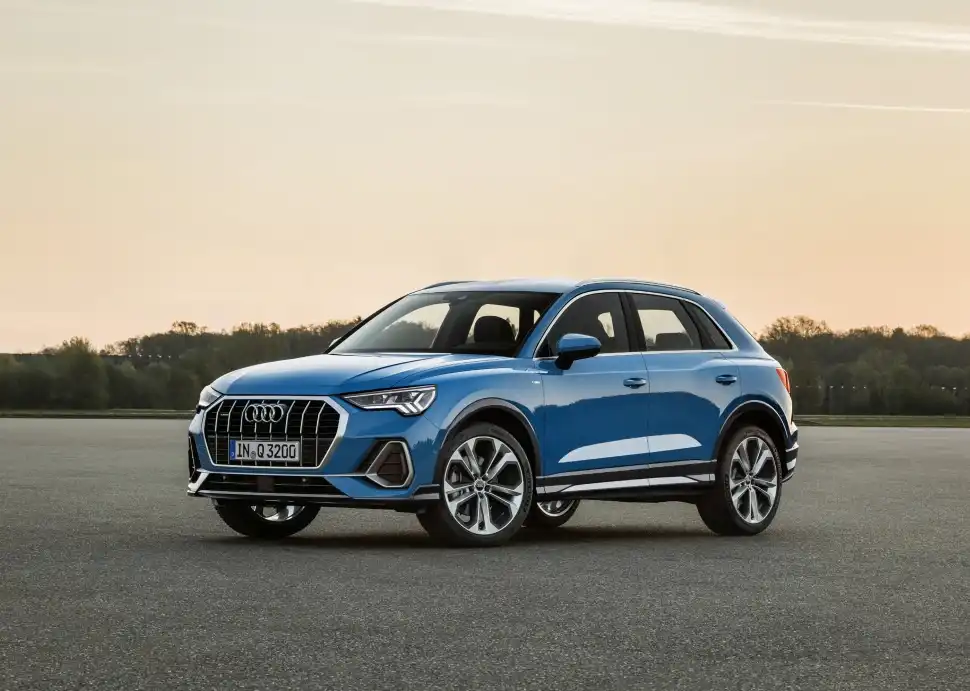
The Audi Q3 II (F3) 45 TFSI quattro S tronic represents a significant iteration in Audi’s popular compact luxury SUV lineup. Produced from January 2021 to March 2024, this variant occupied a mid-to-upper position within the F3 generation Q3 range, offering a blend of performance, technology, and practicality. Built on the Volkswagen Group’s MQB platform (specifically the 1HX0/A3 variant), the 45 TFSI model aimed to deliver a more engaging driving experience than the base engine options while remaining accessible to a broad customer base. It was primarily marketed in Europe and other global markets where compact SUVs are highly sought after, offering a premium alternative to rivals like the BMW X1 and Mercedes-Benz GLA.
Technical Specifications
| Brand | Audi |
| Model | Q3 |
| Generation | Q3 II (F3) |
| Type (Engine) | 45 TFSI (245 Hp) quattro S tronic |
| Start of production | January, 2021 |
| End of production | March, 2024 |
| Powertrain Architecture | Internal Combustion engine |
| Body type | SUV |
| Seats | 5 |
| Doors | 5 |
| Combined fuel consumption (WLTP) | 8.2-8.9 l/100 km (28.7 – 26.4 US mpg, 34.4 – 31.7 UK mpg, 12.2 – 11.2 km/l) |
| CO2 emissions (WLTP) | 185-201 g/km |
| Fuel consumption (economy) – urban (NEDC, WLTP equivalent) | 8.9-9.2 l/100 km (26.4 – 25.6 US mpg, 31.7 – 30.7 UK mpg, 11.2 – 10.9 km/l) |
| Fuel consumption (economy) – extra urban (NEDC, WLTP equivalent) | 6.1-6.6 l/100 km (38.6 – 35.6 US mpg, 46.3 – 42.8 UK mpg, 16.4 – 15.2 km/l) |
| Fuel consumption (economy) – combined (NEDC, WLTP equivalent) | 7.1-7.5 l/100 km (33.1 – 31.4 US mpg, 39.8 – 37.7 UK mpg, 14.1 – 13.3 km/l) |
| CO2 emissions (NEDC, WLTP equivalent) | 163-172 g/km |
| Fuel Type | Petrol (Gasoline) |
| Acceleration 0 – 100 km/h | 5.8 sec |
| Acceleration 0 – 62 mph | 5.8 sec |
| Acceleration 0 – 60 mph | 5.5 sec |
| Maximum speed | 238 km/h (147.89 mph) |
| Emission standard | Euro 6d-ISC-FCM |
| Weight-to-power ratio | 6.6 kg/Hp, 151.2 Hp/tonne |
| Weight-to-torque ratio | 4.4 kg/Nm, 228.4 Nm/tonne |
| Power | 245 Hp @ 5000-6500 rpm |
| Power per litre | 123.5 Hp/l |
| Torque | 370 Nm @ 1600-4300 rpm (272.9 lb.-ft. @ 1600-4300 rpm) |
| Engine layout | Front, Transverse |
| Engine Model/Code | EA888 / DNPA |
| Engine displacement | 1984 cm3 (121.07 cu. in.) |
| Number of cylinders | 4 |
| Engine configuration | Inline |
| Cylinder Bore | 82.5 mm (3.25 in.) |
| Piston Stroke | 92.8 mm (3.65 in.) |
| Compression ratio | 9.6:1 |
| Number of valves per cylinder | 4 |
| Fuel injection system | Direct injection |
| Engine aspiration | Turbocharger, Intercooler |
| Valvetrain | DOHC |
| Engine oil capacity | 5.7 l (6.02 US qt | 5.02 UK qt) |
| Coolant | 9.2 l (9.72 US qt | 8.09 UK qt) |
| Kerb Weight | 1620 kg (3571.49 lbs.) |
| Max. weight | 2150-2200 kg (4739.94 – 4850.17 lbs.) |
| Max load | 530-580 kg (1168.45 – 1278.68 lbs.) |
| Trunk (boot) space – minimum | 530 l (18.72 cu. ft.) |
| Trunk (boot) space – maximum | 1525 l (53.85 cu. ft.) |
| Fuel tank capacity | 60 l (15.85 US gal | 13.2 UK gal) |
| Max. roof load | 75 kg (165.35 lbs.) |
| Permitted trailer load with brakes (8%) | 2100 kg (4629.71 lbs.) |
| Permitted trailer load with brakes (12%) | 2100 kg (4629.71 lbs.) |
| Permitted trailer load without brakes | 750 kg (1653.47 lbs.) |
| Permitted towbar download | 90 kg (198.42 lbs.) |
| Length | 4484 mm (176.54 in.) |
| Width | 1856 mm (73.07 in.) |
| Width including mirrors | 2024 mm (79.69 in.) |
| Height | 1616 mm (63.62 in.) |
| Wheelbase | 2680 mm (105.51 in.) |
| Front track | 1584 mm (62.36 in.) |
| Rear (Back) track | 1576 mm (62.05 in.) |
| Front overhang | 896 mm (35.28 in.) |
| Rear overhang | 908 mm (35.75 in.) |
| Drag coefficient (Cd) | 0.33 |
| Minimum turning circle (turning diameter) | 11.8 m (38.71 ft.) |
| Approach angle | 18.8° |
| Departure angle | 16.2° |
| Drivetrain Architecture | The Internal combustion engine (ICE) drives the front wheels permanently, and the rear wheels are driven through an electrically or mechanically operated clutch if necessary. |
| Drive wheel | All wheel drive (4×4) |
| Number of gears and type of gearbox | 7 gears, automatic transmission S tronic |
| Front suspension | Independent, type McPherson with coil spring and anti-roll bar |
| Rear suspension | Independent multi-link spring suspension with stabilizer |
| Front brakes | Ventilated discs |
| Rear brakes | Disc |
| Assisting systems | ABS (Anti-lock braking system) |
| Steering type | Steering rack and pinion |
| Power steering | Electric Steering |
| Tires size | 215/65 R17; 235/55 R18; 235/50 R19; 255/45 R19; 255/40 R20 |
| Wheel rims size | 6.5J x 17; 7J x 17; 7J x 18; 7J x 19; 8.5J x 19; 8.5J x 20 |
INTRODUCTION
The Audi Q3 II (F3) 45 TFSI quattro S tronic, launched in 2021, represents a significant step forward in Audi’s compact SUV offerings. This model is part of the second generation Q3 (F3), which brought a more mature and sophisticated design language, along with updated technology and improved driving dynamics. The “45 TFSI” designation indicates the engine’s power output within Audi’s naming scheme, and the “quattro” signifies Audi’s renowned all-wheel-drive system. The “S tronic” label denotes the use of Audi’s dual-clutch transmission. This particular variant aimed to bridge the gap between the entry-level Q3 models and the higher-performance SQ3, offering a compelling balance of power, efficiency, and luxury.
Powertrain & Engine Architecture
At the heart of the Q3 45 TFSI lies the EA888 2.0-liter turbocharged four-cylinder engine, specifically coded DNPA. This engine is a staple in the Volkswagen Group’s portfolio, known for its robust construction and tuning potential. It utilizes direct fuel injection, delivering fuel directly into the combustion chamber for improved efficiency and power. The engine also features an integrated intercooler to cool the intake air, further enhancing performance. The EA888 engine employs a dual overhead camshaft (DOHC) valvetrain with four valves per cylinder, optimizing airflow for increased power output. The seven-speed S tronic dual-clutch transmission is a key component of this variant. This transmission offers incredibly fast and smooth gear changes, contributing to both performance and fuel efficiency. The quattro all-wheel-drive system utilizes a multi-plate clutch to distribute torque between the front and rear axles as needed, providing enhanced traction and stability in various driving conditions.
Driving Characteristics
The Q3 45 TFSI quattro S tronic delivers a noticeably more spirited driving experience compared to lower-powered Q3 variants. The 245 horsepower and 272.9 lb.-ft. of torque provide ample acceleration, with a 0-60 mph time of around 5.5 seconds. The S tronic transmission contributes to this responsiveness, offering quick and precise gear changes. The quattro all-wheel-drive system inspires confidence in all weather conditions, providing excellent grip and stability. The gear ratios are tuned to provide a balance between acceleration and fuel efficiency, with the transmission readily downshifting for quick overtaking maneuvers. While not as overtly sporty as the SQ3, the 45 TFSI offers a refined and engaging driving experience that is well-suited for both daily commutes and longer journeys.
Equipment & Trim Levels
The Q3 45 TFSI quattro S tronic typically came well-equipped as standard. Interior features included premium cloth or leather upholstery, a multi-function steering wheel, and Audi’s MMI infotainment system with a touchscreen display. Standard safety features included Audi pre sense basic, lane departure warning, and automatic emergency braking. Optional extras included a panoramic sunroof, a premium sound system, adaptive cruise control, and a virtual cockpit digital instrument cluster. Trim levels varied by market, but generally offered packages that added features like upgraded interior trim, larger wheels, and advanced driver-assistance systems.
Chassis & Braking
The Q3 45 TFSI utilizes an independent suspension setup, with McPherson struts at the front and a multi-link suspension at the rear. This configuration provides a comfortable ride while maintaining good handling characteristics. Stabilizer bars are fitted to both axles to reduce body roll during cornering. The braking system consists of ventilated discs at the front and solid discs at the rear, providing ample stopping power. Anti-lock braking system (ABS) and electronic stability control (ESC) are standard features, enhancing safety and control.
Market Reception & Comparison
The Audi Q3 45 TFSI quattro S tronic was generally well-received by automotive critics. Reviewers praised its refined engine, responsive transmission, and comfortable ride. The quattro all-wheel-drive system was also highlighted as a key strength. Compared to the base Q3 models, the 45 TFSI offered a significant performance upgrade. Compared to the SQ3, it provided a more accessible price point while still delivering a satisfying driving experience. Fuel economy was considered reasonable for its class, although not class-leading. Reliability reports have been generally positive, with the EA888 engine proving to be a durable and dependable unit.
Legacy
The Audi Q3 II (F3) 45 TFSI quattro S tronic has established itself as a popular choice in the used car market. Its combination of performance, luxury, and practicality makes it an appealing option for buyers seeking a compact SUV. The EA888 engine and S tronic transmission are known for their reliability, although regular maintenance is essential to ensure long-term durability. As a well-rounded and capable vehicle, the Q3 45 TFSI continues to hold its value and remains a competitive option in its segment.